




Certain properties are mentioned below. Find a leaf corresponding to its property and describe those plants.
Leaves with a smooth surface.
Answer
 Verified
543k+ views
Hint: Leaves are the primary sites for photosynthesis: the process of synthesizing food in plants. Most leaves are usually green, due to the presence of chlorophyll in their leaf cells. However, some leaves may have varied colours, caused by other plant pigments that mask the effect of chlorophyll.
Complete Answer:
Leaves have smooth surfaces to maintain the movement of gas inside and outside the trees. The smooth surface contains stomata and guard cells that assist the plant in the movement of the carbon dioxide and oxygen into channels. The palisade layer conducts photosynthesis and the spongy layer in the leaf maintains the concentration of the important gases.
Banana leaf has a smooth surface. They are large, wide, elongated and slightly rounded with an average length of two meters, half a meter width and 8-12 leaves per tree. The surface of the leaves are waxy, flexible, and glossy. They range in colour from lime, olive green, to dark green. There is a central midrib that runs along the length of the leaf with two laminas (leaf halves) found on either side of the midrib. The leaves lack branching veins which makes them vulnerable to tearing. Banana plants also have a pseudostem, which is a false stem that looks like a trunk but is actually multiple fleshy leaf sheaths tightly overlapped. Banana leaves have a grassy and sweet flavour.
The leaf is formed by the apical meristem on the rhizome and emerges from the centre of the pseudostem as a rolled cylinder, which is named the cigar leaf. The cigar leaf is tightly coiled, whitish and fragile. It slips into the petiole canal of the preceding leaf, grows and then unfolds. This process has been divided into five stages as given below:
Stage 1: The cigar leaf is joined to the previous leaf.
Stage 2: The cigar leaf grows but has not yet reached its full length.
Stage 3: The cigar leaf is completely free, has reached its full length and its diameter increases
Stage 4: The left-hand side unfurls and the apex opens up.
Stage 5: The upper part of the leaf unfurls and the base is an open cone shape.
The leaf ratio is measured on the third leaf, counting from the last one that emerged. Normal leaves do not overlap and leaf ratio is superior to 2.5 whereas dwarf leaves strongly overlap and leaf ratio is inferior to 2.5. The banana plant (Musa spp.) comes under the classification of simple leaves. In simple leaves, there is only a single leaf blade and incision, which are so light that it does not divide the leaf blade.
Note:
Banana leaves contain polyphenols that are natural antioxidants. They are botanically classified as Musa acuminate and grow on a perennial herbal shrub that resembles a tree but is classified as a plant. The leaves are not typically consumed but are used as a waterproof wrapper to cook food and add flavour. In addition to cooking, they are also used as plate liners, cups and bowls and even as a writing tablet.
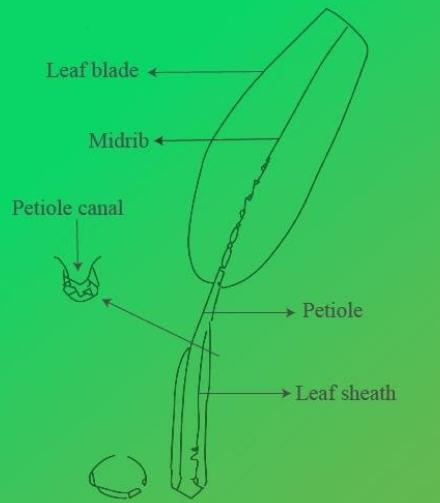
Figure: Structure of a banana leaf
Complete Answer:
Leaves have smooth surfaces to maintain the movement of gas inside and outside the trees. The smooth surface contains stomata and guard cells that assist the plant in the movement of the carbon dioxide and oxygen into channels. The palisade layer conducts photosynthesis and the spongy layer in the leaf maintains the concentration of the important gases.
Banana leaf has a smooth surface. They are large, wide, elongated and slightly rounded with an average length of two meters, half a meter width and 8-12 leaves per tree. The surface of the leaves are waxy, flexible, and glossy. They range in colour from lime, olive green, to dark green. There is a central midrib that runs along the length of the leaf with two laminas (leaf halves) found on either side of the midrib. The leaves lack branching veins which makes them vulnerable to tearing. Banana plants also have a pseudostem, which is a false stem that looks like a trunk but is actually multiple fleshy leaf sheaths tightly overlapped. Banana leaves have a grassy and sweet flavour.
The leaf is formed by the apical meristem on the rhizome and emerges from the centre of the pseudostem as a rolled cylinder, which is named the cigar leaf. The cigar leaf is tightly coiled, whitish and fragile. It slips into the petiole canal of the preceding leaf, grows and then unfolds. This process has been divided into five stages as given below:
Stage 1: The cigar leaf is joined to the previous leaf.
Stage 2: The cigar leaf grows but has not yet reached its full length.
Stage 3: The cigar leaf is completely free, has reached its full length and its diameter increases
Stage 4: The left-hand side unfurls and the apex opens up.
Stage 5: The upper part of the leaf unfurls and the base is an open cone shape.
The leaf ratio is measured on the third leaf, counting from the last one that emerged. Normal leaves do not overlap and leaf ratio is superior to 2.5 whereas dwarf leaves strongly overlap and leaf ratio is inferior to 2.5. The banana plant (Musa spp.) comes under the classification of simple leaves. In simple leaves, there is only a single leaf blade and incision, which are so light that it does not divide the leaf blade.
Note:
Banana leaves contain polyphenols that are natural antioxidants. They are botanically classified as Musa acuminate and grow on a perennial herbal shrub that resembles a tree but is classified as a plant. The leaves are not typically consumed but are used as a waterproof wrapper to cook food and add flavour. In addition to cooking, they are also used as plate liners, cups and bowls and even as a writing tablet.
Figure: Structure of a banana leaf
Recently Updated Pages
Master Class 11 English: Engaging Questions & Answers for Success

Master Class 11 Social Science: Engaging Questions & Answers for Success
Master Class 11 Maths: Engaging Questions & Answers for Success
Master Class 11 Biology: Engaging Questions & Answers for Success
Master Class 11 Physics: Engaging Questions & Answers for Success
Master Class 11 Chemistry: Engaging Questions & Answers for Success
Trending doubts
One Metric ton is equal to kg A 10000 B 1000 C 100 class 11 physics CBSE
Difference Between Prokaryotic Cells and Eukaryotic Cells
1 ton equals to A 100 kg B 1000 kg C 10 kg D 10000 class 11 physics CBSE
Find the value of the expression given below sin 30circ class 11 maths CBSE
Two of the body parts which do not appear in MRI are class 11 biology CBSE
What are hard magnetic materials class 11 physics CBSE