




Cells which lack nuclear membrane are?
Answer
 Verified
507k+ views
Hint: The outer covering of the nucleus is known as a nuclear membrane. It is also known as the nuclear envelope. The nuclear membrane functions as a barrier between the nucleus and cytoplasm.
Complete answer:
The cells that lack a nuclear membrane are known as prokaryotic cells. These are one of the earliest cells to have existed on the Earth. The organisms consisting of prokaryotic cells are known as prokaryotes and are unicellular. These cells are very primitive in nature and do not contain specialized membrane bound organelles such as mitochondria, Golgi bodies, and lysosomes. These cells have an outer covering called the cell wall and is made up of amino acids and carbohydrates.
The nucleus in these cells is primitive and is known as a nucleoid which carries the genetic material. The only organelle present in these cells are Ribosomes which are scattered in the cytoplasm and are involved in the synthesis of proteins. A distinctive characteristic of these types of cells is the presence of Plasmids, which are extra chromosomal circular DNA.
Some of the cells have hair-like structures on it known as flagella that help in the movement of the organism. Examples of prokaryotic organisms are Archaebacteria and Cyanobacteria or Blue- green Algae.
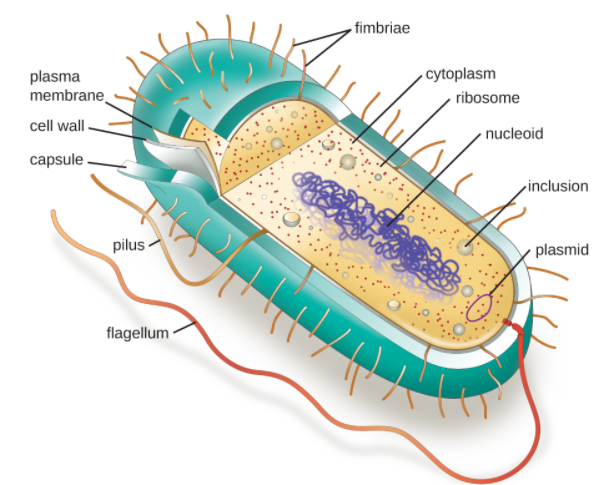
Note: The cells consisting of a well-defined and well-developed nucleus are known as Eukaryotic cells. These cells contain nuclei with a nuclear membrane as well as membrane-bound organelles such as mitochondria, Golgi bodies, lysosomes, and chloroplasts. All multicellular organisms are made of eukaryotic cells. Examples of eukaryotic organisms are organisms belonging to the Kingdom Protista, Animalia, and Plantae.
Complete answer:
The cells that lack a nuclear membrane are known as prokaryotic cells. These are one of the earliest cells to have existed on the Earth. The organisms consisting of prokaryotic cells are known as prokaryotes and are unicellular. These cells are very primitive in nature and do not contain specialized membrane bound organelles such as mitochondria, Golgi bodies, and lysosomes. These cells have an outer covering called the cell wall and is made up of amino acids and carbohydrates.
The nucleus in these cells is primitive and is known as a nucleoid which carries the genetic material. The only organelle present in these cells are Ribosomes which are scattered in the cytoplasm and are involved in the synthesis of proteins. A distinctive characteristic of these types of cells is the presence of Plasmids, which are extra chromosomal circular DNA.
Some of the cells have hair-like structures on it known as flagella that help in the movement of the organism. Examples of prokaryotic organisms are Archaebacteria and Cyanobacteria or Blue- green Algae.
Note: The cells consisting of a well-defined and well-developed nucleus are known as Eukaryotic cells. These cells contain nuclei with a nuclear membrane as well as membrane-bound organelles such as mitochondria, Golgi bodies, lysosomes, and chloroplasts. All multicellular organisms are made of eukaryotic cells. Examples of eukaryotic organisms are organisms belonging to the Kingdom Protista, Animalia, and Plantae.
Recently Updated Pages
Master Class 11 Social Science: Engaging Questions & Answers for Success

Master Class 11 Chemistry: Engaging Questions & Answers for Success
Master Class 12 Business Studies: Engaging Questions & Answers for Success
Master Class 12 Chemistry: Engaging Questions & Answers for Success
Master Class 12 Biology: Engaging Questions & Answers for Success
Class 12 Question and Answer - Your Ultimate Solutions Guide
Trending doubts
One Metric ton is equal to kg A 10000 B 1000 C 100 class 11 physics CBSE
Difference Between Prokaryotic Cells and Eukaryotic Cells
Two of the body parts which do not appear in MRI are class 11 biology CBSE
Explain zero factorial class 11 maths CBSE
10 examples of friction in our daily life
Name the Largest and the Smallest Cell in the Human Body ?