




Caulimovirus (Cauliflower mosaic virus) is a group of viruses which have
(A)Double-stranded RNA
(B)Single-stranded RNA
(C)Single-stranded DNA
(D)Double-stranded DNA
Answer
 Verified
621.3k+ views
Hint: Caulimovirus (Cauliflower mosaic virus) is a group of viruses that have a molecule composed of two polynucleotide chains that coil around each other carrying genetic instructions of all known organisms and many viruses.
Complete answer:
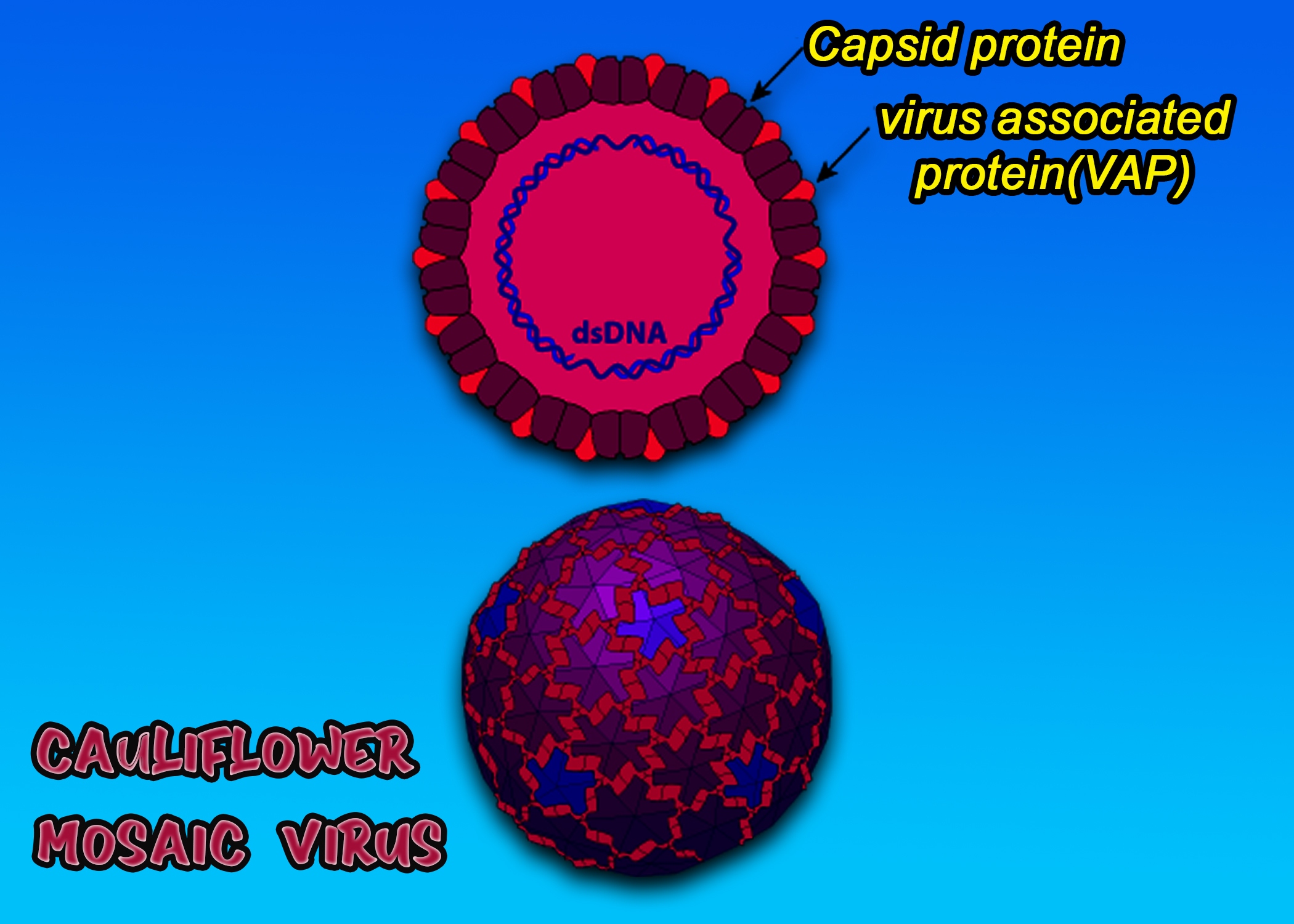
Caulimovirus (Cauliflower mosaic virus) is a group of viruses which have Double-stranded DNA. The two polynucleotide chains which are seen in DNA coil around each other to form a double helix which is carrying the genetic instructions for many purposes like for the development, the functioning of the cells of the organism, growth, and reproduction of all known organisms and many viruses.
Additional Information: The CaMV i,e Cauliflower mosaic virus is a member of the genus Caulimovirus, which is one among the six genera within the family Caulimoviridae, which are the viruses that infect plants. These viruses replicate through reverse transcription a bit like retroviruses, but the viral particles contain DNA rather than RNA. Mostly plants of the Cruciferae family which includes plants such as cauliflower and turnip) are infected by CaMV but some CaMV strains (D4 and W260) also are ready to infect Solanaceae species of the genera, namely the Datura and Nicotiana. It was seen that the CaMV mostly induces a spread of systemic symptoms which includes manly like mosaic, necrotic lesions on leaf surfaces, stunted growth, and deformation of the general plant part. The symptoms exhibited vary counting on the viral strain, host ecotype, and environmental conditions. CaMV is transmitted during a non-circulatory manner by aphid species like Myzus persicae. Once these are introduced within a plant host cell, virions migrate to the nuclear envelope of the plant cell.
So, the correct answer is ‘Double-stranded DNA’.
Note: The particle of CaMV is found to be an icosahedron with a diameter of approx 51 nm built from 420 capsid protein (CP) subunits arranged with a triangulation T = 7, which surrounds a solvent-filled central cavity.
Complete answer:
Caulimovirus (Cauliflower mosaic virus) is a group of viruses which have Double-stranded DNA. The two polynucleotide chains which are seen in DNA coil around each other to form a double helix which is carrying the genetic instructions for many purposes like for the development, the functioning of the cells of the organism, growth, and reproduction of all known organisms and many viruses.
Additional Information: The CaMV i,e Cauliflower mosaic virus is a member of the genus Caulimovirus, which is one among the six genera within the family Caulimoviridae, which are the viruses that infect plants. These viruses replicate through reverse transcription a bit like retroviruses, but the viral particles contain DNA rather than RNA. Mostly plants of the Cruciferae family which includes plants such as cauliflower and turnip) are infected by CaMV but some CaMV strains (D4 and W260) also are ready to infect Solanaceae species of the genera, namely the Datura and Nicotiana. It was seen that the CaMV mostly induces a spread of systemic symptoms which includes manly like mosaic, necrotic lesions on leaf surfaces, stunted growth, and deformation of the general plant part. The symptoms exhibited vary counting on the viral strain, host ecotype, and environmental conditions. CaMV is transmitted during a non-circulatory manner by aphid species like Myzus persicae. Once these are introduced within a plant host cell, virions migrate to the nuclear envelope of the plant cell.
So, the correct answer is ‘Double-stranded DNA’.
Note: The particle of CaMV is found to be an icosahedron with a diameter of approx 51 nm built from 420 capsid protein (CP) subunits arranged with a triangulation T = 7, which surrounds a solvent-filled central cavity.
Recently Updated Pages
Basicity of sulphurous acid and sulphuric acid are

Master Class 11 English: Engaging Questions & Answers for Success
Master Class 11 Physics: Engaging Questions & Answers for Success
Master Class 11 Computer Science: Engaging Questions & Answers for Success
Master Class 11 Chemistry: Engaging Questions & Answers for Success
Master Class 11 Social Science: Engaging Questions & Answers for Success
Trending doubts
Difference Between Prokaryotic Cells and Eukaryotic Cells
Two of the body parts which do not appear in MRI are class 11 biology CBSE
One Metric ton is equal to kg A 10000 B 1000 C 100 class 11 physics CBSE
10 examples of friction in our daily life
Draw a diagram of nephron and explain its structur class 11 biology CBSE
What will happen if the mucus is not secreted by the class 11 biology CBSE