




How do you calculate\[\arccos \left( { - \dfrac{{\sqrt 3 }}{2}} \right)\]?
Answer
 Verified
561k+ views
Hint: We use the concept that arc means inverse of the function. We are given the value of sine of an angle. Use the trigonometric identity \[{\sin ^2}x + {\cos ^2}x = 1\]to find the value of cosine of the same angle. Divide sine of the angle by cosine of the angle to calculate tangent of the angle. Use a quadrant diagram to write the value of angle for cosine.
* Arc cosine of a function is defined as the inverse cosine of the function. When \[\cos y = x\], then we can write \[\arccos x = {\cos ^{ - 1}}x = y\].
* We know the values of all trigonometric angles are positive in the first quadrant.
Values of only \[\sin \theta \]are positive in the second quadrant.
Values of only \[\tan \theta \]are positive in the third quadrant.
Values of only\[\cos \theta \] are positive in the fourth quadrant.
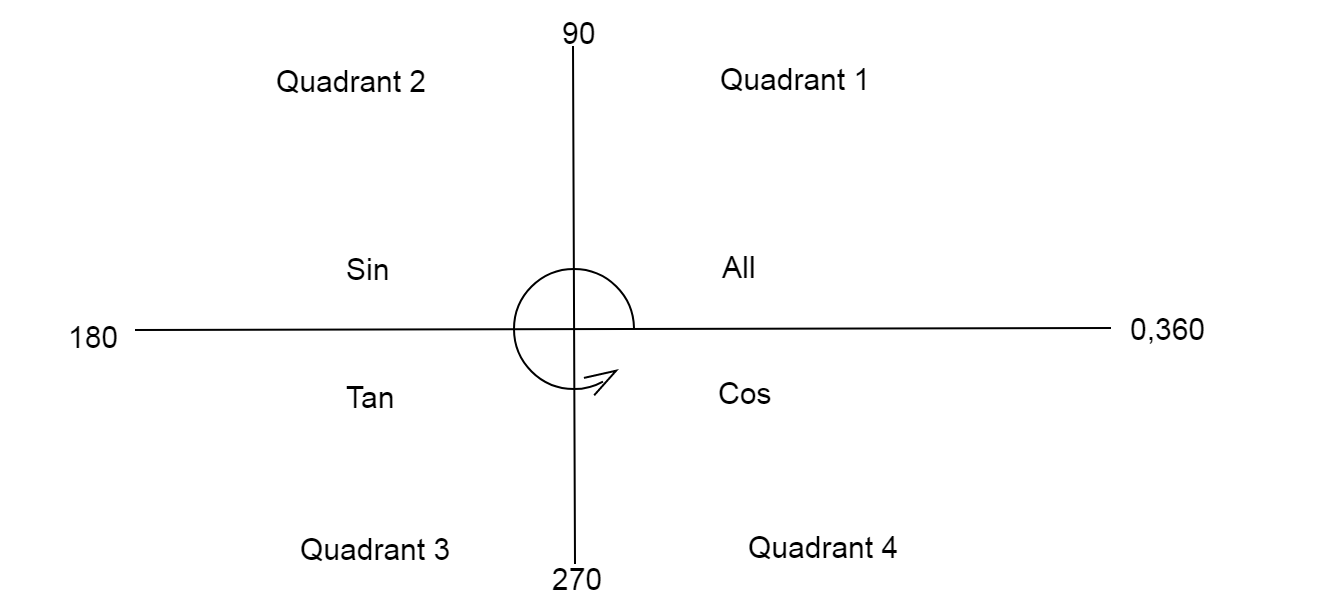
Complete step-by-step answer:
Let us assume the angle as ‘x’
We are given that \[\arccos \left( { - \dfrac{{\sqrt 3 }}{2}} \right)\]
Since we know that \[\arccos x = {\cos ^{ - 1}}x = y\]
Then we can write \[\arccos \left( { - \dfrac{{\sqrt 3 }}{2}} \right) = {\cos ^{ - 1}}\left( { - \dfrac{{\sqrt 3 }}{2}} \right) = y\]
\[ \Rightarrow {\cos ^{ - 1}}\left( { - \dfrac{{\sqrt 3 }}{2}} \right) = y\]
Take cosine on both sides of the equation
\[ \Rightarrow \cos \left[ {{{\cos }^{ - 1}}\left( { - \dfrac{{\sqrt 3 }}{2}} \right)} \right] = \cos y\]
Cancel cosine and cosine inverse on left side of the equation
\[ \Rightarrow - \dfrac{{\sqrt 3 }}{2} = \cos y\] … (1)
We know that the value of \[\cos \dfrac{\pi }{6} = \dfrac{{\sqrt 3 }}{2}\]
Also, we know cosine is an even function, so, \[\cos ( - x) = - \cos x\] and that cosine function is negative in the second and third quadrant.
We can write \[\cos \left( {\pi + \dfrac{\pi }{6}} \right) = \dfrac{{ - \sqrt 3 }}{2}\]and \[\cos \left( {\pi - \dfrac{\pi }{6}} \right) = \dfrac{{ - \sqrt 3 }}{2}\]
i.e. \[\cos \left( {\dfrac{{6\pi + \pi }}{6}} \right) = \dfrac{{ - \sqrt 3 }}{2}\]and \[\cos \left( {\dfrac{{6\pi - \pi }}{6}} \right) = \dfrac{{ - \sqrt 3 }}{2}\]
i.e. \[\cos \left( {\dfrac{{7\pi }}{6}} \right) = \dfrac{{ - \sqrt 3 }}{2}\]and \[\cos \left( {\dfrac{{5\pi }}{6}} \right) = \dfrac{{ - \sqrt 3 }}{2}\]
So equation (1) becomes
\[ \Rightarrow \cos \left( {\dfrac{{7\pi }}{6}} \right) = \cos y\]and \[\cos \left( {\dfrac{{5\pi }}{6}} \right) = \cos y\]
Taking inverse sine function on both sides
\[ \Rightarrow {\cos ^{ - 1}}\left[ {\cos \left( {\dfrac{{7\pi }}{6}} \right)} \right] = {\cos ^{ - 1}}\left[ {\cos y} \right]\]and \[{\cos ^{ - 1}}\left[ {\cos \left( {\dfrac{{5\pi }}{6}} \right)} \right] = {\cos ^{ - 1}}\left[ {\cos y} \right]\]
Cancel inverse of the function by the function
\[ \Rightarrow y = \dfrac{{5\pi }}{6}\]and \[y = \dfrac{{7\pi }}{6}\]
\[\therefore \] The values of \[\arccos \left( { - \dfrac{{\sqrt 3 }}{2}} \right)\]are \[\dfrac{{5\pi }}{6}\]and \[\dfrac{{7\pi }}{6}\]
Note:
Many students make mistake of calculating the angle inside cosine as positive which is wrong, the value of cosine is given negative so we will have to look at the quadrant diagram and figure out what to add or subtract the angle from. Keep in mind we can use table for trigonometric terms if we don’t remember the values at some common angles\[{0^ \circ },{30^ \circ },{45^ \circ },{60^ \circ },{90^ \circ }\]
* Arc cosine of a function is defined as the inverse cosine of the function. When \[\cos y = x\], then we can write \[\arccos x = {\cos ^{ - 1}}x = y\].
* We know the values of all trigonometric angles are positive in the first quadrant.
Values of only \[\sin \theta \]are positive in the second quadrant.
Values of only \[\tan \theta \]are positive in the third quadrant.
Values of only\[\cos \theta \] are positive in the fourth quadrant.
Complete step-by-step answer:
Let us assume the angle as ‘x’
We are given that \[\arccos \left( { - \dfrac{{\sqrt 3 }}{2}} \right)\]
Since we know that \[\arccos x = {\cos ^{ - 1}}x = y\]
Then we can write \[\arccos \left( { - \dfrac{{\sqrt 3 }}{2}} \right) = {\cos ^{ - 1}}\left( { - \dfrac{{\sqrt 3 }}{2}} \right) = y\]
\[ \Rightarrow {\cos ^{ - 1}}\left( { - \dfrac{{\sqrt 3 }}{2}} \right) = y\]
Take cosine on both sides of the equation
\[ \Rightarrow \cos \left[ {{{\cos }^{ - 1}}\left( { - \dfrac{{\sqrt 3 }}{2}} \right)} \right] = \cos y\]
Cancel cosine and cosine inverse on left side of the equation
\[ \Rightarrow - \dfrac{{\sqrt 3 }}{2} = \cos y\] … (1)
We know that the value of \[\cos \dfrac{\pi }{6} = \dfrac{{\sqrt 3 }}{2}\]
Also, we know cosine is an even function, so, \[\cos ( - x) = - \cos x\] and that cosine function is negative in the second and third quadrant.
We can write \[\cos \left( {\pi + \dfrac{\pi }{6}} \right) = \dfrac{{ - \sqrt 3 }}{2}\]and \[\cos \left( {\pi - \dfrac{\pi }{6}} \right) = \dfrac{{ - \sqrt 3 }}{2}\]
i.e. \[\cos \left( {\dfrac{{6\pi + \pi }}{6}} \right) = \dfrac{{ - \sqrt 3 }}{2}\]and \[\cos \left( {\dfrac{{6\pi - \pi }}{6}} \right) = \dfrac{{ - \sqrt 3 }}{2}\]
i.e. \[\cos \left( {\dfrac{{7\pi }}{6}} \right) = \dfrac{{ - \sqrt 3 }}{2}\]and \[\cos \left( {\dfrac{{5\pi }}{6}} \right) = \dfrac{{ - \sqrt 3 }}{2}\]
So equation (1) becomes
\[ \Rightarrow \cos \left( {\dfrac{{7\pi }}{6}} \right) = \cos y\]and \[\cos \left( {\dfrac{{5\pi }}{6}} \right) = \cos y\]
Taking inverse sine function on both sides
\[ \Rightarrow {\cos ^{ - 1}}\left[ {\cos \left( {\dfrac{{7\pi }}{6}} \right)} \right] = {\cos ^{ - 1}}\left[ {\cos y} \right]\]and \[{\cos ^{ - 1}}\left[ {\cos \left( {\dfrac{{5\pi }}{6}} \right)} \right] = {\cos ^{ - 1}}\left[ {\cos y} \right]\]
Cancel inverse of the function by the function
\[ \Rightarrow y = \dfrac{{5\pi }}{6}\]and \[y = \dfrac{{7\pi }}{6}\]
\[\therefore \] The values of \[\arccos \left( { - \dfrac{{\sqrt 3 }}{2}} \right)\]are \[\dfrac{{5\pi }}{6}\]and \[\dfrac{{7\pi }}{6}\]
Note:
Many students make mistake of calculating the angle inside cosine as positive which is wrong, the value of cosine is given negative so we will have to look at the quadrant diagram and figure out what to add or subtract the angle from. Keep in mind we can use table for trigonometric terms if we don’t remember the values at some common angles\[{0^ \circ },{30^ \circ },{45^ \circ },{60^ \circ },{90^ \circ }\]
| ANGLEFUNCTION | \[{0^ \circ }\] | \[{30^ \circ }\] | \[{45^ \circ }\] | \[{60^ \circ }\] | \[{90^ \circ }\] |
| Sin | 0 | \[\dfrac{1}{2}\] | \[\dfrac{1}{{\sqrt 2 }}\] | \[\dfrac{{\sqrt 3 }}{2}\] | 1 |
| Cos | 1 | \[\dfrac{{\sqrt 3 }}{2}\] | \[\dfrac{1}{{\sqrt 2 }}\] | \[\dfrac{1}{2}\] | 0 |
| Tan | 0 | \[\dfrac{1}{{\sqrt 3 }}\] | 1 | \[\sqrt 3 \] | Not defined |
Recently Updated Pages
Master Class 11 Computer Science: Engaging Questions & Answers for Success

Master Class 11 Business Studies: Engaging Questions & Answers for Success
Master Class 11 Economics: Engaging Questions & Answers for Success
Master Class 11 English: Engaging Questions & Answers for Success
Master Class 11 Maths: Engaging Questions & Answers for Success
Master Class 11 Biology: Engaging Questions & Answers for Success
Trending doubts
One Metric ton is equal to kg A 10000 B 1000 C 100 class 11 physics CBSE
There are 720 permutations of the digits 1 2 3 4 5 class 11 maths CBSE
Discuss the various forms of bacteria class 11 biology CBSE
Draw a diagram of a plant cell and label at least eight class 11 biology CBSE
State the laws of reflection of light
Explain zero factorial class 11 maths CBSE