




How do you calculate the ratio of the surface area to the volume of a cube?
Answer
 Verified
580.2k+ views
Hint:
We start solving the problem by assuming the length of the side of the cube and then drawing the figure of the cube to represent it. We then find the volume of the cube using the fact that the volume of the cube with side p units is defined as $ {{p}^{3}} $ cubic units. We then find the surface area of the cube using the fact that the surface area of the cube with side p units is defined as $ 6{{p}^{2}} $ square units. We then take the ratio of the surface area to the volume of the cube by using the fact that the ratio of a to b is defined as $ \dfrac{a}{b} $.
Complete step by step answer:
According to the problem, we are asked to calculate the ratio of the surface area to the volume of a cube.
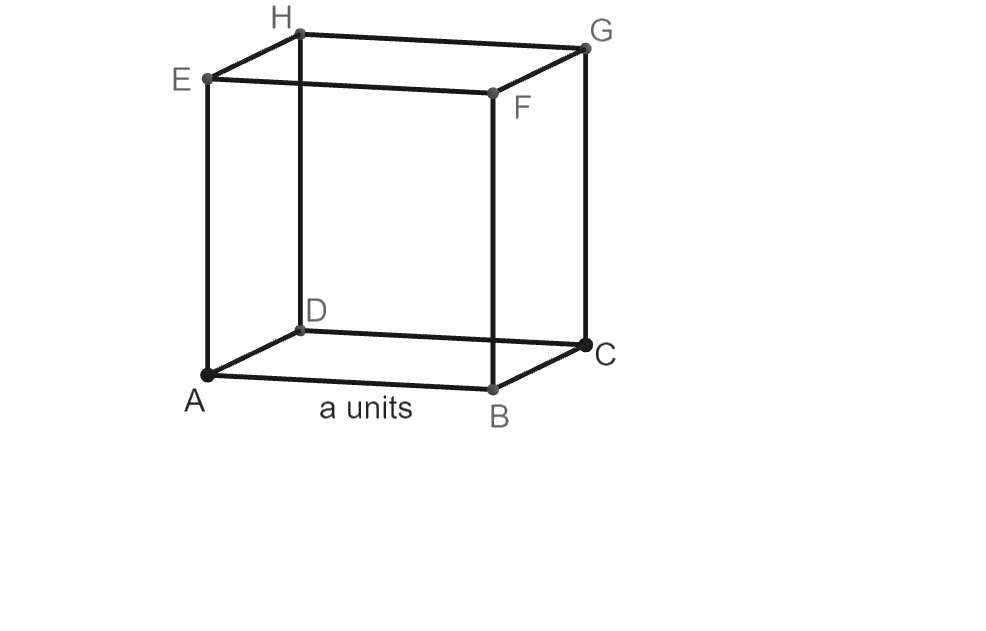
Let us assume the length of the side of the cube be ‘a’ units. Now, let us draw the figure representing the given information.
We know that the volume of the cube with side p units is defined as $ {{p}^{3}} $ cubic units.
So, we get volume of cube as $ V={{a}^{3}} $ cubic units ---(1).
We know that the surface area of the cube with side p units is defined as $ 6{{p}^{2}} $ square units.
So, we get surface area of cube as $ S=6{{a}^{2}} $ square units ---(2).
Now, let us take the ratio of surface area to volume of the cube.
We know that the ratio of a to b is defined as $ \dfrac{a}{b} $ .
So, we get $ \dfrac{S}{V}=\dfrac{6{{a}^{2}}}{{{a}^{3}}} $ .
$ \Rightarrow \dfrac{S}{V}=\dfrac{6}{a} $ .
So, we have found the ratio of the surface area to the volume of a cube with side a units is $ \dfrac{6}{a} $ .
Note:
We should know that the volume of any object can be found by multiplying length breadth and height. Since the length, breadth, and height of the cube is the same, we get the volume as $ {{a}^{3}} $. We can find the surface area of any object by adding the areas of all the surfaces. From the figure, we can see that the cube has 6 surfaces and each surface is square with side ‘a’ units. We know that the area of the square with a unit is $ {{a}^{2}} $ which helps in finding the surface area of the cube. Similarly, we can expect problems to find the ratio of volume to the surface area of a cuboid with length, breadth, and height following the ratio of $ 1:2:3 $.
We start solving the problem by assuming the length of the side of the cube and then drawing the figure of the cube to represent it. We then find the volume of the cube using the fact that the volume of the cube with side p units is defined as $ {{p}^{3}} $ cubic units. We then find the surface area of the cube using the fact that the surface area of the cube with side p units is defined as $ 6{{p}^{2}} $ square units. We then take the ratio of the surface area to the volume of the cube by using the fact that the ratio of a to b is defined as $ \dfrac{a}{b} $.
Complete step by step answer:
According to the problem, we are asked to calculate the ratio of the surface area to the volume of a cube.
Let us assume the length of the side of the cube be ‘a’ units. Now, let us draw the figure representing the given information.
We know that the volume of the cube with side p units is defined as $ {{p}^{3}} $ cubic units.
So, we get volume of cube as $ V={{a}^{3}} $ cubic units ---(1).
We know that the surface area of the cube with side p units is defined as $ 6{{p}^{2}} $ square units.
So, we get surface area of cube as $ S=6{{a}^{2}} $ square units ---(2).
Now, let us take the ratio of surface area to volume of the cube.
We know that the ratio of a to b is defined as $ \dfrac{a}{b} $ .
So, we get $ \dfrac{S}{V}=\dfrac{6{{a}^{2}}}{{{a}^{3}}} $ .
$ \Rightarrow \dfrac{S}{V}=\dfrac{6}{a} $ .
So, we have found the ratio of the surface area to the volume of a cube with side a units is $ \dfrac{6}{a} $ .
Note:
We should know that the volume of any object can be found by multiplying length breadth and height. Since the length, breadth, and height of the cube is the same, we get the volume as $ {{a}^{3}} $. We can find the surface area of any object by adding the areas of all the surfaces. From the figure, we can see that the cube has 6 surfaces and each surface is square with side ‘a’ units. We know that the area of the square with a unit is $ {{a}^{2}} $ which helps in finding the surface area of the cube. Similarly, we can expect problems to find the ratio of volume to the surface area of a cuboid with length, breadth, and height following the ratio of $ 1:2:3 $.
Recently Updated Pages
Master Class 10 Social Science: Engaging Questions & Answers for Success

Master Class 10 Science: Engaging Questions & Answers for Success
Master Class 10 Maths: Engaging Questions & Answers for Success
Master Class 10 General Knowledge: Engaging Questions & Answers for Success
Master Class 10 Computer Science: Engaging Questions & Answers for Success
Class 10 Question and Answer - Your Ultimate Solutions Guide
Trending doubts
What is the full form of PNG A Petrol Natural Gas B class 10 chemistry CBSE
Explain the Treaty of Vienna of 1815 class 10 social science CBSE
Why is there a time difference of about 5 hours between class 10 social science CBSE
What is the median of the first 10 natural numbers class 10 maths CBSE
The power of the lens is 2D What is its focal length class 10 physics CBSE
Who Won 36 Oscar Awards? Record Holder Revealed