




How do you calculate the radius of a hemispherical solid whose total surface area is \[48\pi {\text{ }}c{m^2}\]?
Answer
 Verified
526.8k+ views
Hint: We have to find the radius of a hemispherical solid whose total surface area is \[48\pi {\text{ }}c{m^2}\]. For this we will first assume the radius of the hemispherical solid to be \[r\]. Then using the formula of total surface area of a hemisphere i.e., \[3\pi {\left( {radius} \right)^2}\] we will calculate the total surface area in terms of \[r\] and then we will equate this total surface area to given total surface area i.e., \[48\pi {\text{ }}c{m^2}\] to find \[r\].
Complete step by step answer:
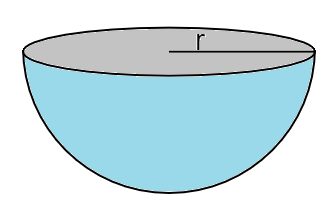
A hemisphere is the half piece of a sphere. If we cut the sphere into two equal parts, each part will have a curved surface as well as a flat surface.
The total surface area of a hemisphere is the sum of the curved surface area and flat surface area.
Therefore, \[{\text{total surface area of a hemisphere = flat surface area + curved surface area}}\]
Then, \[{\text{Total surface area of a hemisphere}} = \pi {\left( {radius} \right)^2} + 2\pi {\left( {radius} \right)^2}\]
\[\therefore {\text{Total surface area of a hemisphere}} = 3\pi {\left( {radius} \right)^2}\]
Let the radius of hemispherical solid be \[r\].
Given, total surface area of the hemispherical solid \[ = 48\pi {\text{ }}c{m^2}\]
Therefore, we can write
\[ \Rightarrow 3\pi {r^2} = 48\pi {\text{ }}\]
Dividing both the sides by \[3\pi \],
\[ \Rightarrow {r^2} = 16\]
On simplifying we get
\[ \Rightarrow r = 4{\text{ }}cm\]
Therefore, the radius of a hemispherical solid whose total surface area is \[48\pi {\text{ }}c{m^2}\] is \[4{\text{ }}cm\].
Note:
A hemisphere is half of a sphere, the total surface area of the hemisphere consists of two parts, which are the curved and flat surface areas. The curved surface area of a hemisphere is half of the surface area of a sphere i.e., \[2\pi {r^2}\] whereas in the total surface area of a hemisphere we additionally need to determine the surface area of the circular surface of the flat base of the given hemisphere, which is equal to \[\pi {r^2}\], which makes the total surface area to be \[3\pi {r^2}\].
Complete step by step answer:
A hemisphere is the half piece of a sphere. If we cut the sphere into two equal parts, each part will have a curved surface as well as a flat surface.
The total surface area of a hemisphere is the sum of the curved surface area and flat surface area.
Therefore, \[{\text{total surface area of a hemisphere = flat surface area + curved surface area}}\]
Then, \[{\text{Total surface area of a hemisphere}} = \pi {\left( {radius} \right)^2} + 2\pi {\left( {radius} \right)^2}\]
\[\therefore {\text{Total surface area of a hemisphere}} = 3\pi {\left( {radius} \right)^2}\]
Let the radius of hemispherical solid be \[r\].
Given, total surface area of the hemispherical solid \[ = 48\pi {\text{ }}c{m^2}\]
Therefore, we can write
\[ \Rightarrow 3\pi {r^2} = 48\pi {\text{ }}\]
Dividing both the sides by \[3\pi \],
\[ \Rightarrow {r^2} = 16\]
On simplifying we get
\[ \Rightarrow r = 4{\text{ }}cm\]
Therefore, the radius of a hemispherical solid whose total surface area is \[48\pi {\text{ }}c{m^2}\] is \[4{\text{ }}cm\].
Note:
A hemisphere is half of a sphere, the total surface area of the hemisphere consists of two parts, which are the curved and flat surface areas. The curved surface area of a hemisphere is half of the surface area of a sphere i.e., \[2\pi {r^2}\] whereas in the total surface area of a hemisphere we additionally need to determine the surface area of the circular surface of the flat base of the given hemisphere, which is equal to \[\pi {r^2}\], which makes the total surface area to be \[3\pi {r^2}\].
Recently Updated Pages
Master Class 12 Economics: Engaging Questions & Answers for Success

Master Class 12 English: Engaging Questions & Answers for Success
Master Class 12 Social Science: Engaging Questions & Answers for Success
Master Class 12 Maths: Engaging Questions & Answers for Success
Master Class 12 Physics: Engaging Questions & Answers for Success
Master Class 9 General Knowledge: Engaging Questions & Answers for Success
Trending doubts
Explain the Treaty of Vienna of 1815 class 10 social science CBSE
Why is it 530 pm in india when it is 1200 afternoon class 10 social science CBSE
What is the full form of POSCO class 10 social science CBSE
Define Potential, Developed, Stock and Reserved resources
Which Country Has the Largest Border with India?
Complete the sentence with the most appropriate word class 10 english CBSE