




Calculate the height of an equilateral triangle each of whose sides measures \[12{\text{cm}}\].
Answer
 Verified
603k+ views
Hint:In the question we are asked to find the height of the equilateral triangle, the side of the equilateral triangle is given. An equilateral triangle has all its sides equal. Draw a diagram using the given value and concept of equilateral triangle. You will need to use Pythagoras theorem to solve the problem.
Complete step by step solution:
Given, each side of the equilateral triangle is \[12{\text{cm}}\]
To find the height of the equilateral triangle, let us first draw a diagram of an equilateral triangle
\[\Delta {\text{ABC}}\]with sides \[{\text{AB}} = {\text{BC}} = {\text{CA}} = 12{\text{cm}}\] and height \[{\text{AD}}\].
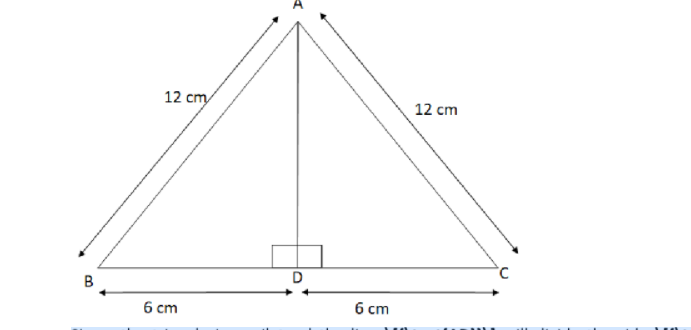
Since, the triangle is equilateral the line \[{\text{AD}}\] will divide the side \[{\text{BC}}\] into two equal parts that is\[{\text{BD}} = {\text{CD}} = 6\,{\text{cm}}\].
Also the line \[{\text{AD}}\] will make right angle on side \[{\text{BC}}\], forming two right angled triangles \[\Delta {\text{ABD}}\] and\[\Delta {\text{ACD}}\].
Now, we will use Pythagoras theorem for triangles \[\Delta {\text{ABD}}\] or \[\Delta {\text{ACD}}\] to find the height of the equilateral triangle. From Pythagoras theorem we have,
\[{\left( {{\text{hypotenuse}}} \right)^2} = {\left( {{\text{base}}} \right)^2} + {\left(
{{\text{perpendicular}}} \right)^2}\] (i)
For \[\Delta {\text{ABD}}\]
\[{\text{hypotenuse}} = {\text{AB}}\]
\[{\text{base}} = {\text{BD}}\]
\[{\text{perpendicular}} = {\text{AD}}\]
Putting these values in equation (i), we get
\[{\text{A}}{{\text{B}}^2} = {\text{B}}{{\text{D}}^2} + {\text{A}}{{\text{D}}^2}\] (ii)
Now, putting the values \[{\text{AB}} = 12\,{\text{cm}}\] and \[{\text{BD}} = 6\,{\text{cm}}\] in equation (ii), we get
\[{12^2} = {6^2} + {\text{A}}{{\text{D}}^2}\]
\[ \Rightarrow {\text{A}}{{\text{D}}^2} = {12^2} - {6^2}\]
\[ \Rightarrow {\text{A}}{{\text{D}}^2} = 144 - 36\]
\[ \Rightarrow {\text{A}}{{\text{D}}^2} = 108\]
\[ \Rightarrow {\text{AD}} = 6\sqrt 3 \,{\text{cm}}\]
Therefore, the height of the equilateral triangle is \[6\sqrt 3 \,{\text{cm}}\].
We can also find the height, by similarly applying Pythagoras theorem for \[\Delta {\text{ACD}}\].
Hence, the required answer is \[6\sqrt 3 \,{\text{cm}}\].
Note:Triangles can be classified into three types based on their lengths of sides. These are equilateral triangle, isosceles triangle and scalene triangle. We have discussed the equilateral triangle in the above question and for equilateral triangles all sides are equal in length. In the case of an isosceles triangle, two of its sides have equal length. And in the case of a scalene triangle, all the sides have different lengths.
Complete step by step solution:
Given, each side of the equilateral triangle is \[12{\text{cm}}\]
To find the height of the equilateral triangle, let us first draw a diagram of an equilateral triangle
\[\Delta {\text{ABC}}\]with sides \[{\text{AB}} = {\text{BC}} = {\text{CA}} = 12{\text{cm}}\] and height \[{\text{AD}}\].
Since, the triangle is equilateral the line \[{\text{AD}}\] will divide the side \[{\text{BC}}\] into two equal parts that is\[{\text{BD}} = {\text{CD}} = 6\,{\text{cm}}\].
Also the line \[{\text{AD}}\] will make right angle on side \[{\text{BC}}\], forming two right angled triangles \[\Delta {\text{ABD}}\] and\[\Delta {\text{ACD}}\].
Now, we will use Pythagoras theorem for triangles \[\Delta {\text{ABD}}\] or \[\Delta {\text{ACD}}\] to find the height of the equilateral triangle. From Pythagoras theorem we have,
\[{\left( {{\text{hypotenuse}}} \right)^2} = {\left( {{\text{base}}} \right)^2} + {\left(
{{\text{perpendicular}}} \right)^2}\] (i)
For \[\Delta {\text{ABD}}\]
\[{\text{hypotenuse}} = {\text{AB}}\]
\[{\text{base}} = {\text{BD}}\]
\[{\text{perpendicular}} = {\text{AD}}\]
Putting these values in equation (i), we get
\[{\text{A}}{{\text{B}}^2} = {\text{B}}{{\text{D}}^2} + {\text{A}}{{\text{D}}^2}\] (ii)
Now, putting the values \[{\text{AB}} = 12\,{\text{cm}}\] and \[{\text{BD}} = 6\,{\text{cm}}\] in equation (ii), we get
\[{12^2} = {6^2} + {\text{A}}{{\text{D}}^2}\]
\[ \Rightarrow {\text{A}}{{\text{D}}^2} = {12^2} - {6^2}\]
\[ \Rightarrow {\text{A}}{{\text{D}}^2} = 144 - 36\]
\[ \Rightarrow {\text{A}}{{\text{D}}^2} = 108\]
\[ \Rightarrow {\text{AD}} = 6\sqrt 3 \,{\text{cm}}\]
Therefore, the height of the equilateral triangle is \[6\sqrt 3 \,{\text{cm}}\].
We can also find the height, by similarly applying Pythagoras theorem for \[\Delta {\text{ACD}}\].
Hence, the required answer is \[6\sqrt 3 \,{\text{cm}}\].
Note:Triangles can be classified into three types based on their lengths of sides. These are equilateral triangle, isosceles triangle and scalene triangle. We have discussed the equilateral triangle in the above question and for equilateral triangles all sides are equal in length. In the case of an isosceles triangle, two of its sides have equal length. And in the case of a scalene triangle, all the sides have different lengths.
Recently Updated Pages
Master Class 11 English: Engaging Questions & Answers for Success

Master Class 11 Social Science: Engaging Questions & Answers for Success
Master Class 11 Maths: Engaging Questions & Answers for Success
Master Class 11 Biology: Engaging Questions & Answers for Success
Master Class 11 Physics: Engaging Questions & Answers for Success
Master Class 11 Chemistry: Engaging Questions & Answers for Success
Trending doubts
Explain the Treaty of Vienna of 1815 class 10 social science CBSE
What is the full form of POSCO class 10 social science CBSE
Define Potential, Developed, Stock and Reserved resources
The diagonals of a rhombus are 10cm and 24cm Find the class 10 maths CBSE
Fill the blanks with proper collective nouns 1 A of class 10 english CBSE
What planets have no moons Which one has only one moon class 10 physics CBSE