




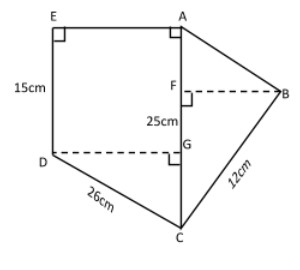
Calculate the area of the figure given below: which is not drawn to scale.
\[\begin{array}{*{20}{l}}
{A.{\text{ }}630sq.cm} \\
{B.{\text{ }}620sq.cm} \\
{C.{\text{ }}640sq.cm} \\
{D.{\text{ }}600sq.cm}
\end{array}\]
Answer
 Verified
618k+ views
Hint: Joint DG divides DCAE into two polygons via ΔGCD and AGDE.
Further find area of $\Delta ABC$ and area of $\Delta GCD$ and the area of rectangle AGDE.
Then add the areas of two triangles$(\Delta ABC\,and\,\Delta GCD)$and rectangle AGDE.
Area of triangle $ = \dfrac{{base \times height}}{2}$ and area of rectangle\[ = length \times breadth.\]
Complete step by step solution:
From D, draw perpendicular such that\[DG \bot AC\] ,thereby,
making a right angled triangle GCD and rectangle AGDE.
Given: \[AC = 25cm\]
\[AC = AG + GC\]
As, \[AG = ED\] (opposite sides of rectangle)
\[\therefore AC = ED + GC\]
\[ \Rightarrow 25\,\,{\text{ = }}15 + GC\] \[\left[ {As{\text{ }}ED\; = 15{\text{ }}cm} \right]\]
⇒ GC = 25 -15 = 10 cm \[ \ldots .\left( 1 \right)\]
In \[\Delta GCD;\]
By using Pythagoras theorem,
${(hypotenuse)^2} = {(perpendicular\,)^2} + {(base)^2}$
\[C{D^2} = G{C^2} + G{D^2}\]
Or\[{26^2} = {10^2} + G{D^2}\] \[\left[ {GC = 10{\text{ }}cm{\text{ }}from{\text{ }}\left( 1 \right),CD = 26{\text{ }}cm{\text{ }}given} \right]\]
\[G{D^2} = {26^2} - {10^2}\]
\[ \Rightarrow 676-100 = 576\]
$GD = \sqrt {576} $
\[GD = 24{\text{ }}cm\;\;\;\;\;\;\;\;\;\;\;\;\;\;\;\;\;\;\;\;\;\;\;\;\;\;\;\;\;\;\;\;\;\;\;\;\;\;\;\; \ldots .\left( 2 \right)\]
Entire figure consists of three parts viz;
\[\begin{array}{*{20}{l}}
{\left( 1 \right)\Delta ABC} \\
{\left( 2 \right)\Delta GCD} \\
{\left( 3 \right)Rectangle{\text{ }}AGDE}
\end{array}\]
$\therefore ar(ABCDE) = ar(\Delta ABC) + ar(\Delta GCD) + ar(AGDE)$
\[ = \dfrac{1}{2} \times 25 \times 12 + \dfrac{1}{2} \times 10 \times 24 + 15 \times 24\] \[\left[ {GC = 10{\text{ }}cm{\text{ }}from{\text{ }}\left( 1 \right){\text{ }}and{\text{ }}GD = 24{\text{ }}cm{\text{ }}from{\text{ }}\left( 2 \right)} \right]\]
$ = 150 + 120 + 360$
$ = 630sq\,cm$
Thus, the area of the given figure is\[630sq{\text{ }}cm\] .
Hence, the correct option is A.
Note: In$\Delta ABC$and $\Delta GCD$one angle is \[90^\circ \]so, these two triangles are right angled triangles, that is why we used the formula area of triangle$ = \dfrac{1}{2} \times base \times height$.
Further find area of $\Delta ABC$ and area of $\Delta GCD$ and the area of rectangle AGDE.
Then add the areas of two triangles$(\Delta ABC\,and\,\Delta GCD)$and rectangle AGDE.
Area of triangle $ = \dfrac{{base \times height}}{2}$ and area of rectangle\[ = length \times breadth.\]
Complete step by step solution:
From D, draw perpendicular such that\[DG \bot AC\] ,thereby,
making a right angled triangle GCD and rectangle AGDE.
Given: \[AC = 25cm\]
\[AC = AG + GC\]
As, \[AG = ED\] (opposite sides of rectangle)
\[\therefore AC = ED + GC\]
\[ \Rightarrow 25\,\,{\text{ = }}15 + GC\] \[\left[ {As{\text{ }}ED\; = 15{\text{ }}cm} \right]\]
⇒ GC = 25 -15 = 10 cm \[ \ldots .\left( 1 \right)\]
In \[\Delta GCD;\]
By using Pythagoras theorem,
${(hypotenuse)^2} = {(perpendicular\,)^2} + {(base)^2}$
\[C{D^2} = G{C^2} + G{D^2}\]
Or\[{26^2} = {10^2} + G{D^2}\] \[\left[ {GC = 10{\text{ }}cm{\text{ }}from{\text{ }}\left( 1 \right),CD = 26{\text{ }}cm{\text{ }}given} \right]\]
\[G{D^2} = {26^2} - {10^2}\]
\[ \Rightarrow 676-100 = 576\]
$GD = \sqrt {576} $
\[GD = 24{\text{ }}cm\;\;\;\;\;\;\;\;\;\;\;\;\;\;\;\;\;\;\;\;\;\;\;\;\;\;\;\;\;\;\;\;\;\;\;\;\;\;\;\; \ldots .\left( 2 \right)\]
Entire figure consists of three parts viz;
\[\begin{array}{*{20}{l}}
{\left( 1 \right)\Delta ABC} \\
{\left( 2 \right)\Delta GCD} \\
{\left( 3 \right)Rectangle{\text{ }}AGDE}
\end{array}\]
$\therefore ar(ABCDE) = ar(\Delta ABC) + ar(\Delta GCD) + ar(AGDE)$
\[ = \dfrac{1}{2} \times 25 \times 12 + \dfrac{1}{2} \times 10 \times 24 + 15 \times 24\] \[\left[ {GC = 10{\text{ }}cm{\text{ }}from{\text{ }}\left( 1 \right){\text{ }}and{\text{ }}GD = 24{\text{ }}cm{\text{ }}from{\text{ }}\left( 2 \right)} \right]\]
$ = 150 + 120 + 360$
$ = 630sq\,cm$
Thus, the area of the given figure is\[630sq{\text{ }}cm\] .
Hence, the correct option is A.
Note: In$\Delta ABC$and $\Delta GCD$one angle is \[90^\circ \]so, these two triangles are right angled triangles, that is why we used the formula area of triangle$ = \dfrac{1}{2} \times base \times height$.
Recently Updated Pages
Master Class 12 Business Studies: Engaging Questions & Answers for Success

Master Class 12 Biology: Engaging Questions & Answers for Success
Master Class 12 Chemistry: Engaging Questions & Answers for Success
Class 12 Question and Answer - Your Ultimate Solutions Guide
Master Class 11 Social Science: Engaging Questions & Answers for Success
Master Class 11 English: Engaging Questions & Answers for Success
Trending doubts
Explain the Treaty of Vienna of 1815 class 10 social science CBSE
Who Won 36 Oscar Awards? Record Holder Revealed
What is the median of the first 10 natural numbers class 10 maths CBSE
Why is it 530 pm in india when it is 1200 afternoon class 10 social science CBSE
What is the full form of POSCO class 10 social science CBSE
The highest temperature in Karnataka is recorded in class 10 social science CBSE