




Cadets are marching in a parade. There are $4$ cadets in each row. What is the rule for the number of cadets, for a given number of rows? Use $n$ for the number of rows.
Answer
 Verified
558.3k+ views
Hint: First, the problem deals with the basic knowledge of mathematics and no formulas required to solve the given problem.
In the parade all the cadets stand in rows and columns, they march ahead with respect to columns, and the cadets in each column stand in a row. Since the problem is in the rule to be applied here is the multiplication only with the cadets in a given row. Which is how many cadets per row.
Complete step-by-step solution:
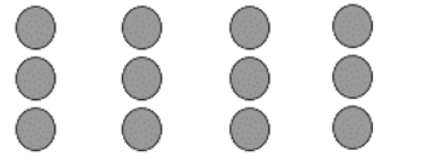
Since the above dots represent the cadets in a parade, as in the given problem there are $4$ cadets in each row, of separate columns.
Also, given that the number of cadets in each row is equals $4$
The number of cadets in $1$ a row $ = 4$
The number of cadets in $2$ rows $ = 4 \times 2 \Rightarrow 8$
The number of cadets in $3$ rows $ = 4 \times 3 \Rightarrow 12$
Hence the total number of the cadets in the parade is given as the number of rows are
The number of cadets $ = 4 \times $ number of rows.
Since from the given, we know that the number of rows is $n$
Therefore, the total number of cadets is four times the number of rows. Hence, we have $4n$
Hence the rule for the number of cadets for a given number of rows $n$ is given as $4n$
Note: The cadets are standing in rows and columns where the cadets per row are given, when the cadets per column are given then the number of cadets in the whole parade is given by the multiplication of the number of cadets in a column and given the number of columns.
In the parade all the cadets stand in rows and columns, they march ahead with respect to columns, and the cadets in each column stand in a row. Since the problem is in the rule to be applied here is the multiplication only with the cadets in a given row. Which is how many cadets per row.
Complete step-by-step solution:
Since the above dots represent the cadets in a parade, as in the given problem there are $4$ cadets in each row, of separate columns.
Also, given that the number of cadets in each row is equals $4$
The number of cadets in $1$ a row $ = 4$
The number of cadets in $2$ rows $ = 4 \times 2 \Rightarrow 8$
The number of cadets in $3$ rows $ = 4 \times 3 \Rightarrow 12$
Hence the total number of the cadets in the parade is given as the number of rows are
The number of cadets $ = 4 \times $ number of rows.
Since from the given, we know that the number of rows is $n$
Therefore, the total number of cadets is four times the number of rows. Hence, we have $4n$
Hence the rule for the number of cadets for a given number of rows $n$ is given as $4n$
Note: The cadets are standing in rows and columns where the cadets per row are given, when the cadets per column are given then the number of cadets in the whole parade is given by the multiplication of the number of cadets in a column and given the number of columns.
Recently Updated Pages
Master Class 11 Social Science: Engaging Questions & Answers for Success

Master Class 11 English: Engaging Questions & Answers for Success
Master Class 11 Accountancy: Engaging Questions & Answers for Success
Master Class 11 Physics: Engaging Questions & Answers for Success
Master Class 11 Computer Science: Engaging Questions & Answers for Success
Master Class 11 Business Studies: Engaging Questions & Answers for Success
Trending doubts
Find the value of the expression given below sin 30circ class 11 maths CBSE
One Metric ton is equal to kg A 10000 B 1000 C 100 class 11 physics CBSE
Draw a diagram of nephron and explain its structur class 11 biology CBSE
10 examples of friction in our daily life
Proton was discovered by A Thomson B Rutherford C Chadwick class 11 chemistry CBSE
The teeth used for biting and cutting food are called class 11 biology CBSE