




${C}_{4}$ -cycle discovered by
(a)Hatch and Slack
(b)Calvin
(c)Hill
(d)Arnon
Answer
 Verified
618k+ views
Hint: Australian botanists in 1966 researched that there are two kinds of chloroplasts in sugarcane. The discovery of ${C}_{4}$ cycle in monocots like sugarcane, maize, and sorghum has specified that these plants have resolved the matter of photorespiration.
Complete answer:
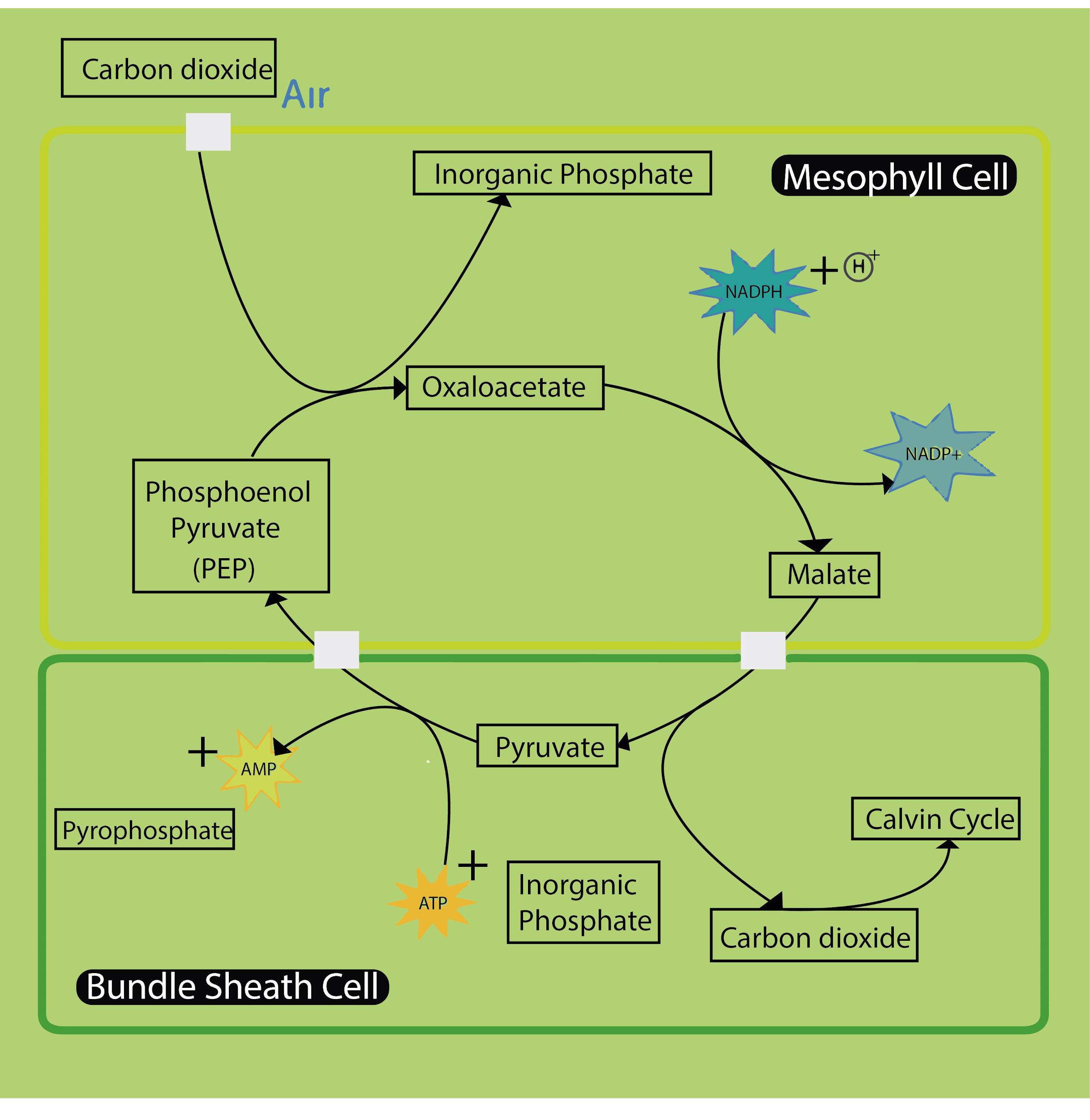
${C}_{4}$ cycle which is also referred to as the Hatch-Slack pathway is a cyclic process. It occurs in chloroplasts. ${C}_{4}$ -cycle was discovered by two Australian scientists Hatch and Slack. It is found in ${C}_{4}$ plants. Carbon dioxide fixation is done in this pathway. The primary ${CO}_{2}$ acceptor is the three-carbon molecule phosphoenolpyruvate (PEP) and it is present in mesophyll cells. The enzyme which catalyzes the ${CO}_{2}$ fixation is PEP carboxylase or PEPcase. The mesophyll cells of ${C}_{4}$ plants do not contain the enzyme RuBisCO. The 4-carbon oxaloacetic acid (OAA) is made within the mesophyll cells which is further converted into the malic acid or amino acid then transported into bundle sheath cells. In the bundle sheath cells, these ${C}_{4}$ acids are weakened to release ${CO}_{2}$ and a three-carbon molecule.
Additional information:
${C}_{4}$ photosynthesis comprise novel leaf anatomy, metabolic specializations, and altered gene expression. Plants that use this pathway basically have a specific Kranz leaf anatomy, consisting of two photosynthetic cell types. Their vascular bundles are surrounded by two rings of cells. The innermost ring also referred to as bundle sheath cells contain starch-rich chloroplasts lacking grana, which vary from those in mesophyll cells located as the outer ring. This structural framework allows for the categorization and functional division of two pairs of carboxylation and decarboxylation reactions.
So, the correct answer is ‘Hatch and Slack’.
Note: The light-dependent reactions and the Calvin cycle are divided in the ${C}_{4}$ plants. The Calvin cycle takes place in the bundle-sheath cells and the light-dependent reactions occur in the mesophyll cells. In ${C}_{4}$ grasses such as maize, the mesophyll cells surround the bundle sheath cells, and the bundle sheath cells enclose the veins. ${C}_{4}$ photosynthesis is present in many plant species, mainly in monocots (like maize, sugar cane, and grasses) but also in many dicots (like amaranth and flaveria).
Complete answer:
${C}_{4}$ cycle which is also referred to as the Hatch-Slack pathway is a cyclic process. It occurs in chloroplasts. ${C}_{4}$ -cycle was discovered by two Australian scientists Hatch and Slack. It is found in ${C}_{4}$ plants. Carbon dioxide fixation is done in this pathway. The primary ${CO}_{2}$ acceptor is the three-carbon molecule phosphoenolpyruvate (PEP) and it is present in mesophyll cells. The enzyme which catalyzes the ${CO}_{2}$ fixation is PEP carboxylase or PEPcase. The mesophyll cells of ${C}_{4}$ plants do not contain the enzyme RuBisCO. The 4-carbon oxaloacetic acid (OAA) is made within the mesophyll cells which is further converted into the malic acid or amino acid then transported into bundle sheath cells. In the bundle sheath cells, these ${C}_{4}$ acids are weakened to release ${CO}_{2}$ and a three-carbon molecule.
Additional information:
${C}_{4}$ photosynthesis comprise novel leaf anatomy, metabolic specializations, and altered gene expression. Plants that use this pathway basically have a specific Kranz leaf anatomy, consisting of two photosynthetic cell types. Their vascular bundles are surrounded by two rings of cells. The innermost ring also referred to as bundle sheath cells contain starch-rich chloroplasts lacking grana, which vary from those in mesophyll cells located as the outer ring. This structural framework allows for the categorization and functional division of two pairs of carboxylation and decarboxylation reactions.
So, the correct answer is ‘Hatch and Slack’.
Note: The light-dependent reactions and the Calvin cycle are divided in the ${C}_{4}$ plants. The Calvin cycle takes place in the bundle-sheath cells and the light-dependent reactions occur in the mesophyll cells. In ${C}_{4}$ grasses such as maize, the mesophyll cells surround the bundle sheath cells, and the bundle sheath cells enclose the veins. ${C}_{4}$ photosynthesis is present in many plant species, mainly in monocots (like maize, sugar cane, and grasses) but also in many dicots (like amaranth and flaveria).
Recently Updated Pages
Basicity of sulphurous acid and sulphuric acid are

Master Class 11 English: Engaging Questions & Answers for Success
Master Class 11 Physics: Engaging Questions & Answers for Success
Master Class 11 Computer Science: Engaging Questions & Answers for Success
Master Class 11 Chemistry: Engaging Questions & Answers for Success
Master Class 11 Social Science: Engaging Questions & Answers for Success
Trending doubts
Difference Between Prokaryotic Cells and Eukaryotic Cells
Two of the body parts which do not appear in MRI are class 11 biology CBSE
One Metric ton is equal to kg A 10000 B 1000 C 100 class 11 physics CBSE
10 examples of friction in our daily life
Draw a diagram of nephron and explain its structur class 11 biology CBSE
What will happen if the mucus is not secreted by the class 11 biology CBSE