




Why –(-) butan- 2 -ol is optically inactive ?
Answer
 Verified
641.7k+ views
Hint: For a compound to be optically active, the presence of a chiral center is necessary. A compound having a chiral center can be optically inactive due to the presence of symmetry or some factor that can cancel the optical activity.
Complete answer:
A compound having a chiral center will be optically active. A center having four different substituents is known as a chiral center.
The chiral molecule rotates the light in a clockwise direction are known as dextrorotatory and represented by \[\left( + \right)\] sign and the chiral molecule rotate the light in an anticlockwise direction are known as laevorotatory and represented by \[\left( - \right)\] sign.
A chiral molecule can be optical inactive in two conditions:
- If the molecule has symmetry such as tartaric acid having a plane of symmetry.
- If the molecule exists in two enantiomers and both are present in equal amounts and both rotate the light in opposite directions.
This type of mixture when two enantiomers of a chiral molecule present in the same amount and both rotate the light in opposite directions, is known as a racemic mixture.
Write the structure of –(–) butan- 2 -ol as follows:
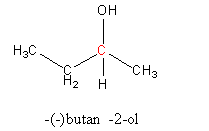
The carbon in red colour is the chiral center because it has four different substituents.
So, butan-2-ol should be optically active.
But the (-) and (+) enantiomers of butan-2-ol, both exist in equal amounts, so both rotate the light in opposite directions in equal amounts. So, rotation of both enantiomers cancel out by each other thus the –(–) butan-2-ol is optically inactive.
Therefore, –(–) butan-2-ol is optically inactive due to racemic mixture.
Note: The racemic mixture is optical active but the optical activity of the racemic mixture is not observed due to the cancelation of optical activity of both enantiomers by each other.
Complete answer:
A compound having a chiral center will be optically active. A center having four different substituents is known as a chiral center.
The chiral molecule rotates the light in a clockwise direction are known as dextrorotatory and represented by \[\left( + \right)\] sign and the chiral molecule rotate the light in an anticlockwise direction are known as laevorotatory and represented by \[\left( - \right)\] sign.
A chiral molecule can be optical inactive in two conditions:
- If the molecule has symmetry such as tartaric acid having a plane of symmetry.
- If the molecule exists in two enantiomers and both are present in equal amounts and both rotate the light in opposite directions.
This type of mixture when two enantiomers of a chiral molecule present in the same amount and both rotate the light in opposite directions, is known as a racemic mixture.
Write the structure of –(–) butan- 2 -ol as follows:
The carbon in red colour is the chiral center because it has four different substituents.
So, butan-2-ol should be optically active.
But the (-) and (+) enantiomers of butan-2-ol, both exist in equal amounts, so both rotate the light in opposite directions in equal amounts. So, rotation of both enantiomers cancel out by each other thus the –(–) butan-2-ol is optically inactive.
Therefore, –(–) butan-2-ol is optically inactive due to racemic mixture.
Note: The racemic mixture is optical active but the optical activity of the racemic mixture is not observed due to the cancelation of optical activity of both enantiomers by each other.
Recently Updated Pages
Master Class 11 Social Science: Engaging Questions & Answers for Success

Master Class 11 English: Engaging Questions & Answers for Success
Master Class 11 Accountancy: Engaging Questions & Answers for Success
Master Class 11 Physics: Engaging Questions & Answers for Success
Master Class 11 Computer Science: Engaging Questions & Answers for Success
Master Class 11 Business Studies: Engaging Questions & Answers for Success
Trending doubts
One Metric ton is equal to kg A 10000 B 1000 C 100 class 11 physics CBSE
Find the value of the expression given below sin 30circ class 11 maths CBSE
Draw a diagram of nephron and explain its structur class 11 biology CBSE
10 examples of friction in our daily life
Proton was discovered by A Thomson B Rutherford C Chadwick class 11 chemistry CBSE
How many kilometers are there in 100 meters class 11 maths CBSE