




Bulliform cells are found in
A. Seeds of sunflower
B. Leaf of wheat
C. Pod of pea
D. Tuber of potato
Answer
 Verified
624.9k+ views
Hint: Bulliform cells are large epidermal cells that can store water. Found in structures that are more prone to water loss.
Complete answer:
Bulliform cells are found in the leaf of wheat. Bulliform cells are bubble-shaped cells that are present in groups near the mid-vein portion on the upper surface of the leaves of many monocots. The presence of these cells helps the cell to survive stress conditions. These are large, empty, and transparent cells that can store water. During sufficient water supply, Bulliform cells absorb water and become rigid due to which the leaf opens up and becomes straight (more surface area is exposed). But, insufficient water supply or stress conditions like transpiration or infection there is a loss of water due to which these cells become flaccid which makes the leaves to curl in so that less surface area of the leaves are exposed. Thus, reducing the loss of water. Once the conditions are favorable these cells again fill up themself with water and re-straighten the leaves. This mechanism is usually seen in grasses.
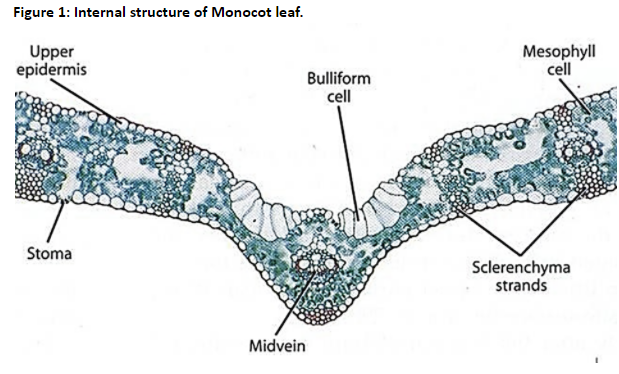
Additional Information:
1. Bulliform cells minimize the loss of water during stress and unfavorable conditions through the folding of leaves. As the leaves are folded they have less exposed area to sunlight, thus reducing evaporation through the leaf surface and hence conserving the water in plants.
2. Bulliform cells are also known as Hygroscopic or motor cells.
So, The correct option is ‘Leaf of wheat’.
Note: Cactus plants have leaf structures as thorns in order to reduce water loss through leaves. Thus, photosynthesis is performed by the green thick stem of the cactus plant.
Complete answer:
Bulliform cells are found in the leaf of wheat. Bulliform cells are bubble-shaped cells that are present in groups near the mid-vein portion on the upper surface of the leaves of many monocots. The presence of these cells helps the cell to survive stress conditions. These are large, empty, and transparent cells that can store water. During sufficient water supply, Bulliform cells absorb water and become rigid due to which the leaf opens up and becomes straight (more surface area is exposed). But, insufficient water supply or stress conditions like transpiration or infection there is a loss of water due to which these cells become flaccid which makes the leaves to curl in so that less surface area of the leaves are exposed. Thus, reducing the loss of water. Once the conditions are favorable these cells again fill up themself with water and re-straighten the leaves. This mechanism is usually seen in grasses.
Additional Information:
1. Bulliform cells minimize the loss of water during stress and unfavorable conditions through the folding of leaves. As the leaves are folded they have less exposed area to sunlight, thus reducing evaporation through the leaf surface and hence conserving the water in plants.
2. Bulliform cells are also known as Hygroscopic or motor cells.
So, The correct option is ‘Leaf of wheat’.
Note: Cactus plants have leaf structures as thorns in order to reduce water loss through leaves. Thus, photosynthesis is performed by the green thick stem of the cactus plant.
Recently Updated Pages
Master Class 12 Economics: Engaging Questions & Answers for Success

Master Class 12 English: Engaging Questions & Answers for Success
Master Class 12 Social Science: Engaging Questions & Answers for Success
Master Class 12 Maths: Engaging Questions & Answers for Success
Master Class 12 Physics: Engaging Questions & Answers for Success
Master Class 9 General Knowledge: Engaging Questions & Answers for Success
Trending doubts
One Metric ton is equal to kg A 10000 B 1000 C 100 class 11 physics CBSE
Difference Between Prokaryotic Cells and Eukaryotic Cells
Find the value of the expression given below sin 30circ class 11 maths CBSE
Two of the body parts which do not appear in MRI are class 11 biology CBSE
1 ton equals to A 100 kg B 1000 kg C 10 kg D 10000 class 11 physics CBSE
Draw a diagram of nephron and explain its structur class 11 biology CBSE