




Briefly describe about viral proteins.
Answer
 Verified
495.9k+ views
Hint: The virus is the obligate parasite which is considered both living and nonliving. It requires a living host to complete its life cycle and replicate. It is made up of genetic material DNA or RNA enclosed in a protein coat called the capsid.
Complete answer:
The virus is made up of a protein coat called the capsid and the genetic material DNA or RNA which is enclosed in the protein coat. The virus leaves behind its protein coat after infecting the host.
To solve this question, we must discuss the capsid and the proteins associated with it.
The viral proteins are the proteins made by the virus which are essential for structural, regulatory, non-structural roles. The structural protein is the capsid. The capsid is the protein layer which helps in protecting the genetic material of the virus. The capsid is made up of several arrays of capsomers. It is found to be polyhedral in shape. The main role of protein capsid is to protect the nucleic acid from enzymatic digestion. It has specialised sites on its surface which helps attachment of the virus to the host. The proteins help in penetrating the nucleic acid to the cytoplasm of the host.
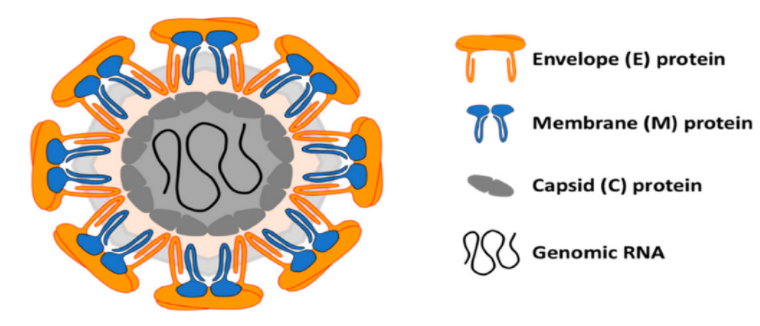
The non-structural proteins include the proteins which are synthesised by the virus and expressed in the host cell.
Note:
The virus does not use its protein synthesis for replication. Instead, it uses the proteins synthesised by the host for its replication. The regulatory and the accessory proteins control the cellular activities of the host. They enhance viral gene expression.
Complete answer:
The virus is made up of a protein coat called the capsid and the genetic material DNA or RNA which is enclosed in the protein coat. The virus leaves behind its protein coat after infecting the host.
To solve this question, we must discuss the capsid and the proteins associated with it.
The viral proteins are the proteins made by the virus which are essential for structural, regulatory, non-structural roles. The structural protein is the capsid. The capsid is the protein layer which helps in protecting the genetic material of the virus. The capsid is made up of several arrays of capsomers. It is found to be polyhedral in shape. The main role of protein capsid is to protect the nucleic acid from enzymatic digestion. It has specialised sites on its surface which helps attachment of the virus to the host. The proteins help in penetrating the nucleic acid to the cytoplasm of the host.
The non-structural proteins include the proteins which are synthesised by the virus and expressed in the host cell.
Note:
The virus does not use its protein synthesis for replication. Instead, it uses the proteins synthesised by the host for its replication. The regulatory and the accessory proteins control the cellular activities of the host. They enhance viral gene expression.
Recently Updated Pages
Master Class 11 Social Science: Engaging Questions & Answers for Success

Master Class 11 Physics: Engaging Questions & Answers for Success
Master Class 11 Maths: Engaging Questions & Answers for Success
Master Class 11 Economics: Engaging Questions & Answers for Success
Master Class 11 Computer Science: Engaging Questions & Answers for Success
Master Class 11 Chemistry: Engaging Questions & Answers for Success
Trending doubts
One Metric ton is equal to kg A 10000 B 1000 C 100 class 11 physics CBSE
There are 720 permutations of the digits 1 2 3 4 5 class 11 maths CBSE
1 Quintal is equal to a 110 kg b 10 kg c 100kg d 1000 class 11 physics CBSE
State and prove Bernoullis theorem class 11 physics CBSE
Difference Between Prokaryotic Cells and Eukaryotic Cells
Which among the following are examples of coming together class 11 social science CBSE