




Both nyctinasty and thigmonasty are observed in
(a) Drosera
(b) Cuscuta
(c) Utricularia
(d) None of the above
Answer
 Verified
616.2k+ views
Hint: It is one of the largest genera of carnivorous plants. They used insects to supplement poor mineral nutrition and are commonly known as sundews.
Complete answer:Both nyctinasty and thigmonasty are observed in Drosera. The movement response of the plant to contact is called thigmonasty and nyctinasty is the movement of plant parts in response to darkness.
Additional information:Different types of nastic movements are:
Thigmonasty: It is the movement response of the plant to contact. An important example of the thigmotactic movement is the closing of a venus fly trap.
Nyctinasty: It is the movement response of the plant to darkness. Some plants can assume a position at night that is different from their position during the daytime.
Epinasty: It is the downward-bending from growth at the top, for example, the bending down of a heavy flower.
Hyponasty: It is an upward bending of leaves or other plant parts, due to faster growth of the lower side of the petiole in comparison to its upper part. Submerged plants often display the hyponastic response.
Photonasty: It is the response to light, for example in sunflowers the flowers always face the sunlight.
Chemonasty: It is the movement of plants in response to chemicals or nutrients. Example., closing of glandular hairs of sundew in response to nitrogenous compounds from an insect to prevent the escape of such insects.
Hydronasty: It is the movement of plants in response to water. It can be seen in movements of roots toward the water.
Thermonasty: It is the movement of plants in response to heat. Flower opening in certain crocus and tulip species is due to thigmonastic movements.
So the correct answer is ‘Drosera’.
Note:Nastic movements are different from tropic movements (tropisms). Tropisms are directional movements or growth responses of a plant to the stimulus whereas nastic movement is non-directional.
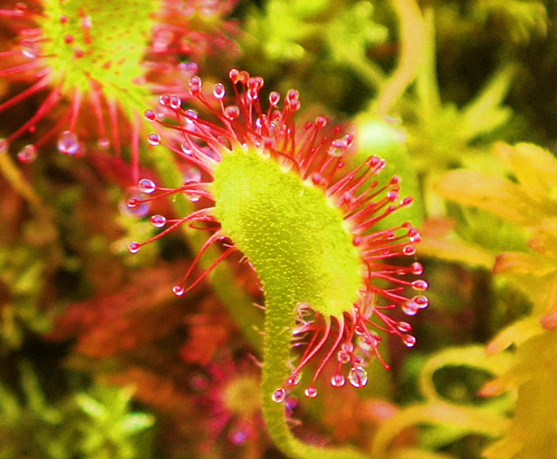
Figure: Drosera
Complete answer:Both nyctinasty and thigmonasty are observed in Drosera. The movement response of the plant to contact is called thigmonasty and nyctinasty is the movement of plant parts in response to darkness.
Additional information:Different types of nastic movements are:
Thigmonasty: It is the movement response of the plant to contact. An important example of the thigmotactic movement is the closing of a venus fly trap.
Nyctinasty: It is the movement response of the plant to darkness. Some plants can assume a position at night that is different from their position during the daytime.
Epinasty: It is the downward-bending from growth at the top, for example, the bending down of a heavy flower.
Hyponasty: It is an upward bending of leaves or other plant parts, due to faster growth of the lower side of the petiole in comparison to its upper part. Submerged plants often display the hyponastic response.
Photonasty: It is the response to light, for example in sunflowers the flowers always face the sunlight.
Chemonasty: It is the movement of plants in response to chemicals or nutrients. Example., closing of glandular hairs of sundew in response to nitrogenous compounds from an insect to prevent the escape of such insects.
Hydronasty: It is the movement of plants in response to water. It can be seen in movements of roots toward the water.
Thermonasty: It is the movement of plants in response to heat. Flower opening in certain crocus and tulip species is due to thigmonastic movements.
So the correct answer is ‘Drosera’.
Note:Nastic movements are different from tropic movements (tropisms). Tropisms are directional movements or growth responses of a plant to the stimulus whereas nastic movement is non-directional.
Figure: Drosera
Recently Updated Pages
Master Class 12 Economics: Engaging Questions & Answers for Success

Master Class 12 English: Engaging Questions & Answers for Success
Master Class 12 Social Science: Engaging Questions & Answers for Success
Master Class 12 Maths: Engaging Questions & Answers for Success
Master Class 12 Physics: Engaging Questions & Answers for Success
Master Class 11 Social Science: Engaging Questions & Answers for Success
Trending doubts
One Metric ton is equal to kg A 10000 B 1000 C 100 class 11 physics CBSE
Difference Between Prokaryotic Cells and Eukaryotic Cells
Two of the body parts which do not appear in MRI are class 11 biology CBSE
1 ton equals to A 100 kg B 1000 kg C 10 kg D 10000 class 11 physics CBSE
Draw a diagram of nephron and explain its structur class 11 biology CBSE
10 examples of friction in our daily life