




Bonding in silicon is __________.
Answer
 Verified
522.6k+ views
Hint: Silicon is commonly known as silicon dioxide or silica. Silica is present as the major constituent of earth’s crust. Pure forms of silicon exist as colourless solid, but impurity due to metal has some characteristic colour to the silicon.
Complete answer:
Silicon is known as covalent solid which is capable of forming a three-dimensional network. In the chemical structure of the silicon, each oxygen atom of silicon is bonded covalently with silicon atom. This fashion is repeated in three dimensions to create a huge network of silicon.
Silicon comes under the carbon family having atomic number $14$. Electronic configuration of silicon is written as $\left[ {Ne} \right]3{s^2}3{p^2}$. From the electronic configuration of silicon, we can see that it contains $4$electron in its outermost shell. Hence, it requires four more electrons to complete its octet.
When silicon combines with an oxygen atom despite forming a double bond as formed between $\left( {C = O} \right)$, Silicon forms a single bond with the oxygen atom. The main reason behind formation of this single bond is that the size of $3p$ orbital is quite large with respect to the size of $2p$ orbital of the oxygen atom. This size difference between the orbital of silicon and oxygen restricts the effective overlapping between the atoms. Therefore, to satisfy the valency of silicon it combines with oxygen atom with a single bond.
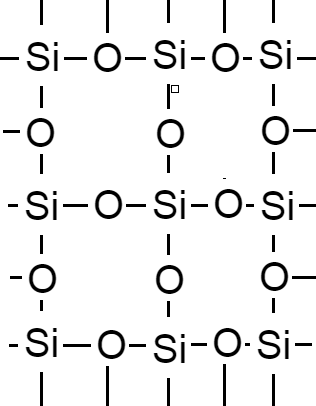
Hence, in a network one silicon atom forms four covalent bonds with four oxygen atoms.
Therefore, we can say that bonding in silicon is covalent bonding.
Note:
Due to formation of this huge network silicon is non-reactive in nature. Silica exists in different crystallographic forms such as quartz, cristobalite and tridymite. All of these forms of silica are interconvertible with each other and show different structures.
Complete answer:
Silicon is known as covalent solid which is capable of forming a three-dimensional network. In the chemical structure of the silicon, each oxygen atom of silicon is bonded covalently with silicon atom. This fashion is repeated in three dimensions to create a huge network of silicon.
Silicon comes under the carbon family having atomic number $14$. Electronic configuration of silicon is written as $\left[ {Ne} \right]3{s^2}3{p^2}$. From the electronic configuration of silicon, we can see that it contains $4$electron in its outermost shell. Hence, it requires four more electrons to complete its octet.
When silicon combines with an oxygen atom despite forming a double bond as formed between $\left( {C = O} \right)$, Silicon forms a single bond with the oxygen atom. The main reason behind formation of this single bond is that the size of $3p$ orbital is quite large with respect to the size of $2p$ orbital of the oxygen atom. This size difference between the orbital of silicon and oxygen restricts the effective overlapping between the atoms. Therefore, to satisfy the valency of silicon it combines with oxygen atom with a single bond.
Hence, in a network one silicon atom forms four covalent bonds with four oxygen atoms.
Therefore, we can say that bonding in silicon is covalent bonding.
Note:
Due to formation of this huge network silicon is non-reactive in nature. Silica exists in different crystallographic forms such as quartz, cristobalite and tridymite. All of these forms of silica are interconvertible with each other and show different structures.
Recently Updated Pages
Master Class 12 Economics: Engaging Questions & Answers for Success

Master Class 12 English: Engaging Questions & Answers for Success
Master Class 12 Social Science: Engaging Questions & Answers for Success
Master Class 12 Maths: Engaging Questions & Answers for Success
Master Class 12 Physics: Engaging Questions & Answers for Success
Master Class 11 Social Science: Engaging Questions & Answers for Success
Trending doubts
1 ton equals to A 100 kg B 1000 kg C 10 kg D 10000 class 11 physics CBSE
Draw a diagram of nephron and explain its structur class 11 biology CBSE
DNA is not present in A Nucleus B Mitochondria C Chloroplast class 11 biology CBSE
Proton was discovered by A Thomson B Rutherford C Chadwick class 11 chemistry CBSE
Mention the important general characters of Urocho class 11 biology CBSE
Define pneumatic bones class 11 biology CBSE