




Bond angle in water molecule is:
A. ${{100}^{o}}$
B. ${{90}^{o}}$
C. ${{105}^{o}}$
D. ${{110}^{o}}$
Answer
 Verified
646.8k+ views
Hint: As per the question asked, we have to find out the bond angle of the water molecule which can be derived by knowing that the oxygen in the water molecule has four electron groups (i.e. two lone pairs of electrons). So, the molecule will have two lone pairs and two bond pairs giving it a tetrahedral electron geometry.
Complete step by step answer:
We should know that,
Water i.e. ${{H}_{2}}O$, is a polar molecule with one oxygen atom bonded to the two different hydrogen atoms. Due to high electronegativity of oxygen atoms, the bond formed (i.e. covalent bond) between oxygen and hydrogen is polar.
Hence, oxygen atom acquires two partial negative charges whereas, each hydrogen atom acquires one partial positive charge.
So, oxygen has two lone pairs of electrons. Thus, now water molecules have two bond pairs and two lone pairs of electrons which are arranged in tetrahedral geometry around the central atom which is oxygen.
Normally, we know that tetrahedral bond angle is ${{109.5}^{o}}$, but in water molecule, because of the presence of two lone pair-lone pair repulsion and lone pair-bond pair repulsion, the bond angle gets decreased from ${{109.5}^{o}}$ to ${{104.5}^{o}}$ which is approximately ${{105}^{o}}$.
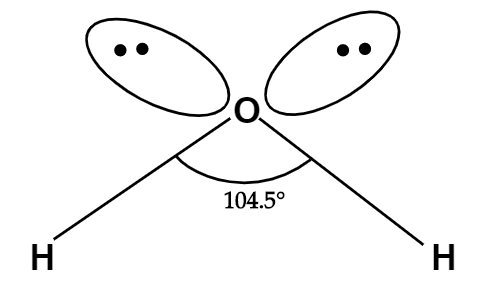
Leaving the lone pairs, the shape of the water molecule will be bent shaped.
We know that, oxygen atom acquires $s{{p}^{3}}$ hybridisation. Because of the polarity of the bonds, water molecules have high dipole moments where negative charge is directed towards the lone pair.
As we know that, polar molecules attract each other by dipole-dipole forces where the negative part of one water molecule is attracted to the positive part of another water molecule. So here, in water molecules the hydrogen atom has low density. Thus, the hydrogen atom of one molecule is attracted to the lone pair of the oxygen atom of another molecule. Thereby decreasing its bond angle.
So, the correct answer is “Option C”.
Note: We should know that, the lone pair-lone pair repulsions are of the greatest magnitude and bond pair-bond pair repulsions are of the lowest magnitude and the lone pair-bond pair repulsions are greater than bond pair-bond pair and lower than the lone pair-lone pair repulsions.
Complete step by step answer:
We should know that,
Water i.e. ${{H}_{2}}O$, is a polar molecule with one oxygen atom bonded to the two different hydrogen atoms. Due to high electronegativity of oxygen atoms, the bond formed (i.e. covalent bond) between oxygen and hydrogen is polar.
Hence, oxygen atom acquires two partial negative charges whereas, each hydrogen atom acquires one partial positive charge.
So, oxygen has two lone pairs of electrons. Thus, now water molecules have two bond pairs and two lone pairs of electrons which are arranged in tetrahedral geometry around the central atom which is oxygen.
Normally, we know that tetrahedral bond angle is ${{109.5}^{o}}$, but in water molecule, because of the presence of two lone pair-lone pair repulsion and lone pair-bond pair repulsion, the bond angle gets decreased from ${{109.5}^{o}}$ to ${{104.5}^{o}}$ which is approximately ${{105}^{o}}$.
Leaving the lone pairs, the shape of the water molecule will be bent shaped.
We know that, oxygen atom acquires $s{{p}^{3}}$ hybridisation. Because of the polarity of the bonds, water molecules have high dipole moments where negative charge is directed towards the lone pair.
As we know that, polar molecules attract each other by dipole-dipole forces where the negative part of one water molecule is attracted to the positive part of another water molecule. So here, in water molecules the hydrogen atom has low density. Thus, the hydrogen atom of one molecule is attracted to the lone pair of the oxygen atom of another molecule. Thereby decreasing its bond angle.
So, the correct answer is “Option C”.
Note: We should know that, the lone pair-lone pair repulsions are of the greatest magnitude and bond pair-bond pair repulsions are of the lowest magnitude and the lone pair-bond pair repulsions are greater than bond pair-bond pair and lower than the lone pair-lone pair repulsions.
Recently Updated Pages
Which will be the least stable resonating structure class 11 chemistry CBSE

How many 5 digit telephone numbers can be construc-class-11-maths-CBSE
How do you find the angle of the resultant vector class 11 physics CBSE
Draw labelled diagram of the following i Gram seed class 11 biology CBSE
What is the need and importance of classification class 11 biology CBSE
The way in which the sparrows expressed their sorrow class 11 english CBSE
Trending doubts
One Metric ton is equal to kg A 10000 B 1000 C 100 class 11 physics CBSE
Find the value of the expression given below sin 30circ class 11 maths CBSE
1 Quintal is equal to a 110 kg b 10 kg c 100kg d 1000 class 11 physics CBSE
Draw a diagram of nephron and explain its structur class 11 biology CBSE
10 examples of friction in our daily life
Proton was discovered by A Thomson B Rutherford C Chadwick class 11 chemistry CBSE