




What is the bond angle in a tetrahedral molecule?
Answer
 Verified
555k+ views
Hint: According to the VSEPR theory, each atom in a molecule will obtain a shape that minimises repulsion between electrons in that atom's valence shell. It's essentially a model for predicting molecular geometry. The bonding and molecular geometry of organic molecules and polyatomic ions are the main focus of VSEPR models.
Complete answer:
As we know, tetra means four and hedral means a solid face, therefore tetrahedral means "having four faces." When four bonds are all linked to one core atom and there are no lone electron pairs, this shape is formed.
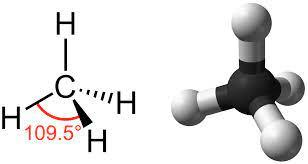
A tetrahedral molecule is made up $ 4 $ equally spaced $ s{p^3} $ hybrid orbitals forming bond angles of $ {109.5^ \circ } $
Example of a tetrahedral molecule is methane.
The four equivalent bonds ( $ C - H $ ) point in four geometrically equivalent directions in three dimensions which can be corresponded to the four corners of a tetrahedron as hydrogen, centred on the carbon atom.
Additional Information:
The VSEPR model accurately predicts the $ 3 $ -D shape of molecules and ions, but it fails to provide any detailed information on bond length or bond structure.
VSEPR models are based on the idea that electrons revolving around a core atom will arrange themselves to minimise repulsion, dictating the molecule's shape.
It can predict the form of almost every compound with a centre atom.
Note:
When counting bond angles, always use shapes above geometries of the given molecule because bond angles are always between bonds, not between lone pairs. Shape primarily examines real bonds, whereas geometry considers the total arrangement of a molecule, including bonds and lone pairs.
Complete answer:
As we know, tetra means four and hedral means a solid face, therefore tetrahedral means "having four faces." When four bonds are all linked to one core atom and there are no lone electron pairs, this shape is formed.
A tetrahedral molecule is made up $ 4 $ equally spaced $ s{p^3} $ hybrid orbitals forming bond angles of $ {109.5^ \circ } $
Example of a tetrahedral molecule is methane.
The four equivalent bonds ( $ C - H $ ) point in four geometrically equivalent directions in three dimensions which can be corresponded to the four corners of a tetrahedron as hydrogen, centred on the carbon atom.
Additional Information:
The VSEPR model accurately predicts the $ 3 $ -D shape of molecules and ions, but it fails to provide any detailed information on bond length or bond structure.
VSEPR models are based on the idea that electrons revolving around a core atom will arrange themselves to minimise repulsion, dictating the molecule's shape.
It can predict the form of almost every compound with a centre atom.
Note:
When counting bond angles, always use shapes above geometries of the given molecule because bond angles are always between bonds, not between lone pairs. Shape primarily examines real bonds, whereas geometry considers the total arrangement of a molecule, including bonds and lone pairs.
Recently Updated Pages
Which will be the least stable resonating structure class 11 chemistry CBSE

How many 5 digit telephone numbers can be construc-class-11-maths-CBSE
How do you find the angle of the resultant vector class 11 physics CBSE
Draw labelled diagram of the following i Gram seed class 11 biology CBSE
1 Quintal is equal to a 110 kg b 10 kg c 100kg d 1000 class 11 physics CBSE
What is the need and importance of classification class 11 biology CBSE
Trending doubts
One Metric ton is equal to kg A 10000 B 1000 C 100 class 11 physics CBSE
Find the value of the expression given below sin 30circ class 11 maths CBSE
Draw a diagram of nephron and explain its structur class 11 biology CBSE
10 examples of friction in our daily life
Proton was discovered by A Thomson B Rutherford C Chadwick class 11 chemistry CBSE
The teeth used for biting and cutting food are called class 11 biology CBSE