




Blessy has two bags containing numbered counters.
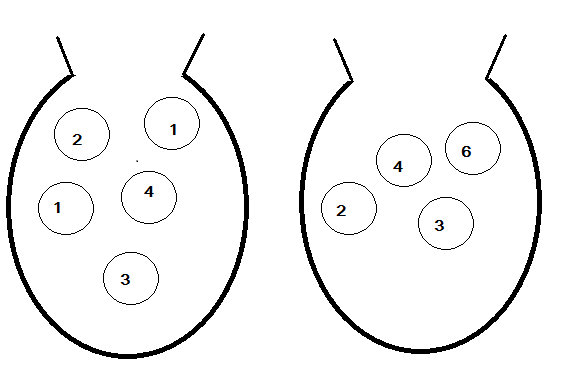
She takes one counter at random from bag A and another counter at random from Bag B. She adds the numbers on her two counters. Find the probability that Blessy’s answer is more than 6.
Answer
 Verified
625.8k+ views
Hint: n this question, we need to determine the probability that Blessy’s answer was more than 6 when she had drawn 2 balls at random from the bags A and B. For this, we will use the basic formula of probability which is given as $P(E) = \dfrac{{n(F)}}{{n(A)}}$.
Complete step-by-step answer:
A total number of events of drawing counters from bag A and bag B having 5 counters and 4 counters respectively is the product of the total counters in the bags.
Let the total number of events be $n(A)$.
So, the total number of events is given as: $n(A) = 5 \times 4 = 20 - - - - (i)$
Now, a favourable number of events are the events satisfying the given condition in the question. Here, the condition is that the total sum of the counters should be more than 6.
So, the favourable number of outcomes is given as:
\[n(F) = \left\{ {\left( {1,6} \right);\left( {2,6} \right);\left( {3,4} \right);\left( {3,6} \right);\left( {4,3} \right);\left( {1,6} \right);\left( {4,4} \right);\left( {4,6} \right)} \right\} = 8 - - - - (ii)\]
Now, the ratio of the favourable number of outcomes to the total number of outcomes results in the probability of satisfying the favourable outcomes. Mathematically $P(E) = \dfrac{{n(F)}}{{n(A)}}$. Here, a favourable number of outcomes is 8, and the total number of outcomes is 20.
So, substitute $n(F) = 8{\text{ and }}n(A) = 20$ in the formula $P(E) = \dfrac{{n(F)}}{{n(A)}}$ to determine the probability that Blessy’s have more than 6 as the sum of the counters.
\[
P(E) = \dfrac{{n(F)}}{{n(A)}} \\
= \dfrac{8}{{20}} \\
= \dfrac{2}{5} \\
= 0.4 \\
\]
Hence, the probability that Bleesy has the sum of the counters in her hand is 0.4.
Note: Students must be careful while estimating the total number of favourable outcomes as if even one favourable outcome has not been counted then, it will lead to the wrong answer.
Complete step-by-step answer:
A total number of events of drawing counters from bag A and bag B having 5 counters and 4 counters respectively is the product of the total counters in the bags.
Let the total number of events be $n(A)$.
So, the total number of events is given as: $n(A) = 5 \times 4 = 20 - - - - (i)$
Now, a favourable number of events are the events satisfying the given condition in the question. Here, the condition is that the total sum of the counters should be more than 6.
So, the favourable number of outcomes is given as:
\[n(F) = \left\{ {\left( {1,6} \right);\left( {2,6} \right);\left( {3,4} \right);\left( {3,6} \right);\left( {4,3} \right);\left( {1,6} \right);\left( {4,4} \right);\left( {4,6} \right)} \right\} = 8 - - - - (ii)\]
Now, the ratio of the favourable number of outcomes to the total number of outcomes results in the probability of satisfying the favourable outcomes. Mathematically $P(E) = \dfrac{{n(F)}}{{n(A)}}$. Here, a favourable number of outcomes is 8, and the total number of outcomes is 20.
So, substitute $n(F) = 8{\text{ and }}n(A) = 20$ in the formula $P(E) = \dfrac{{n(F)}}{{n(A)}}$ to determine the probability that Blessy’s have more than 6 as the sum of the counters.
\[
P(E) = \dfrac{{n(F)}}{{n(A)}} \\
= \dfrac{8}{{20}} \\
= \dfrac{2}{5} \\
= 0.4 \\
\]
Hence, the probability that Bleesy has the sum of the counters in her hand is 0.4.
Note: Students must be careful while estimating the total number of favourable outcomes as if even one favourable outcome has not been counted then, it will lead to the wrong answer.
Recently Updated Pages
Master Class 12 Business Studies: Engaging Questions & Answers for Success

Master Class 12 Chemistry: Engaging Questions & Answers for Success
Master Class 12 Biology: Engaging Questions & Answers for Success
Class 12 Question and Answer - Your Ultimate Solutions Guide
Master Class 11 English: Engaging Questions & Answers for Success
Master Class 11 Social Science: Engaging Questions & Answers for Success
Trending doubts
Which are the Top 10 Largest Countries of the World?
Draw a labelled sketch of the human eye class 12 physics CBSE
Differentiate between homogeneous and heterogeneous class 12 chemistry CBSE
Differentiate between Pyramid of energy and pyramid class 12 biology CBSE
Why is the cell called the structural and functional class 12 biology CBSE
Draw the diagram of the pyramid of energy Explain In class 12 biology CBSE