




Black pigment of eye which reduces internal reflection is
(A) Choroid
(B) Iris
(C) Scierotic
(D) Cornea
Answer
 Verified
602.4k+ views
Hint: The human eye is responsible for vision and it's one of the most complicated sense organs. The human eye is made up of tissues, muscles, nerves and blood which have an important role in its functioning.
Complete answer:
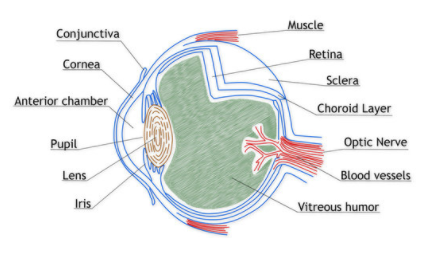
Let us know a little bit about the structure of the eye before we find the correct answer.
The structure of eye can be divided into two parts,
Internal structure - It includes retina, aqueous and vitreous humour and lens
External structure - It includes pupil, cornea, iris, conjunctiva, and sclera
In humans, the pigmentation of the iris varies from light brown to black, depending on the concentration of melanin in the iris pigment epithelium (located on the back of the iris), the melanin content within the iris stroma (located at the front of the iris), and the cellular density of the stroma.
The appearance of blue and green, as well as hazel eyes, results from the Tyndall scattering of light in the stroma, a phenomenon similar to that which accounts for the blueness of the sky called Rayleigh scattering. The retina is a thin layer of tissue that lines the back of the eye on the inside.
It is located near the optic nerve. The purpose of the retina is to receive light that the lens has focused, convert the light into neural signals, and send these signals on to the brain for visual recognition. Inside the retina there is a black pigment called a choroid.
Therefore, from the above explanation the correct option is (A) Choroid.
Note: The choroid, also known as the choroidea or choroid coat, is the vascular layer of the eye, containing connective tissues, and lying between the retina and the sclera. The human choroid is thickest at the far extreme rear of the eye (at 0.2 mm), while in the outlying areas it narrows to 0.1 mm.
Complete answer:
Let us know a little bit about the structure of the eye before we find the correct answer.
The structure of eye can be divided into two parts,
Internal structure - It includes retina, aqueous and vitreous humour and lens
External structure - It includes pupil, cornea, iris, conjunctiva, and sclera
In humans, the pigmentation of the iris varies from light brown to black, depending on the concentration of melanin in the iris pigment epithelium (located on the back of the iris), the melanin content within the iris stroma (located at the front of the iris), and the cellular density of the stroma.
The appearance of blue and green, as well as hazel eyes, results from the Tyndall scattering of light in the stroma, a phenomenon similar to that which accounts for the blueness of the sky called Rayleigh scattering. The retina is a thin layer of tissue that lines the back of the eye on the inside.
It is located near the optic nerve. The purpose of the retina is to receive light that the lens has focused, convert the light into neural signals, and send these signals on to the brain for visual recognition. Inside the retina there is a black pigment called a choroid.
Therefore, from the above explanation the correct option is (A) Choroid.
Note: The choroid, also known as the choroidea or choroid coat, is the vascular layer of the eye, containing connective tissues, and lying between the retina and the sclera. The human choroid is thickest at the far extreme rear of the eye (at 0.2 mm), while in the outlying areas it narrows to 0.1 mm.
Recently Updated Pages
Master Class 11 English: Engaging Questions & Answers for Success

Master Class 11 Social Science: Engaging Questions & Answers for Success
Master Class 11 Maths: Engaging Questions & Answers for Success
Master Class 11 Biology: Engaging Questions & Answers for Success
Master Class 11 Physics: Engaging Questions & Answers for Success
Master Class 11 Chemistry: Engaging Questions & Answers for Success
Trending doubts
One Metric ton is equal to kg A 10000 B 1000 C 100 class 11 physics CBSE
What is cell theory Who formulated it class 11 biology CBSE
Phyllotaxy is the arrangement of ALeaflets BLeaves class 11 biology CBSE
Difference Between Prokaryotic Cells and Eukaryotic Cells
The symbiotic association of fungi and algae is called class 11 biology CBSE
Cell theory was formulated by A Schleiden and Schwann class 11 biology CBSE