




Bird S is flying at \[5{\rm{ }}{{\rm{m}} {\left/
{\vphantom {{\rm{m}} {\rm{s}}}} \right.
} {\rm{s}}}\] towards south, and bird T is flying at \[5\sqrt 2 {\rm{ }}{{\rm{m}} {\left/
{\vphantom {{\rm{m}} {\rm{s}}}} \right.
} {\rm{s}}}\] towards the south-east. Then, velocity of bird S relative to bird T is:
A. \[10\sqrt 2 {\rm{ }}{{\rm{m}} {\left/
{\vphantom {{\rm{m}} {\rm{s}}}} \right.
} {\rm{s}}}\] South-West
B. \[5{\rm{ }}{{\rm{m}} {\left/
{\vphantom {{\rm{m}} {\rm{s}}}} \right.
} {\rm{s}}}\] West
C. \[10\sqrt 2 {\rm{ }}{{\rm{m}} {\left/
{\vphantom {{\rm{m}} {\rm{s}}}} \right.
} {\rm{s}}}\] North-West
D. \[5{\rm{ }}{{\rm{m}} {\left/
{\vphantom {{\rm{m}} {\rm{s}}}} \right.
} {\rm{s}}}\] East
Answer
 Verified
586.2k+ views
Hint:The relative velocity of bird S relative to bird T is equal to the difference of their absolute velocities. We will draw the directions of bird S and bird T graphically, and we will find that the bird S is moving at an angle of \[45^\circ \] with east and south.
Complete step by step answer:
Let us first draw all the possible directions.
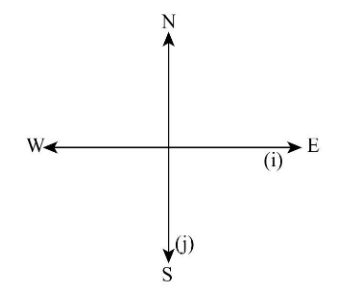
Here S represents the south, W represents the west, E represents east, and N represents north direction.
It is given that bird S is flying with \[5{\rm{ }}{{\rm{m}} {\left/
{\vphantom {{\rm{m}} {\rm{s}}}} \right.
} {\rm{s}}}\] towards the south, and bird T is flying with \[5\sqrt 2 {\rm{ }}{{\rm{m}} {\left/
{\vphantom {{\rm{m}} {\rm{s}}}} \right.
} {\rm{s}}}\] towards the south-east so we can represent it graphically, as shown below.
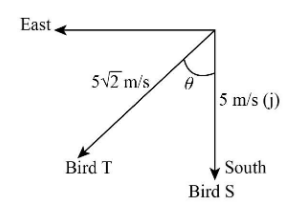
Let us consider positive j as north, negative j as south, positive i as east and negative i as west.
In vector form, we can write the velocity of the bird S as:
\[{V_s} = - 5\hat j\]
The velocity of bird T in vector form can be expressed as:
\[{V_T} = 5\sqrt 2 \sin \theta \hat i + 5\sqrt 2 \cos \theta \hat j\]
The direction of bird T is south-west, so we can substitute \[45^\circ \] for \[\theta \] in the above expression.
\[{V_T} = 5\sqrt 2 \sin 45^\circ \hat i + 5\sqrt 2 \cos 45^\circ \hat j\]
Taking direction into consideration, we can write:
\[{V_T} = - 5\hat i - 5\hat j\]
Let us write the expression for the relative velocity of bird S with respect to bird T.
\[{V_{ST}} = {V_S} - {V_T}\]
On substituting \[ - 5\hat j\] for \[{V_S}\] and \[ - 5\hat i - 5\hat j\] for \[{V_T}\] in the above expression, we get:
\[\begin{array}{l}
{V_{ST}} = - 5\hat j - \left( { - 5\hat i - 5\hat j} \right)\\
= 5\hat i
\end{array}\]
We know that the positive i represents the east direction.
Therefore, bird S's relation velocity with respect to bird T is \[5{\rm{ }}{{\rm{m}} {\left/
{\vphantom {{\rm{m}} {\rm{s}}}} \right.
} {\rm{s}}}\] east, and option (B) is correct.
Note:Do not forget to consider the sign conventions while writing the velocity in vector form. Although we can decide the positive or negative direction as per our convenience, it is better to consider the downward direction as negative and upward as positive.
Complete step by step answer:
Let us first draw all the possible directions.
Here S represents the south, W represents the west, E represents east, and N represents north direction.
It is given that bird S is flying with \[5{\rm{ }}{{\rm{m}} {\left/
{\vphantom {{\rm{m}} {\rm{s}}}} \right.
} {\rm{s}}}\] towards the south, and bird T is flying with \[5\sqrt 2 {\rm{ }}{{\rm{m}} {\left/
{\vphantom {{\rm{m}} {\rm{s}}}} \right.
} {\rm{s}}}\] towards the south-east so we can represent it graphically, as shown below.
Let us consider positive j as north, negative j as south, positive i as east and negative i as west.
In vector form, we can write the velocity of the bird S as:
\[{V_s} = - 5\hat j\]
The velocity of bird T in vector form can be expressed as:
\[{V_T} = 5\sqrt 2 \sin \theta \hat i + 5\sqrt 2 \cos \theta \hat j\]
The direction of bird T is south-west, so we can substitute \[45^\circ \] for \[\theta \] in the above expression.
\[{V_T} = 5\sqrt 2 \sin 45^\circ \hat i + 5\sqrt 2 \cos 45^\circ \hat j\]
Taking direction into consideration, we can write:
\[{V_T} = - 5\hat i - 5\hat j\]
Let us write the expression for the relative velocity of bird S with respect to bird T.
\[{V_{ST}} = {V_S} - {V_T}\]
On substituting \[ - 5\hat j\] for \[{V_S}\] and \[ - 5\hat i - 5\hat j\] for \[{V_T}\] in the above expression, we get:
\[\begin{array}{l}
{V_{ST}} = - 5\hat j - \left( { - 5\hat i - 5\hat j} \right)\\
= 5\hat i
\end{array}\]
We know that the positive i represents the east direction.
Therefore, bird S's relation velocity with respect to bird T is \[5{\rm{ }}{{\rm{m}} {\left/
{\vphantom {{\rm{m}} {\rm{s}}}} \right.
} {\rm{s}}}\] east, and option (B) is correct.
Note:Do not forget to consider the sign conventions while writing the velocity in vector form. Although we can decide the positive or negative direction as per our convenience, it is better to consider the downward direction as negative and upward as positive.
Recently Updated Pages
Master Class 11 Business Studies: Engaging Questions & Answers for Success

Master Class 11 Computer Science: Engaging Questions & Answers for Success
Master Class 11 Economics: Engaging Questions & Answers for Success
Master Class 11 Social Science: Engaging Questions & Answers for Success
Master Class 11 English: Engaging Questions & Answers for Success
Master Class 11 Chemistry: Engaging Questions & Answers for Success
Trending doubts
Draw a diagram of nephron and explain its structur class 11 biology CBSE
Explain zero factorial class 11 maths CBSE
Chemical formula of Bleaching powder is A Ca2OCl2 B class 11 chemistry CBSE
Name the part of the brain responsible for the precision class 11 biology CBSE
The growth of tendril in pea plants is due to AEffect class 11 biology CBSE
One Metric ton is equal to kg A 10000 B 1000 C 100 class 11 physics CBSE