




Benzonitrile on reaction with ${C_2}{H_5}MgBr$, followed by hydrolysis, gives:
A.
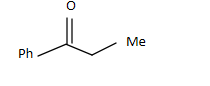
B.
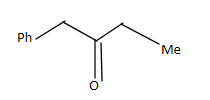
C.
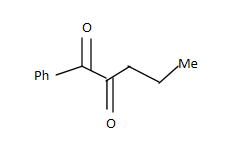
D.
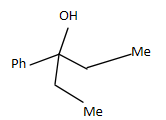
Answer
 Verified
648.6k+ views
Hint:${C_2}{H_5}MgBr$ is known as Grignard reagent , so think about the reactions between Grignard reagent and aliphatic or aromatic nitriles. Addition of Grignard reagent to nitriles gives ketones after hydrolysis.
Complete step by step answer:
The reaction of Grignard reagents with nitriles is,
$R - C \equiv N\xrightarrow[{{H_3}{O^ + }}]{{R' - MgX}}R - CO - R'$
So the reaction between benzonitrile and ${C_2}{H_5}MgBr$ gives,
$Ph - C \equiv N + {C_2}{H_5}MgBr\xrightarrow{{{H_3}{O^ + }}}Ph - CO - C{H_2} - C{H_3}$
So the answer is A.
Additional Information:- The Grignard reaction is an organometallic chemical reaction in which alkyl, allyl, vinyl or aryl–magnesium halides add to a carbonyl group in an aldehyde or ketone. This reaction is important for the formation of carbon-carbon bonds. Grignard compounds are popular reagents in organic synthesis for creating new carbon-carbon bonds. Pure Grignard reagents are extremely reactive solids. They are normally handled as solutions in solvents such as diethyl ether or tetrahydrofuran, which are relatively stable as long as water is excluded. Grignard reagents are prepared by treating an organic halide with magnesium metal. Cyclic or acyclic ethers are required to stabilize the organomagnesium compound. The reaction to form Grignard reagents involves the use of magnesium ribbon. All magnesium is coated with a passivating layer of magnesium oxide, which inhibits reactions with the organic halide. Grignard reagents are more sensitive to moisture and oxygen. Grignard reagents are nucleophiles in nucleophilic aliphatic substitutions. Grignard reagents serve as a base for protic substances.
Note:
Grignard reagents are basic and react with alcohols, phenols to give alkoxides. In the reaction between aromatic nitriles and Grignard reagent at first the imine salt is formed and then the produced imine salt reacts with water to give ketone.
Complete step by step answer:
The reaction of Grignard reagents with nitriles is,
$R - C \equiv N\xrightarrow[{{H_3}{O^ + }}]{{R' - MgX}}R - CO - R'$
So the reaction between benzonitrile and ${C_2}{H_5}MgBr$ gives,
$Ph - C \equiv N + {C_2}{H_5}MgBr\xrightarrow{{{H_3}{O^ + }}}Ph - CO - C{H_2} - C{H_3}$
So the answer is A.
Additional Information:- The Grignard reaction is an organometallic chemical reaction in which alkyl, allyl, vinyl or aryl–magnesium halides add to a carbonyl group in an aldehyde or ketone. This reaction is important for the formation of carbon-carbon bonds. Grignard compounds are popular reagents in organic synthesis for creating new carbon-carbon bonds. Pure Grignard reagents are extremely reactive solids. They are normally handled as solutions in solvents such as diethyl ether or tetrahydrofuran, which are relatively stable as long as water is excluded. Grignard reagents are prepared by treating an organic halide with magnesium metal. Cyclic or acyclic ethers are required to stabilize the organomagnesium compound. The reaction to form Grignard reagents involves the use of magnesium ribbon. All magnesium is coated with a passivating layer of magnesium oxide, which inhibits reactions with the organic halide. Grignard reagents are more sensitive to moisture and oxygen. Grignard reagents are nucleophiles in nucleophilic aliphatic substitutions. Grignard reagents serve as a base for protic substances.
Note:
Grignard reagents are basic and react with alcohols, phenols to give alkoxides. In the reaction between aromatic nitriles and Grignard reagent at first the imine salt is formed and then the produced imine salt reacts with water to give ketone.
Recently Updated Pages
Explain the structure of megasporangium class 12 biology CBSE

Why is chloroform kept in dark coloured bottles class 12 chemistry CBSE
Derive the balancing condition of a Wheatstone bri class 12 physics CBSE
Draw VI characteristics of a pn junction diode Explain class 12 physics CBSE
Is it possible to carry pride in ones language too class 12 english CBSE
In a population at Hardy Weinberg equilibrium the allele class 12 biology CBSE
Trending doubts
Which is the correct genotypic ratio of mendel dihybrid class 12 biology CBSE
Differentiate between homogeneous and heterogeneous class 12 chemistry CBSE
Which animal never drinks water in its entire life class 12 biology CBSE
What is the Full Form of 1.DPT 2.DDT 3.BCG
The first microscope was invented by A Leeuwenhoek class 12 biology CBSE
How many structural isomers of C5H10O are there class 12 chemistry CBSE