




Benzene diazonium chloride on reaction with phenol in a basic medium gives:
A) diphenyl ether
B) p-Hydroxy azobenzene
C) chlorobenzene
D) benzene
Answer
 Verified
653.1k+ views
Hint: When the concentration of OH- ion in solution is more, it is basic in nature. We call such a solution a basic medium.
Complete step by step answer:
Benzene diazonium chloride in reaction with phenol in a basic medium gives p-Hydroxy azobenzene.
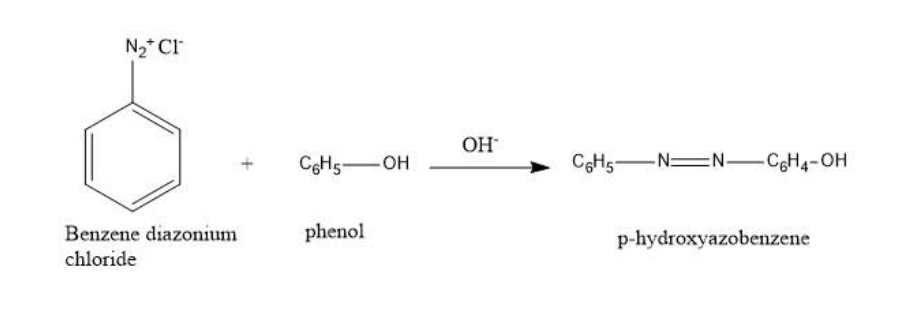
So, out of the given options, B is the correct option, that is, p-Hydroxy azobenzene.
Additional information:
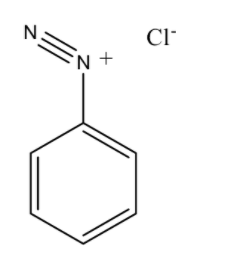
The structure of Benzene diazonium chloride is
And the structure of p-Hydroxy azobenzene is,
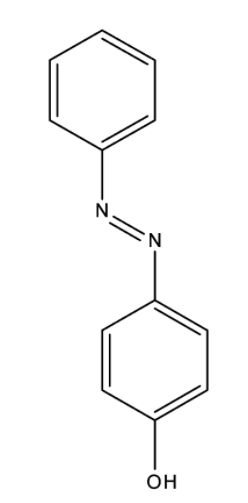
Benzene diazonium chloride has the chemical formula ${{\rm{C}}_{\rm{6}}}{{\rm{H}}_{\rm{5}}}{\rm{Cl}}{{\rm{N}}_{\rm{2}}}$. Benzene diazonium chloride is a salt of a chloride and diazonium cation. Benzene diazonium chloride exists as a colourless solid and it is soluble in polar solvents such as in water. It acts as the parent member of the aryl diazonium compounds. This compound is widely used in organic chemistry. As this salt is unstable, it is not available commercially but is prepared according to the demand. p-hydroxyazobenzene has chemical formula ${\rm{C}}{{\rm{l}}_{\rm{2}}}{{\rm{H}}_{{\rm{10}}}}{{\rm{N}}_{{\rm{20}}}}$ and has the atomic number 198.221. It has a density of $1.13{\rm{g/c}}{{\rm{m}}^{\rm{3}}}$, and has a boiling point of ${369.812^o}C$ and has a refractive index of 1.596.
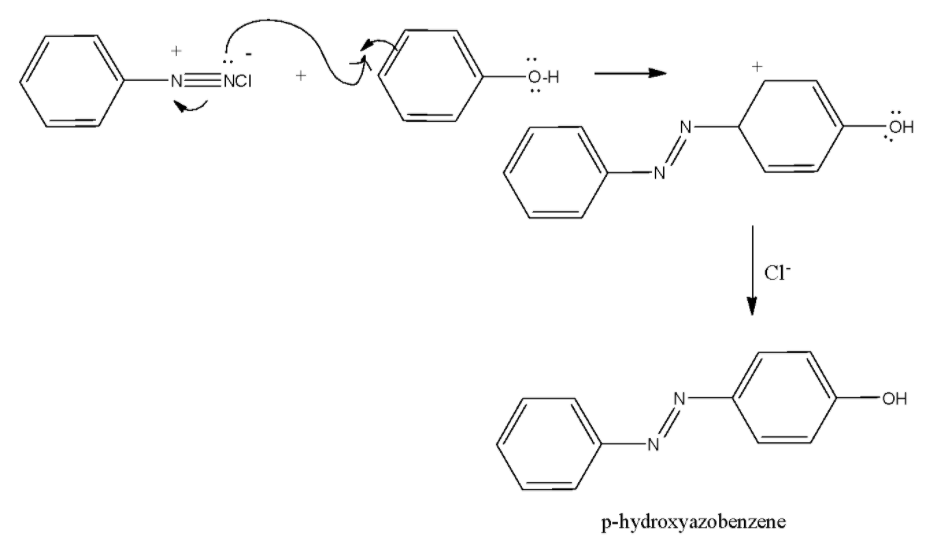
The mechanism for the reaction of benzene diazonium chloride on reaction with phenol can be given as follows:
Note:
Benzene diazonium chloride has the chemical formula ${{\rm{C}}_{\rm{6}}}{{\rm{H}}_{\rm{5}}}{\rm{Cl}}{{\rm{N}}_{\rm{2}}}$. This compound is soluble in polar solvent and it exists as a colourless solid.
Complete step by step answer:
Benzene diazonium chloride in reaction with phenol in a basic medium gives p-Hydroxy azobenzene.
So, out of the given options, B is the correct option, that is, p-Hydroxy azobenzene.
Additional information:
The structure of Benzene diazonium chloride is
And the structure of p-Hydroxy azobenzene is,
Benzene diazonium chloride has the chemical formula ${{\rm{C}}_{\rm{6}}}{{\rm{H}}_{\rm{5}}}{\rm{Cl}}{{\rm{N}}_{\rm{2}}}$. Benzene diazonium chloride is a salt of a chloride and diazonium cation. Benzene diazonium chloride exists as a colourless solid and it is soluble in polar solvents such as in water. It acts as the parent member of the aryl diazonium compounds. This compound is widely used in organic chemistry. As this salt is unstable, it is not available commercially but is prepared according to the demand. p-hydroxyazobenzene has chemical formula ${\rm{C}}{{\rm{l}}_{\rm{2}}}{{\rm{H}}_{{\rm{10}}}}{{\rm{N}}_{{\rm{20}}}}$ and has the atomic number 198.221. It has a density of $1.13{\rm{g/c}}{{\rm{m}}^{\rm{3}}}$, and has a boiling point of ${369.812^o}C$ and has a refractive index of 1.596.
The mechanism for the reaction of benzene diazonium chloride on reaction with phenol can be given as follows:
Note:
Benzene diazonium chloride has the chemical formula ${{\rm{C}}_{\rm{6}}}{{\rm{H}}_{\rm{5}}}{\rm{Cl}}{{\rm{N}}_{\rm{2}}}$. This compound is soluble in polar solvent and it exists as a colourless solid.
Recently Updated Pages
Master Class 11 Social Science: Engaging Questions & Answers for Success

Master Class 11 English: Engaging Questions & Answers for Success
Master Class 11 Accountancy: Engaging Questions & Answers for Success
Master Class 11 Physics: Engaging Questions & Answers for Success
Master Class 11 Computer Science: Engaging Questions & Answers for Success
Master Class 11 Business Studies: Engaging Questions & Answers for Success
Trending doubts
Find the value of the expression given below sin 30circ class 11 maths CBSE
Draw a diagram of nephron and explain its structur class 11 biology CBSE
Proton was discovered by A Thomson B Rutherford C Chadwick class 11 chemistry CBSE
The teeth used for biting and cutting food are called class 11 biology CBSE
Frogs heart when taken out of the body continues to class 11 biology CBSE
10 examples of diffusion in everyday life