




What was the basic principle of Lamarckism?
(a) Inheritance of acquired characters
(b) Natural Selection
(c) Survival of the fittest
(d) Variations
Answer
 Verified
634.2k+ views
Hint: It is named after the French biologist Jean-Baptiste Lamarck and is cited against the theories of Darwinism. The principle of Lamarckism is that organisms pass down their traits to the next generation.
Complete answer:
Lamarckism is the theory that an organism can pass on its physical characteristics to its offspring that it acquired through use or disuse in its lifetime. This idea is also known as the inheritance of acquired characteristics or soft inheritance.
The most prevalent example for the theory of Lamarckism is the explanation behind the long necks of Giraffes. This is explained that as stratification began and grasses were replaced with taller trees, over generations giraffes shifted from grasses to tree leaves. This shift was facilitated by gradual lengthening of their neck to reach to the higher branches of the tree as compared to the grass or shrubs which were lower on the ground.
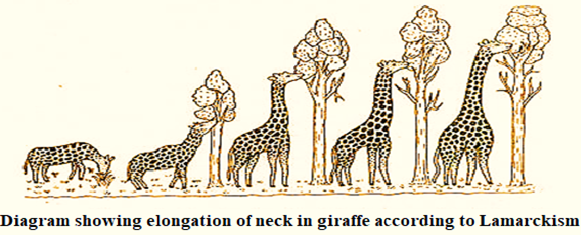
So, the answer is, “Inheritance of acquired characters”.
Additional Information:
It is named after the French biologist Jean-Baptiste Lamarck which is inaccurate, as he did not give this theory but used it as a supplement to his concept of orthogenesis, a drive towards complexity. Lamarckism is cited in textbooks to contrast with Darwinism.
Note: Lamarckism was a classical concept and not a contrasting theory to Darwinism. Even Darwin’s own concept of pangenesis implied soft inheritance. He accepted the use and disuse theory while rejecting the other aspects of Lamarckism. There were also many re-iterations which are collectively called “Neo-Lamarckism”.
Complete answer:
Lamarckism is the theory that an organism can pass on its physical characteristics to its offspring that it acquired through use or disuse in its lifetime. This idea is also known as the inheritance of acquired characteristics or soft inheritance.
The most prevalent example for the theory of Lamarckism is the explanation behind the long necks of Giraffes. This is explained that as stratification began and grasses were replaced with taller trees, over generations giraffes shifted from grasses to tree leaves. This shift was facilitated by gradual lengthening of their neck to reach to the higher branches of the tree as compared to the grass or shrubs which were lower on the ground.
So, the answer is, “Inheritance of acquired characters”.
Additional Information:
It is named after the French biologist Jean-Baptiste Lamarck which is inaccurate, as he did not give this theory but used it as a supplement to his concept of orthogenesis, a drive towards complexity. Lamarckism is cited in textbooks to contrast with Darwinism.
Note: Lamarckism was a classical concept and not a contrasting theory to Darwinism. Even Darwin’s own concept of pangenesis implied soft inheritance. He accepted the use and disuse theory while rejecting the other aspects of Lamarckism. There were also many re-iterations which are collectively called “Neo-Lamarckism”.
Recently Updated Pages
The given figure shows two endocrine glands marked class 11 biology NEET_UG

Match columnI with columnII and select the correct class 11 biology NEET
Match column I with column II and select the correct class 11 biology NEET_UG
Which floral family has left 9 right + 1 arrangement class 11 biology NEET_UG
Which is not a variety of sheep A Lohi B Beetal C Nellore class 11 biology NEET_UG
Match column I with column II and select the correct class 11 biology NEET_UG
Trending doubts
One Metric ton is equal to kg A 10000 B 1000 C 100 class 11 physics CBSE
What is cell theory Who formulated it class 11 biology CBSE
Phyllotaxy is the arrangement of ALeaflets BLeaves class 11 biology CBSE
Difference Between Prokaryotic Cells and Eukaryotic Cells
The symbiotic association of fungi and algae is called class 11 biology CBSE
Cell theory was formulated by A Schleiden and Schwann class 11 biology CBSE