



Based on Saytzeff's rule, select the most stable alkene: 1-methylcyclohexene, 3-methylcyclohexene or 4-methylcyclohexene?
Answer
 Verified
553.5k+ views
Hint: Saytzeff’s Rule is also known as the Zaitsev’s Rule. It was discovered by Alexander Zaitsev, who analyzed different elimination reactions and finalized a general pattern in the resulting alkenes. According to him, an alkene is generated by the removal of hydrogen from the $\beta $ carbon that has less number of hydrogen.
Complete answer:
Saytzeff’s Rule comes into play during the elimination reaction. According to this rule the more substituted product will be most stable and will be the major product. Some alkyl halide’s elimination reaction and alcohol will result in different alkenes and saytzeff’s rule is important to know the major product. If more than one product is possible in the reaction, the more substituted alkene will form the major product and will be stable.
The order of reactivity for elimination according to this rule can be given as:
$C{H_2} = CHR < RCH = CHR < {R_2}C = CHR < {R_2}C = C{R_2}$
The compounds given to us are: 1-methylcyclohexene, 3-methylcyclohexene and 4-methylcyclohexene. The structures can be given as:
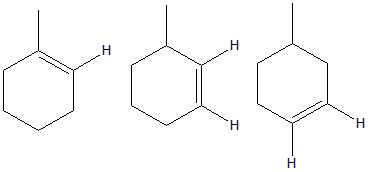
Structure 1 is 1-methylcyclohexene. It has three substituents methyl and two carbons C-3 and C-6. Structure 2 is 3-methylcyclohexene. It has two substituents C-1 and C-4. Next is structure 3 which is also substituted with C-2 and C-5.
As per the rule the more substituted product will be the major product. Out of the three structures 1 is the most substituted. Hence our answer is 1-methylcyclohexene.
Note:
This rule suggests the regioselectivity of the olefin that is formed after the elimination reaction of ${2^ \circ }$ or ${3^ \circ }$ alkyl halides. During the elimination reaction the hydrogen is abstracted from the carbon having less number of substituents. The product thus formed is known as the Saytzeff’s product.
Complete answer:
Saytzeff’s Rule comes into play during the elimination reaction. According to this rule the more substituted product will be most stable and will be the major product. Some alkyl halide’s elimination reaction and alcohol will result in different alkenes and saytzeff’s rule is important to know the major product. If more than one product is possible in the reaction, the more substituted alkene will form the major product and will be stable.
The order of reactivity for elimination according to this rule can be given as:
$C{H_2} = CHR < RCH = CHR < {R_2}C = CHR < {R_2}C = C{R_2}$
The compounds given to us are: 1-methylcyclohexene, 3-methylcyclohexene and 4-methylcyclohexene. The structures can be given as:
Structure 1 is 1-methylcyclohexene. It has three substituents methyl and two carbons C-3 and C-6. Structure 2 is 3-methylcyclohexene. It has two substituents C-1 and C-4. Next is structure 3 which is also substituted with C-2 and C-5.
As per the rule the more substituted product will be the major product. Out of the three structures 1 is the most substituted. Hence our answer is 1-methylcyclohexene.
Note:
This rule suggests the regioselectivity of the olefin that is formed after the elimination reaction of ${2^ \circ }$ or ${3^ \circ }$ alkyl halides. During the elimination reaction the hydrogen is abstracted from the carbon having less number of substituents. The product thus formed is known as the Saytzeff’s product.
Recently Updated Pages
Which will be the least stable resonating structure class 11 chemistry CBSE

How many 5 digit telephone numbers can be construc-class-11-maths-CBSE
How do you find the angle of the resultant vector class 11 physics CBSE
Draw labelled diagram of the following i Gram seed class 11 biology CBSE
What is the need and importance of classification class 11 biology CBSE
The way in which the sparrows expressed their sorrow class 11 english CBSE
Trending doubts
One Metric ton is equal to kg A 10000 B 1000 C 100 class 11 physics CBSE
Find the value of the expression given below sin 30circ class 11 maths CBSE
1 Quintal is equal to a 110 kg b 10 kg c 100kg d 1000 class 11 physics CBSE
Draw a diagram of nephron and explain its structur class 11 biology CBSE
10 examples of friction in our daily life
Proton was discovered by A Thomson B Rutherford C Chadwick class 11 chemistry CBSE