




Banking of roads is provided at turns to:
A. Reduce inertia
B. Increase centripetal force
C. Increase fiction
D. None of these
Answer
 Verified
649.2k+ views
Hint: Banking of roads is done at curves i.e. when roads come across circular paths. Now two forces act on a body when it undergoes a circular motion, namely centripetal and centrifugal forces. The centrifugal force acts outward from the center while centripetal force is directed inwards ensuring that the body stays in the curved path.
Complete step by step answer:
When vehicles go through a turn they travel about a nearly circular arc. Thus there must be some force that produced the required acceleration. If the vehicle goes in a horizontal circular path, this resultant force is also horizontal.
Consider a situation as shown below, a vehicle of mass M is moving at a speed v making a turn on the circular path of radius r. So the external forces acting on the vehicle are
Weight of the vehicle, Mg
Normal force, N
Friction, ${f_s}$
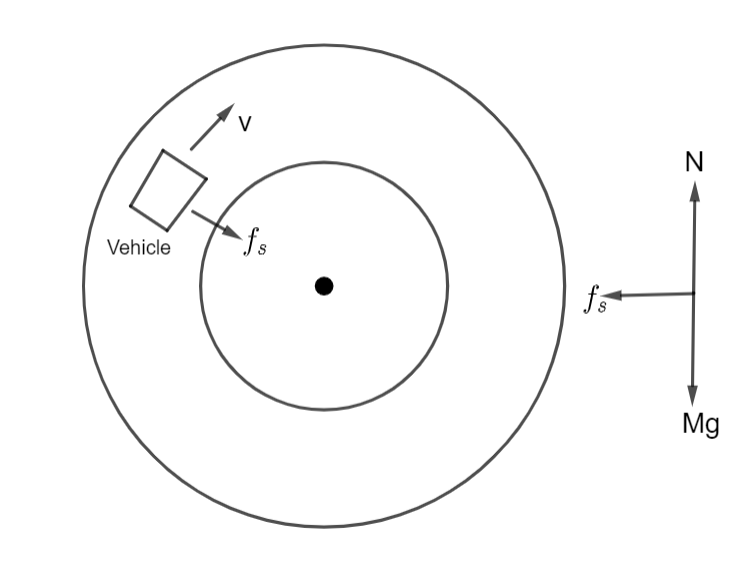
If the road is horizontal, the normal force N is vertically upwards. The only horizontal force that can act towards the center is the friction ${f_s}$. This is static friction and self adjustable. The tyres of the vehicle get a tendency to skip outwards and the frictional force which opposes this skipping acts towards the center. Thus for a safe turn we must have:
$\eqalign{
& \dfrac{{{v^2}}}{r} = \dfrac{{{f_s}}}{M} \cr
& {\text{or }}{f_s} = \dfrac{{M{v^2}}}{r} \cr} $
However, there is a limit to the magnitude of the frictional force. Thus friction is not always reliable if high speed and sharp turns are involved. So to avoid dependence on the friction, the roads are banked at a turn so that the outer part of the road is somewhat lifted up in comparison to the inner part. In return this changes the angle for the normal reaction force N, creating a component of this force along the radius of the road and towards the center. This additional force provides the sufficient centripetal force to overcome skidding of the vehicle.
Therefore, the correct option is B. i.e., increase centripetal force.
Note: If ${\mu _s}$ is the coefficient of static friction between the tyres and the road, the magnitude of friction ${f_s}$ cannot exceed ${\mu _s}N$. For vertical equilibrium N=Mg, so ${f_s} \leqslant {\mu _s}Mg$.
Complete step by step answer:
When vehicles go through a turn they travel about a nearly circular arc. Thus there must be some force that produced the required acceleration. If the vehicle goes in a horizontal circular path, this resultant force is also horizontal.
Consider a situation as shown below, a vehicle of mass M is moving at a speed v making a turn on the circular path of radius r. So the external forces acting on the vehicle are
Weight of the vehicle, Mg
Normal force, N
Friction, ${f_s}$
If the road is horizontal, the normal force N is vertically upwards. The only horizontal force that can act towards the center is the friction ${f_s}$. This is static friction and self adjustable. The tyres of the vehicle get a tendency to skip outwards and the frictional force which opposes this skipping acts towards the center. Thus for a safe turn we must have:
$\eqalign{
& \dfrac{{{v^2}}}{r} = \dfrac{{{f_s}}}{M} \cr
& {\text{or }}{f_s} = \dfrac{{M{v^2}}}{r} \cr} $
However, there is a limit to the magnitude of the frictional force. Thus friction is not always reliable if high speed and sharp turns are involved. So to avoid dependence on the friction, the roads are banked at a turn so that the outer part of the road is somewhat lifted up in comparison to the inner part. In return this changes the angle for the normal reaction force N, creating a component of this force along the radius of the road and towards the center. This additional force provides the sufficient centripetal force to overcome skidding of the vehicle.
Therefore, the correct option is B. i.e., increase centripetal force.
Note: If ${\mu _s}$ is the coefficient of static friction between the tyres and the road, the magnitude of friction ${f_s}$ cannot exceed ${\mu _s}N$. For vertical equilibrium N=Mg, so ${f_s} \leqslant {\mu _s}Mg$.
Recently Updated Pages
Basicity of sulphurous acid and sulphuric acid are

Master Class 11 English: Engaging Questions & Answers for Success
Master Class 11 Physics: Engaging Questions & Answers for Success
Master Class 11 Computer Science: Engaging Questions & Answers for Success
Master Class 11 Chemistry: Engaging Questions & Answers for Success
Master Class 11 Social Science: Engaging Questions & Answers for Success
Trending doubts
Difference Between Prokaryotic Cells and Eukaryotic Cells
Two of the body parts which do not appear in MRI are class 11 biology CBSE
One Metric ton is equal to kg A 10000 B 1000 C 100 class 11 physics CBSE
10 examples of friction in our daily life
Draw a diagram of nephron and explain its structur class 11 biology CBSE
What will happen if the mucus is not secreted by the class 11 biology CBSE