




Bacterium associated with legume roots is
A. Rhizobium
B. Nostoc
C. Spirogyra
D. Clostridium
Answer
 Verified
616.5k+ views
Hint: The organism which is associated with leguminous plants is a bacterium that is gram-negative bacteria.
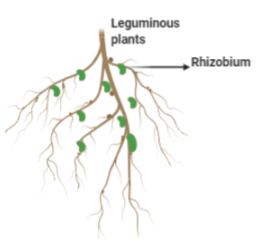
Step by step answer:In option A, Rhizobium is mentioned. Rhizobium is a genus of bacteria. These bacteria live in symbiosis with legumes. They are present in the soil. They attach themselves to the roots of the leguminous plant and form nodules.
In option B, Nostoc is mentioned. It belongs to a genus of cyanobacteria/blue-green algae. It contains two pigments that are blue phycocyanin and red phycoerythrin. Also, they contain chlorophyll. They have the ability to fix the nitrogen in specialized cells called heterocysts. It has been researched that Nostoc is used in secondary metabolite reproduction which is considered harmful for human beings.
In option C, Spirogyra is mentioned. It is also known as water silk. It is an alga. It has a spherical arrangement of chloroplasts which makes it renowned.
In option D, Clostridium is mentioned. It is a genus of bacteria. They are gram-positive. The members of this genus are human pathogens. They are the causative agents for diseases like tetanus and botulism.
So, the correct option is option A
Note: The symbiotic relationship between Rhizobium and the plants. A symbiotic relationship between two species or organisms is a type of interdependent relation. Both of the organisms involved rely on each other for something valuable. The Rhizobium forms nodules. These nodules fix atmospheric nitrogen for plants in those nodules and convert them into ammonia which can be used by the plant for its growth and development. They, in return, get nutrition for their survival.
Step by step answer:In option A, Rhizobium is mentioned. Rhizobium is a genus of bacteria. These bacteria live in symbiosis with legumes. They are present in the soil. They attach themselves to the roots of the leguminous plant and form nodules.
In option B, Nostoc is mentioned. It belongs to a genus of cyanobacteria/blue-green algae. It contains two pigments that are blue phycocyanin and red phycoerythrin. Also, they contain chlorophyll. They have the ability to fix the nitrogen in specialized cells called heterocysts. It has been researched that Nostoc is used in secondary metabolite reproduction which is considered harmful for human beings.
In option C, Spirogyra is mentioned. It is also known as water silk. It is an alga. It has a spherical arrangement of chloroplasts which makes it renowned.
In option D, Clostridium is mentioned. It is a genus of bacteria. They are gram-positive. The members of this genus are human pathogens. They are the causative agents for diseases like tetanus and botulism.
So, the correct option is option A
Note: The symbiotic relationship between Rhizobium and the plants. A symbiotic relationship between two species or organisms is a type of interdependent relation. Both of the organisms involved rely on each other for something valuable. The Rhizobium forms nodules. These nodules fix atmospheric nitrogen for plants in those nodules and convert them into ammonia which can be used by the plant for its growth and development. They, in return, get nutrition for their survival.
Recently Updated Pages
Master Class 12 Economics: Engaging Questions & Answers for Success

Master Class 12 English: Engaging Questions & Answers for Success
Master Class 12 Social Science: Engaging Questions & Answers for Success
Master Class 12 Maths: Engaging Questions & Answers for Success
Master Class 12 Physics: Engaging Questions & Answers for Success
Master Class 9 General Knowledge: Engaging Questions & Answers for Success
Trending doubts
One Metric ton is equal to kg A 10000 B 1000 C 100 class 11 physics CBSE
Difference Between Prokaryotic Cells and Eukaryotic Cells
Two of the body parts which do not appear in MRI are class 11 biology CBSE
Find the value of the expression given below sin 30circ class 11 maths CBSE
1 ton equals to A 100 kg B 1000 kg C 10 kg D 10000 class 11 physics CBSE
Draw a diagram of nephron and explain its structur class 11 biology CBSE