




Axile placentation is found in:
(a) Cassia fistula
(b) Hibiscus rosa-Sinensis
(c) Helianthus annuus
(d) Dalbergia sissoo
Answer
 Verified
629.4k+ views
Hint: The arrangement of tissues in the ovary in which the placenta is axial with the ovules attached to it is called Axile placentation. It is very common in plants of the family Malvaceae.
Complete step by step answer:
The arrangement of ovules inside the ovary is called placentation. There are various types of placentation out of which axle is also one. It is very common in plants of the family Malvaceae. In this type, the ovules are arranged as-
This is seen in Hibiscus rosa-sin:ensis or which we simply call as Hibiscus flower.
Other types of placentation are:
Marginal placentation: Ovules are arranged in such a way that the placenta forms a ridge-like structure and ovules are formed on these ridges in rows. It is found in Cassia fistula and in Dalbergia sissoo.
Parietal placentation: Ovules are arranged on the inner or peripheral walls of the ovary. There is the formation of a pseudo septum which makes it look two-chambered but originally the ovary is single-chambered.
Basal placentation: The placenta develops at the base of the ovary and a single ovule is attached to it. It is found in Helianthus annuus.
Free central placentation: Ovules develop on the central axis and the septum is not present. It is found in Dianthus.
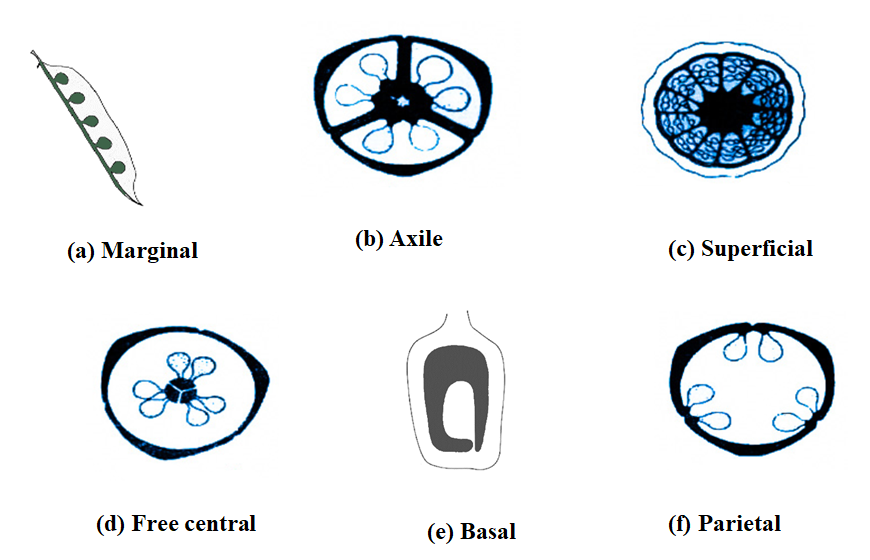
So, the correct answer is ‘(b) Hibiscus rosa-Sinensis’.
Note: The type of placentation i.e. arrangement of ovules has a significant influence on the shape and morphology of a fruit which forms as a result of fertilization. By knowing the type of placentation, the morphology of the fruit can be predicted.
Complete step by step answer:
The arrangement of ovules inside the ovary is called placentation. There are various types of placentation out of which axle is also one. It is very common in plants of the family Malvaceae. In this type, the ovules are arranged as-
This is seen in Hibiscus rosa-sin:ensis or which we simply call as Hibiscus flower.
Other types of placentation are:
Marginal placentation: Ovules are arranged in such a way that the placenta forms a ridge-like structure and ovules are formed on these ridges in rows. It is found in Cassia fistula and in Dalbergia sissoo.
Parietal placentation: Ovules are arranged on the inner or peripheral walls of the ovary. There is the formation of a pseudo septum which makes it look two-chambered but originally the ovary is single-chambered.
Basal placentation: The placenta develops at the base of the ovary and a single ovule is attached to it. It is found in Helianthus annuus.
Free central placentation: Ovules develop on the central axis and the septum is not present. It is found in Dianthus.
So, the correct answer is ‘(b) Hibiscus rosa-Sinensis’.
Note: The type of placentation i.e. arrangement of ovules has a significant influence on the shape and morphology of a fruit which forms as a result of fertilization. By knowing the type of placentation, the morphology of the fruit can be predicted.
Recently Updated Pages
Master Class 9 General Knowledge: Engaging Questions & Answers for Success

Master Class 9 Maths: Engaging Questions & Answers for Success
Master Class 9 Science: Engaging Questions & Answers for Success
Master Class 9 English: Engaging Questions & Answers for Success
Master Class 9 Social Science: Engaging Questions & Answers for Success
Class 9 Question and Answer - Your Ultimate Solutions Guide
Trending doubts
One Metric ton is equal to kg A 10000 B 1000 C 100 class 11 physics CBSE
What is cell theory Who formulated it class 11 biology CBSE
Phyllotaxy is the arrangement of ALeaflets BLeaves class 11 biology CBSE
Difference Between Prokaryotic Cells and Eukaryotic Cells
The symbiotic association of fungi and algae is called class 11 biology CBSE
Cell theory was formulated by A Schleiden and Schwann class 11 biology CBSE