




Average thickness of plasmalemma is
(a) 0.25nm $2.5 { A }^{ \circ }$
(b) 2.5nm $25{ A }^{ \circ }$
(c) 0.75nm $7.5{ A }^{ \circ }$
(d) 7.5nm $75{ A }^{ \circ }$
Answer
 Verified
613.8k+ views
Hint: The thickness of a cell membrane is now stated to be from three to 10 nanometers supported by the advanced technology of today. With the microscope, the cell membrane is seen as a continuing, thin double line with globular proteins embedded throughout.
Complete Step by step answer:
The plasmalemma is also a phospholipid bilayer that are selectively permeable membranes which separate them within the cells (cell organelles and cytoplasm) from the surface environment or the extracellular space.
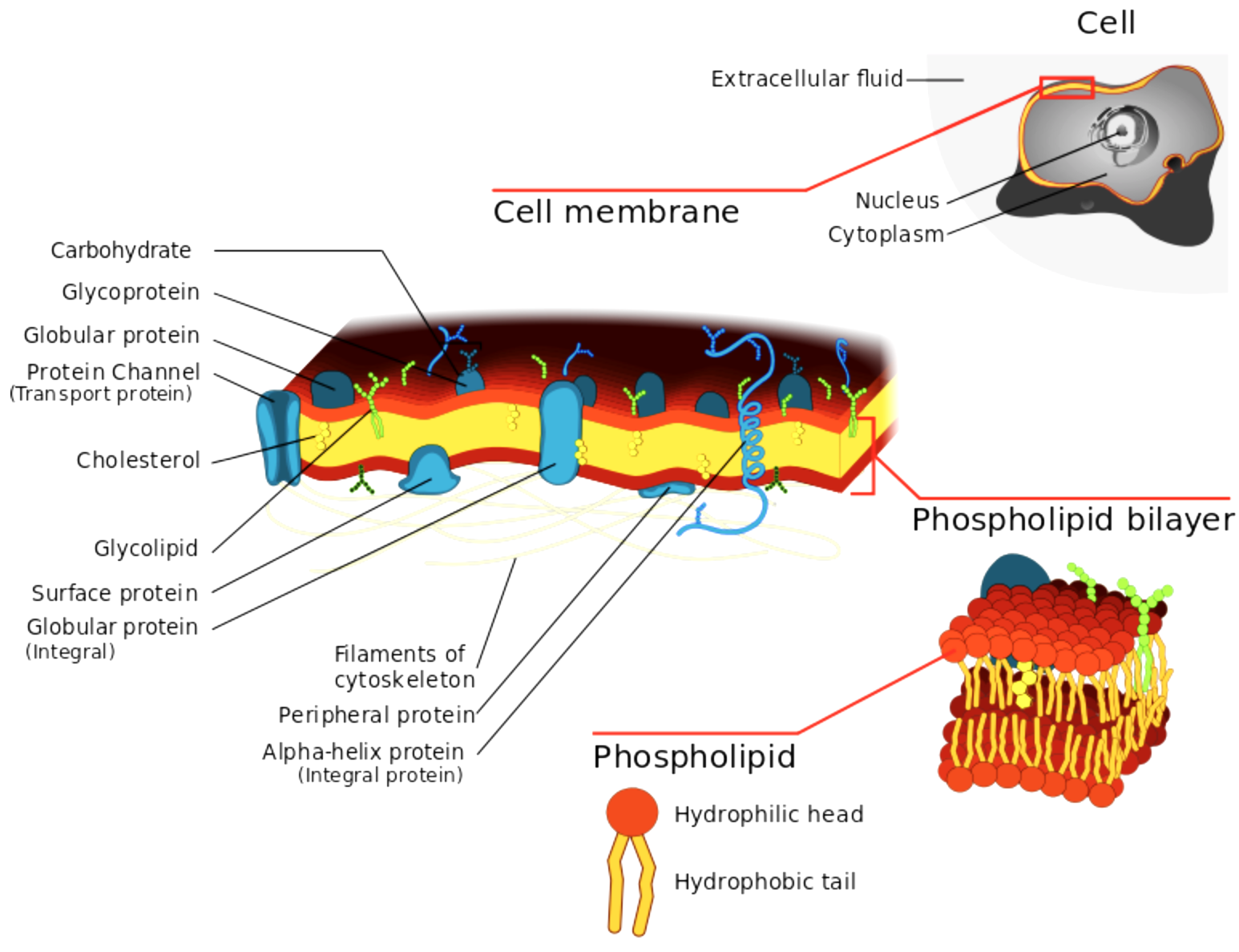
The cell membrane or plasmalemma is about 7.5 nm –10 nm ($75 \ A^\circ$) in thickness with 2 layers of lipid molecules (bilayer) which have different types of proteins.
So, the correct answer is, ‘ 7.5nm $75{ A }^{ \circ }$’.
Additional Information:
The plasma membrane is also known as the cell membrane and it protects the cell. In the plant cells and bacterial cell, there is another layer of rigid protective covering outside the plasma membrane, called the cell wall.
Lipids (phospholipids and cholesterol), proteins, and carbohydrates are the main components of the cell membrane.
To show the arrangement of proteins, carbohydrates, and fats in the plasma membrane, various scientists have suggested different theories. Out of these, the most appreciable one was the Fluid Mosaic model proposed by Singer and Nicolson in 1972.
It contains a lipid bilayer (a globular protein molecule), including cholesterols that sit between phospholipids to maintain their fluidity at various temperatures.
Globular protein is of two types: (a) peripheral extrinsic protein- This is soluble and lies outside the lipid layer. (b) integral protein- This is insoluble and pierces one or both layers of phospholipids.
Note:
- Robert Hooke discovered the cell membrane.
- The most basic role of the plasma membrane is to define the borders of the cell and keep it functional.
- The plasma membrane is selectively permeable, it allows only some substances to pass through, but not others.
Complete Step by step answer:
The plasmalemma is also a phospholipid bilayer that are selectively permeable membranes which separate them within the cells (cell organelles and cytoplasm) from the surface environment or the extracellular space.
The cell membrane or plasmalemma is about 7.5 nm –10 nm ($75 \ A^\circ$) in thickness with 2 layers of lipid molecules (bilayer) which have different types of proteins.
So, the correct answer is, ‘ 7.5nm $75{ A }^{ \circ }$’.
Additional Information:
The plasma membrane is also known as the cell membrane and it protects the cell. In the plant cells and bacterial cell, there is another layer of rigid protective covering outside the plasma membrane, called the cell wall.
Lipids (phospholipids and cholesterol), proteins, and carbohydrates are the main components of the cell membrane.
To show the arrangement of proteins, carbohydrates, and fats in the plasma membrane, various scientists have suggested different theories. Out of these, the most appreciable one was the Fluid Mosaic model proposed by Singer and Nicolson in 1972.
It contains a lipid bilayer (a globular protein molecule), including cholesterols that sit between phospholipids to maintain their fluidity at various temperatures.
Globular protein is of two types: (a) peripheral extrinsic protein- This is soluble and lies outside the lipid layer. (b) integral protein- This is insoluble and pierces one or both layers of phospholipids.
Note:
- Robert Hooke discovered the cell membrane.
- The most basic role of the plasma membrane is to define the borders of the cell and keep it functional.
- The plasma membrane is selectively permeable, it allows only some substances to pass through, but not others.
Recently Updated Pages
Master Class 12 Economics: Engaging Questions & Answers for Success

Master Class 12 English: Engaging Questions & Answers for Success
Master Class 12 Social Science: Engaging Questions & Answers for Success
Master Class 12 Maths: Engaging Questions & Answers for Success
Master Class 12 Physics: Engaging Questions & Answers for Success
Master Class 11 Social Science: Engaging Questions & Answers for Success
Trending doubts
One Metric ton is equal to kg A 10000 B 1000 C 100 class 11 physics CBSE
Difference Between Prokaryotic Cells and Eukaryotic Cells
Find the value of the expression given below sin 30circ class 11 maths CBSE
Two of the body parts which do not appear in MRI are class 11 biology CBSE
1 ton equals to A 100 kg B 1000 kg C 10 kg D 10000 class 11 physics CBSE
Draw a diagram of nephron and explain its structur class 11 biology CBSE