




Authors of Sulva-Sutras knew Pythagoras Theorem much before the birth of Pythagoras, was mentioned in which book?
(a) History of Geometry
(b) History of Trigonometry
(c) History of Mathematics
(d) History of Algebra
Answer
 Verified
632.7k+ views
Hint: The Sulva sutras is not one single book but instead a series of books by various Indian scholars and mathematicians. In 800 BC the mathematician Baudhayana wrote a book where with the help of a rope he explained the relation that the length of the diagonal produces an area which the vertical and horizontal sides make together. This is what we now call as Pythagoras theorem.
Complete step by step solution:
Let us begin with understanding the origin of Sulva sutras. The Sulva Sutras are part of the larger corpus of texts called the Sulva Sutras, considered to be appendices to the Vedas. They are the only sources of knowledge of Indian mathematics from the Vedic period. There are various types of Sulva sutras namely as below,
(i) Apastamba
(ii) Baudhayana
(iii) Manava
(iv) Katyana
(v) Maitrayaniya
(vi) Varaha
(vii) Vadhula
(viii) Hiranyakeshi
There is a reference of the Pythagoras theorem in the Sulva sutra of Baudhayana. It was Baudhayana who discovered the Pythagoras theorem. Baudhayana listed Pythagoras theorem in his book called Baudhayana Śulbasûtra (800 BC). Incidentally, Baudhayana Śulbasûtra is also one of the oldest books on advanced Mathematics. Baudhayana used a rope as an example. A rope stretched along the length of the diagonal produces an area which the vertical and horizontal sides make together.
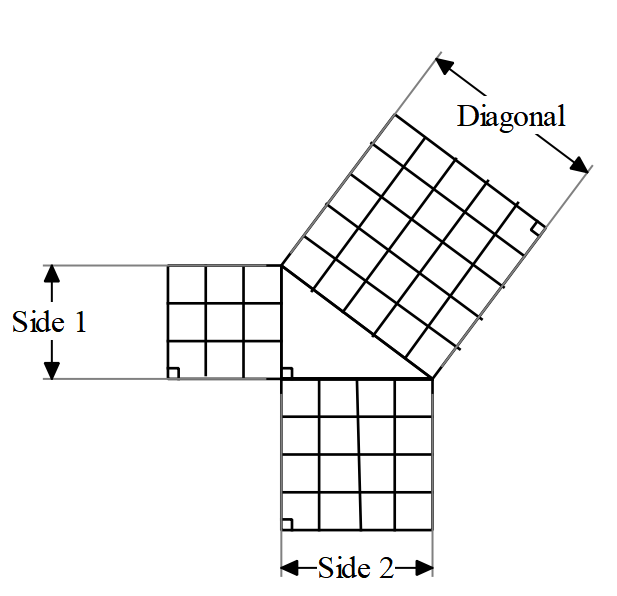
Therefore, the Pythagoras theorem which we know today is ${{\left( \text{Side 1} \right)}^{\text{2}}}\text{+}{{\left( \text{Side 2} \right)}^{\text{2}}}\text{=}{{\left( \text{Diagonal} \right)}^{\text{2}}}$
One really interesting thing is that Pythagoras was not credited for this theorem till at least three centuries after. It was much later when Cicero and other Greek mathematicians/historians decided to tell the world that it was Pythagoras that came up with this theorem. Baudhayama also made remarkable discoveries like calculating the value of pi $\left( \pi \right)$ , Calculating the value of the square root of 2 and many more.
Therefore, Baudhayana is named as the history of mathematics in English translation.
Hence, the correct option is (c).
Note: The common mistake that can be done is as the Pythagoras theorem is taught to us in the Geometry section, it is easily possible to write option (a), but that’s not the case.
Complete step by step solution:
Let us begin with understanding the origin of Sulva sutras. The Sulva Sutras are part of the larger corpus of texts called the Sulva Sutras, considered to be appendices to the Vedas. They are the only sources of knowledge of Indian mathematics from the Vedic period. There are various types of Sulva sutras namely as below,
(i) Apastamba
(ii) Baudhayana
(iii) Manava
(iv) Katyana
(v) Maitrayaniya
(vi) Varaha
(vii) Vadhula
(viii) Hiranyakeshi
There is a reference of the Pythagoras theorem in the Sulva sutra of Baudhayana. It was Baudhayana who discovered the Pythagoras theorem. Baudhayana listed Pythagoras theorem in his book called Baudhayana Śulbasûtra (800 BC). Incidentally, Baudhayana Śulbasûtra is also one of the oldest books on advanced Mathematics. Baudhayana used a rope as an example. A rope stretched along the length of the diagonal produces an area which the vertical and horizontal sides make together.
Therefore, the Pythagoras theorem which we know today is ${{\left( \text{Side 1} \right)}^{\text{2}}}\text{+}{{\left( \text{Side 2} \right)}^{\text{2}}}\text{=}{{\left( \text{Diagonal} \right)}^{\text{2}}}$
One really interesting thing is that Pythagoras was not credited for this theorem till at least three centuries after. It was much later when Cicero and other Greek mathematicians/historians decided to tell the world that it was Pythagoras that came up with this theorem. Baudhayama also made remarkable discoveries like calculating the value of pi $\left( \pi \right)$ , Calculating the value of the square root of 2 and many more.
Therefore, Baudhayana is named as the history of mathematics in English translation.
Hence, the correct option is (c).
Note: The common mistake that can be done is as the Pythagoras theorem is taught to us in the Geometry section, it is easily possible to write option (a), but that’s not the case.
Recently Updated Pages
Master Class 11 English: Engaging Questions & Answers for Success

Master Class 11 Social Science: Engaging Questions & Answers for Success
Master Class 11 Maths: Engaging Questions & Answers for Success
Master Class 11 Chemistry: Engaging Questions & Answers for Success
Master Class 11 Biology: Engaging Questions & Answers for Success
Master Class 11 Physics: Engaging Questions & Answers for Success
Trending doubts
Explain the Treaty of Vienna of 1815 class 10 social science CBSE
Why is it 530 pm in india when it is 1200 afternoon class 10 social science CBSE
What is the full form of CNG A Complete Natural Gas class 10 social science CBSE
In cricket, what is a "Yorker" designed to do?
What is the full form of POSCO class 10 social science CBSE
Define Potential, Developed, Stock and Reserved resources