




ATPase activity in muscle fibre lies with
A. Light meromyosin
B. Head of heavy meromyosin
C. Troponin
D. Short arm of heavy meromyosin
Answer
 Verified
523.8k+ views
Hint: Skeletal muscle contains numerous physiological units, called muscle fibres or muscle cells. They are grouped in the form of bundles called fasciculi. Each muscle fibre is an elongated cell which is syncytial. The sarcolemma is the membrane and sarcoplasm is the cytoplasm of the muscle fibre. The mitochondria of the muscle fibre are called sarcosomes and the endoplasmic reticulum is designated as sarcoplasmic reticulum (a storehouse of calcium ions).
Complete answer:
Muscle fibre has a unique feature is that – the presence of a large number of sarcoplasm having parallely arranged filaments, called myo-filaments of myofibrils. The sarcoplasm of the sarcomere contains many thick and thin myofilaments. The thin consists of actin protein and the thick consists of myosin protein. Both are contractile proteins.
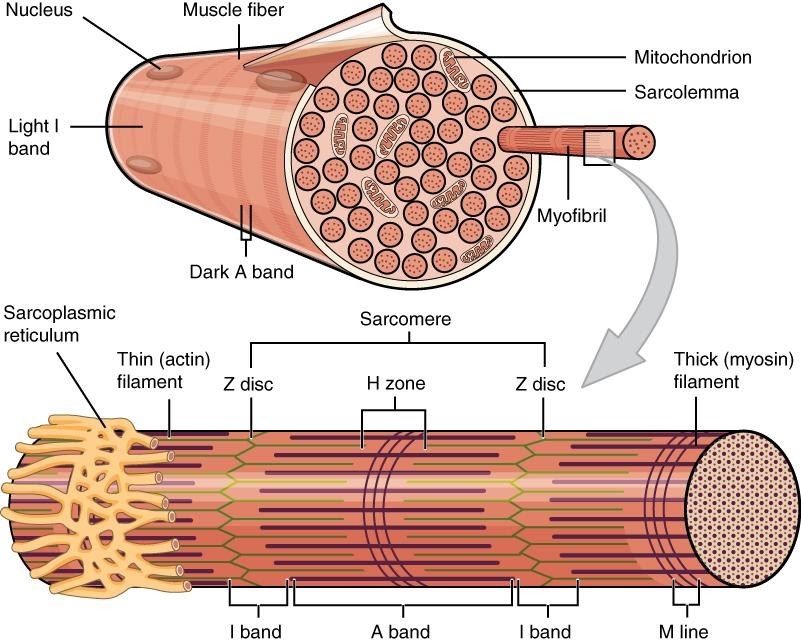
Light meromyosin: It contains a long and straight portion in the tail region or rod portion.
Head of heavy meromyosin: Each myosin filament is also a polymerized protein made up of many monomeric proteins called meromyosin. A meromyosin has a globular head which acts as an active ATPase enzyme, and has binding sites for ATP and active sites for actin.
Troponin: A troponin composed of three globular peptides, is distributed at regular intervals on the tropomyosin. It hides the active binding sites for myosin on the actin filaments.
Short arm of meromyosin: It projects outward at an angle from a polymerized myosin filament at regular distance, and is known as a cross arm.
Therefore, ATPase activity in muscle fibre lies with the head of heavy meromyosin. So, option (B) is correct.
Note:
The major component of muscle is water. In muscle the most abundant mineral element is potassium. Other minerals that are only present in traces are – sodium, calcium, phosphorus and magnesium. Muscles store glycogen and contain oxygen-carrying pigment myoglobin. They also contain ATP, creatinine urea, etc.
Complete answer:
Muscle fibre has a unique feature is that – the presence of a large number of sarcoplasm having parallely arranged filaments, called myo-filaments of myofibrils. The sarcoplasm of the sarcomere contains many thick and thin myofilaments. The thin consists of actin protein and the thick consists of myosin protein. Both are contractile proteins.
Light meromyosin: It contains a long and straight portion in the tail region or rod portion.
Head of heavy meromyosin: Each myosin filament is also a polymerized protein made up of many monomeric proteins called meromyosin. A meromyosin has a globular head which acts as an active ATPase enzyme, and has binding sites for ATP and active sites for actin.
Troponin: A troponin composed of three globular peptides, is distributed at regular intervals on the tropomyosin. It hides the active binding sites for myosin on the actin filaments.
Short arm of meromyosin: It projects outward at an angle from a polymerized myosin filament at regular distance, and is known as a cross arm.
Therefore, ATPase activity in muscle fibre lies with the head of heavy meromyosin. So, option (B) is correct.
Note:
The major component of muscle is water. In muscle the most abundant mineral element is potassium. Other minerals that are only present in traces are – sodium, calcium, phosphorus and magnesium. Muscles store glycogen and contain oxygen-carrying pigment myoglobin. They also contain ATP, creatinine urea, etc.
Recently Updated Pages
Master Class 11 Social Science: Engaging Questions & Answers for Success

Master Class 11 Chemistry: Engaging Questions & Answers for Success
Master Class 12 Business Studies: Engaging Questions & Answers for Success
Master Class 12 Chemistry: Engaging Questions & Answers for Success
Master Class 12 Biology: Engaging Questions & Answers for Success
Class 12 Question and Answer - Your Ultimate Solutions Guide
Trending doubts
One Metric ton is equal to kg A 10000 B 1000 C 100 class 11 physics CBSE
Difference Between Prokaryotic Cells and Eukaryotic Cells
How many of the following diseases can be studied with class 11 biology CBSE
Two of the body parts which do not appear in MRI are class 11 biology CBSE
Which of the following enzymes is used for carboxylation class 11 biology CBSE
Explain zero factorial class 11 maths CBSE