




How many ATP molecules will be produced in a brain cell (neuron) from a glucose molecule involving electron transport chain only?
A. 32
B. 16
C. 38
D. 34
Answer
 Verified
629.1k+ views
Hint: Glucose gets converted into 2 pyruvate molecules after the glycolysis. TCA cycle gives NADH and FADH2 + ATP. One NADH = 2.5 ATP and 1 FADH2 = 1.5 ATP. Glycolysis is followed by TCA cycle ( Kreb cycle) and then comes the electron chain transport.
Complete answer:
Let us understand this whole process in detail.
1. GLYCOLYSIS – The process of conversion of one glucose molecule into two pyruvate molecules.
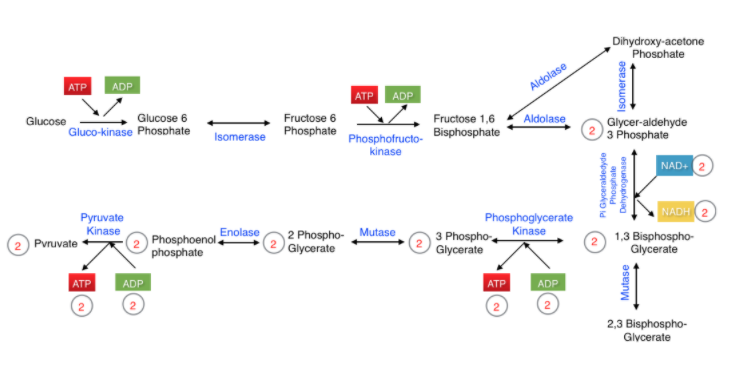
In this figure, in the first half of the glycolysis ATP is being converted to ADP that is it is being utilized. Whereas in the second half, 1 NADH molecule is generated and 4 ATP molecules are being generated. As one NADH = 2.5 ATP. So now we have 2.5 + 4 = 7 ATP.
2. Oxidative decarboxylation of pyruvate – In this, one pyruvate will give one acetyl CoA.
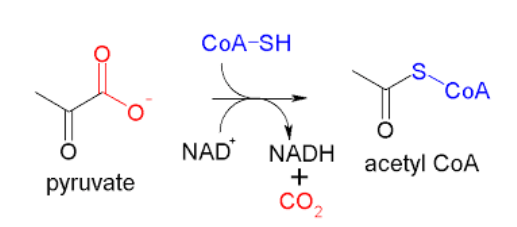
This process will generate 2 NADH molecules, each from one pyruvate.
So we will have 2.5 x 2=5 ATP.
3. Kreb’s Cycle: Conversion of acetyl CoA to CO2, NADH, FADH2 and ATP.

In the Krebs cycle, 3 NADH, 1 FADH2 and 1 ATP is produced (from 1 acetyl CoA only)
As 1 glucose gives 2 acetyl CoA, so, at the end of this process, we will have 6 NADH(15 ATP), 2 FADH2 (3 ATP) and 2 ATP.
The sum total of all the ATP till here is 7 + 5 + 20 = 32 ATP.
After this, these ATP’s are moved to the electron chain transport.
So the answer is option A - 32
Note:
Glycolysis starts in the cytoplasm of the cell but terminates in the mitochondria. That pyruvate is generated in the mitochondria. Kreb’s cycle then takes place in the mitochondria where the next biochemical reactions take place. These processes are part of the cellular respiration.
Complete answer:
Let us understand this whole process in detail.
1. GLYCOLYSIS – The process of conversion of one glucose molecule into two pyruvate molecules.
In this figure, in the first half of the glycolysis ATP is being converted to ADP that is it is being utilized. Whereas in the second half, 1 NADH molecule is generated and 4 ATP molecules are being generated. As one NADH = 2.5 ATP. So now we have 2.5 + 4 = 7 ATP.
2. Oxidative decarboxylation of pyruvate – In this, one pyruvate will give one acetyl CoA.
This process will generate 2 NADH molecules, each from one pyruvate.
So we will have 2.5 x 2=5 ATP.
3. Kreb’s Cycle: Conversion of acetyl CoA to CO2, NADH, FADH2 and ATP.
In the Krebs cycle, 3 NADH, 1 FADH2 and 1 ATP is produced (from 1 acetyl CoA only)
As 1 glucose gives 2 acetyl CoA, so, at the end of this process, we will have 6 NADH(15 ATP), 2 FADH2 (3 ATP) and 2 ATP.
The sum total of all the ATP till here is 7 + 5 + 20 = 32 ATP.
After this, these ATP’s are moved to the electron chain transport.
So the answer is option A - 32
Note:
Glycolysis starts in the cytoplasm of the cell but terminates in the mitochondria. That pyruvate is generated in the mitochondria. Kreb’s cycle then takes place in the mitochondria where the next biochemical reactions take place. These processes are part of the cellular respiration.
Recently Updated Pages
Master Class 12 Economics: Engaging Questions & Answers for Success

Master Class 12 English: Engaging Questions & Answers for Success
Master Class 12 Social Science: Engaging Questions & Answers for Success
Master Class 12 Maths: Engaging Questions & Answers for Success
Master Class 12 Physics: Engaging Questions & Answers for Success
Master Class 9 General Knowledge: Engaging Questions & Answers for Success
Trending doubts
One Metric ton is equal to kg A 10000 B 1000 C 100 class 11 physics CBSE
Difference Between Prokaryotic Cells and Eukaryotic Cells
Two of the body parts which do not appear in MRI are class 11 biology CBSE
Find the value of the expression given below sin 30circ class 11 maths CBSE
1 ton equals to A 100 kg B 1000 kg C 10 kg D 10000 class 11 physics CBSE
Draw a diagram of nephron and explain its structur class 11 biology CBSE