




How many $ATP$ are required in $C4$ cycle?
Answer
 Verified
541.5k+ views
Hint: $C4$ cycle is also called Hatch- Slack pathway which takes place in the bundle sheath of the plant . Oxaloacetic acid is the first \[C{O_2}\] fixation product in this cycle. This process takes place in the xerophytes.
Complete answer:
Plants that are adaptive to dry tropical regions have the $C4$ pathway. Though these plants have the $C4$ pathway or calvin cycle as the main biosynthetic pathway. $C4$ Plants are special: They have a special type of leaf anatomy,they tolerate high temperatures,they respond to high light intensities,they lack a process called photorespiration and have a greater productivity of biomass .Let us understand these one by one .
The particularly large cells around the vascular bundle of the $C4$ pathway plants are called bundle sheath cells,and the leaves which have such anatomy are said to have "kranz"anatomy.Kranz means wreath and is a reflection of the arrangement of cells .The bundle sheath cells may from several layers around the vascular bundles;they are characterised by having a large number of chloroplasts ,thick walls impervious to gaseous exchange and intercellular spaces.
This pathway that has been named the Hatch and Slack pathway,is again a cyclic process .
The primary \[C{O_2}\] acceptor is a \[3 - {\text{ }}carbon\]molecule phosphoenolpyruvate and is present in the mesophyll cells .The enzyme responsible for this fixation is pep carboxylase or pepcase . It is important to note that the mesophyll cells lack RuBisCo enzyme .The $C4$ acid \[OAA\]is formed in the mesophyll cells. It then other \[4 - {\text{ }}carbon\]compounds like malic acid or aspartic acid in the mesophyll itself ,which are transported to the bundle sheath cells.
The \[3 - {\text{ }}carbon\] molecules is transported back to the mesophyll where it is converted to pep again ,thus ,completing the cycle.The \[C{O_2}\] released in the bundle sheath cells entres the $C3$ or the calvin pathway , a pathway common to all plants .The bundle sheath cells are rich in an enzyme Ribulose bisphosphate carboxylase-oxygenase,but lack pepcase .Thus , the basic pathway that result in formation of the sugar .The calvin pathway is common to the $C3$ and $C4$ plants.
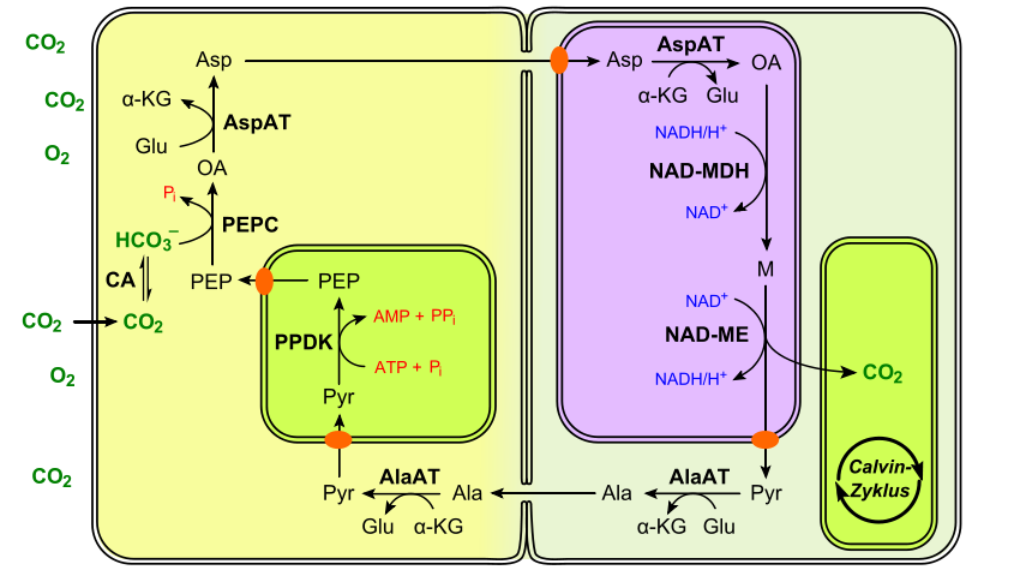
Total thirty $ATP$s are required for the fixation of six \[C{O_2}\] molecules. It occurs in $C4$ pathways also in the bundle sheath cells. The $C3$ cycle required eighteen $ATP$s for six \[C{O_2}\]. Addition to it \[C{O_2}\] initially fixed in $C4$ needs two $ATP$s to fix each \[C{O_2}\] molecule. In total 12 $ATP$s are required.
Note: $C4$ cycle owes the name to the discovery by Marshall Davidson Hatch and Charles Roger Slack that some plants, when supplied with \[C{O_2}\], incorporate the $C - 14$ label into the four- carbon molecules first. It is ancestral and more common to $C3$ carbon fixation.
Complete answer:
Plants that are adaptive to dry tropical regions have the $C4$ pathway. Though these plants have the $C4$ pathway or calvin cycle as the main biosynthetic pathway. $C4$ Plants are special: They have a special type of leaf anatomy,they tolerate high temperatures,they respond to high light intensities,they lack a process called photorespiration and have a greater productivity of biomass .Let us understand these one by one .
The particularly large cells around the vascular bundle of the $C4$ pathway plants are called bundle sheath cells,and the leaves which have such anatomy are said to have "kranz"anatomy.Kranz means wreath and is a reflection of the arrangement of cells .The bundle sheath cells may from several layers around the vascular bundles;they are characterised by having a large number of chloroplasts ,thick walls impervious to gaseous exchange and intercellular spaces.
This pathway that has been named the Hatch and Slack pathway,is again a cyclic process .
The primary \[C{O_2}\] acceptor is a \[3 - {\text{ }}carbon\]molecule phosphoenolpyruvate and is present in the mesophyll cells .The enzyme responsible for this fixation is pep carboxylase or pepcase . It is important to note that the mesophyll cells lack RuBisCo enzyme .The $C4$ acid \[OAA\]is formed in the mesophyll cells. It then other \[4 - {\text{ }}carbon\]compounds like malic acid or aspartic acid in the mesophyll itself ,which are transported to the bundle sheath cells.
The \[3 - {\text{ }}carbon\] molecules is transported back to the mesophyll where it is converted to pep again ,thus ,completing the cycle.The \[C{O_2}\] released in the bundle sheath cells entres the $C3$ or the calvin pathway , a pathway common to all plants .The bundle sheath cells are rich in an enzyme Ribulose bisphosphate carboxylase-oxygenase,but lack pepcase .Thus , the basic pathway that result in formation of the sugar .The calvin pathway is common to the $C3$ and $C4$ plants.
Total thirty $ATP$s are required for the fixation of six \[C{O_2}\] molecules. It occurs in $C4$ pathways also in the bundle sheath cells. The $C3$ cycle required eighteen $ATP$s for six \[C{O_2}\]. Addition to it \[C{O_2}\] initially fixed in $C4$ needs two $ATP$s to fix each \[C{O_2}\] molecule. In total 12 $ATP$s are required.
Note: $C4$ cycle owes the name to the discovery by Marshall Davidson Hatch and Charles Roger Slack that some plants, when supplied with \[C{O_2}\], incorporate the $C - 14$ label into the four- carbon molecules first. It is ancestral and more common to $C3$ carbon fixation.
Recently Updated Pages
Master Class 11 English: Engaging Questions & Answers for Success

Master Class 11 Social Science: Engaging Questions & Answers for Success
Master Class 11 Maths: Engaging Questions & Answers for Success
Master Class 11 Biology: Engaging Questions & Answers for Success
Master Class 11 Physics: Engaging Questions & Answers for Success
Master Class 11 Chemistry: Engaging Questions & Answers for Success
Trending doubts
One Metric ton is equal to kg A 10000 B 1000 C 100 class 11 physics CBSE
What is cell theory Who formulated it class 11 biology CBSE
Phyllotaxy is the arrangement of ALeaflets BLeaves class 11 biology CBSE
Difference Between Prokaryotic Cells and Eukaryotic Cells
The symbiotic association of fungi and algae is called class 11 biology CBSE
Cell theory was formulated by A Schleiden and Schwann class 11 biology CBSE