



What is the atomic number of Fe in ${\text{F}}{{\text{e}}_{\text{2}}}{{\text{(CO)}}_{\text{9}}}$?
A. 35
B. 36
C. 37
D. Cannot be calculated
Answer
 Verified
573.3k+ views
Hint: In the above question, it is asked about EAN value of Fe in ${\text{F}}{{\text{e}}_{\text{2}}}{{\text{(CO)}}_{\text{9}}}$. For finding the EAN value, we have to find the atomic number and oxidation number of Fe and number of electrons donated by the ligands.
Formula Used-
EAN = \[Z - X + Y\]
where Z= atomic number of the central atom
X= oxidation number of central atom
Y= No. of electrons donated by ligand
Complete step-by-step answer:Effective Atomic Number (EAN) is the number that represents the total number of electrons surrounding the nucleus of a metal atom in a metal complex.
According to EAN rule, a metal atom tends to surround itself with sufficient ligands such that the resulting effective atomic number is equal to the atomic number of the noble gas element which is found in the same period in which the metal is situated.
Let us now find out EAN value of ${\text{F}}{{\text{e}}_{\text{2}}}{{\text{(CO)}}_{\text{9}}}$.
Z= atomic number of Fe = $26$
Since, the charge of CO is 0 as it is a neutral ligand, hence oxidation state of Fe can be found out by:
9${{ \times }}$ Charge of CO + 2 ${{ \times }}$ Charge of Fe = Charge on the complex
$ \Rightarrow 9 \times 0 + 2 \times x = 0$
So, X=0
For finding Y, we have to look at the structure of ${\text{F}}{{\text{e}}_{\text{2}}}{{\text{(CO)}}_{\text{9}}}$
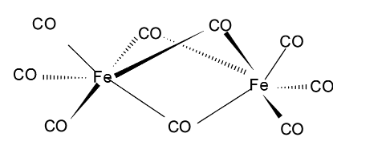
Since, the 3 terminal bonds for each Fe share 2 electrons each while the middle common bonds share 1 electron.
So, Y=$3 \times 2 + 3 = 9$.
EAN =\[Z - X + Y\] = $26 - 0 + 9 = 35$
Therefore, the correct option is option A.
Note:EAN rule is valid for metal complexes with carbon monoxide, metal carbonyl as well as many organometallic compounds.
By using this rule, it is possible to predict the number of ligands in the compounds.
Formula Used-
EAN = \[Z - X + Y\]
where Z= atomic number of the central atom
X= oxidation number of central atom
Y= No. of electrons donated by ligand
Complete step-by-step answer:Effective Atomic Number (EAN) is the number that represents the total number of electrons surrounding the nucleus of a metal atom in a metal complex.
According to EAN rule, a metal atom tends to surround itself with sufficient ligands such that the resulting effective atomic number is equal to the atomic number of the noble gas element which is found in the same period in which the metal is situated.
Let us now find out EAN value of ${\text{F}}{{\text{e}}_{\text{2}}}{{\text{(CO)}}_{\text{9}}}$.
Z= atomic number of Fe = $26$
Since, the charge of CO is 0 as it is a neutral ligand, hence oxidation state of Fe can be found out by:
9${{ \times }}$ Charge of CO + 2 ${{ \times }}$ Charge of Fe = Charge on the complex
$ \Rightarrow 9 \times 0 + 2 \times x = 0$
So, X=0
For finding Y, we have to look at the structure of ${\text{F}}{{\text{e}}_{\text{2}}}{{\text{(CO)}}_{\text{9}}}$
Since, the 3 terminal bonds for each Fe share 2 electrons each while the middle common bonds share 1 electron.
So, Y=$3 \times 2 + 3 = 9$.
EAN =\[Z - X + Y\] = $26 - 0 + 9 = 35$
Therefore, the correct option is option A.
Note:EAN rule is valid for metal complexes with carbon monoxide, metal carbonyl as well as many organometallic compounds.
By using this rule, it is possible to predict the number of ligands in the compounds.
Recently Updated Pages
Master Class 12 Business Studies: Engaging Questions & Answers for Success

Master Class 12 Chemistry: Engaging Questions & Answers for Success
Master Class 12 Biology: Engaging Questions & Answers for Success
Class 12 Question and Answer - Your Ultimate Solutions Guide
Master Class 11 Social Science: Engaging Questions & Answers for Success
Master Class 11 Chemistry: Engaging Questions & Answers for Success
Trending doubts
Which are the Top 10 Largest Countries of the World?
Draw a labelled sketch of the human eye class 12 physics CBSE
Name the crygenes that control cotton bollworm and class 12 biology CBSE
Differentiate between homogeneous and heterogeneous class 12 chemistry CBSE
How many molecules of ATP and NADPH are required information class 12 biology CBSE
In a transcription unit the promoter is said to be class 12 biology CBSE