




At which phase the moon is nearest to the sun?
(A) New Moon
(B) Full Moon
(C) First Quarter
(D) Third Quarter
Answer
 Verified
612.6k+ views
Hint: In this question, we need to comment on which phase the moon is nearest to the Sun. The given four options are the phases of the moon. Compare each phase of the moon with another to find out which one winds up to be closest to the sun.
Complete step by step answer:
We can see our natural satellite moon only because the rays of the sun fall on it and reflect back in our eyes. The moon appears in various phases like full moon, new moon, first quarter, third quarter, crescent, and gibbous.When the light falls on any part of the moon, it reflects back in our eyes and we can see that phase of the moon. However, the light that reflects back to the Earth is only from some part of the moon. Only that part of the moon is visible to us.On a New Moon day, the moon, the Earth, and the sun assemble in such a way that the moon is on the same side of the Earth as that of the sun with respect to the Earth. The following figure will help you clarify it even better.
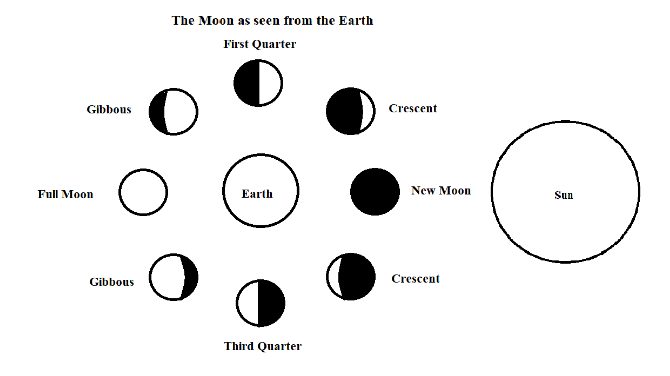
So, as you can see above, on a New Moon day, there is no light from the moon that reaches the Earth and the moon is completely invisible. Its color is black which is the same as that of the night sky. Thus, we can observe that on a new moon day, the moon is nearest to the sun.
So, option A is the correct answer.
Additional Information:
On a new moon day, the moon is lined up between the Earth and the sun. We cannot see the moon because of the brightness of the sun that outshines the moon. When the moon exactly lines up with the sun, what we on Earth experience is called an eclipse.
Note: Students get confused between the Full Moon day and the New Moon day. Full Moon Day is when the moon is situated away from the sun whereas New Moon Day is when the moon is closest to the sun.
Complete step by step answer:
We can see our natural satellite moon only because the rays of the sun fall on it and reflect back in our eyes. The moon appears in various phases like full moon, new moon, first quarter, third quarter, crescent, and gibbous.When the light falls on any part of the moon, it reflects back in our eyes and we can see that phase of the moon. However, the light that reflects back to the Earth is only from some part of the moon. Only that part of the moon is visible to us.On a New Moon day, the moon, the Earth, and the sun assemble in such a way that the moon is on the same side of the Earth as that of the sun with respect to the Earth. The following figure will help you clarify it even better.
So, as you can see above, on a New Moon day, there is no light from the moon that reaches the Earth and the moon is completely invisible. Its color is black which is the same as that of the night sky. Thus, we can observe that on a new moon day, the moon is nearest to the sun.
So, option A is the correct answer.
Additional Information:
On a new moon day, the moon is lined up between the Earth and the sun. We cannot see the moon because of the brightness of the sun that outshines the moon. When the moon exactly lines up with the sun, what we on Earth experience is called an eclipse.
Note: Students get confused between the Full Moon day and the New Moon day. Full Moon Day is when the moon is situated away from the sun whereas New Moon Day is when the moon is closest to the sun.
Recently Updated Pages
Master Class 11 English: Engaging Questions & Answers for Success

Master Class 11 Social Science: Engaging Questions & Answers for Success
Master Class 11 Maths: Engaging Questions & Answers for Success
Master Class 11 Chemistry: Engaging Questions & Answers for Success
Master Class 11 Biology: Engaging Questions & Answers for Success
Master Class 11 Physics: Engaging Questions & Answers for Success
Trending doubts
Why is it 530 pm in india when it is 1200 afternoon class 10 social science CBSE
What is the full form of CNG A Complete Natural Gas class 10 social science CBSE
Which Country Has the Largest Border with India?
Choose the feminine form of the given noun Fox AFoxess class 10 english CBSE
Fill the blanks with proper collective nouns 1 A of class 10 english CBSE
The term Eelam means A Country B State C Nation D class 10 social science CBSE