




At the end of the school day, student A and student B say goodbye and head in opposite directions, walking at constant rates. Student B heads west to the bus stop, while student A walks east to her house. After 3.0 min, student A is 300 m east and student B is 450 m west. Assuming east to be the positive direction, the velocities in m/s of student A and student B are:
A. +1.67 m/s; -2.5m/s
B. +1.67m/s; +2.5m/s
C. +2.5 m/s; -1.67 m/s
D. -1.67 m/s; +2.5m/s
Answer
 Verified
613.5k+ views
Hint: In order to solve this problem we need to know that 1 min is 60 seconds and velocity is equal to distance travelled in meters upon time taken in seconds. Drawing the coordinate axes will help us to get the right direction including signs. Doing this will solve your problem.
Complete answer:
So, the figure for this problem can be drawn as;
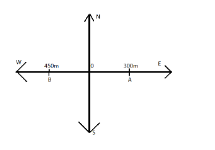
This figure is when the students A and B arrived there home and bus stop after three minutes.
We know that 1 minute = 60 seconds.
Therefore 3 minutes = 180seconds.
So, after 3 min A travels 300m east that is in a positive direction.
We know that velocity is distance upon time, so we get velocity.
$ \Rightarrow \dfrac{{300}}{{180}} = 1.67$m/s in a positive direction.
So, after 3 min B travels 450m west that is in a negative direction.
We know that velocity is distance upon time, so we get velocity.
$ \Rightarrow \dfrac{{450}}{{180}} = 2.5$m/s in negative direction.
So, the correct answer is +1.67m/s and -2.5m/s.
So, the correct answer is “Option A”.
Note:
When you get to solve such problems you need to know that velocity is equal to distance upon time and always consider direction in velocity since it is a vector quantity and must be written with direction. You also need to know that SI unit of velocity is m/s that is meter per second and we have given the answer in meter per second since the options are in meter per second. Most of the time we have to give an answer in the SI unit after converting all the terms in the SI unit. Doing this will help you further and will give you the right answer.
Complete answer:
So, the figure for this problem can be drawn as;
This figure is when the students A and B arrived there home and bus stop after three minutes.
We know that 1 minute = 60 seconds.
Therefore 3 minutes = 180seconds.
So, after 3 min A travels 300m east that is in a positive direction.
We know that velocity is distance upon time, so we get velocity.
$ \Rightarrow \dfrac{{300}}{{180}} = 1.67$m/s in a positive direction.
So, after 3 min B travels 450m west that is in a negative direction.
We know that velocity is distance upon time, so we get velocity.
$ \Rightarrow \dfrac{{450}}{{180}} = 2.5$m/s in negative direction.
So, the correct answer is +1.67m/s and -2.5m/s.
So, the correct answer is “Option A”.
Note:
When you get to solve such problems you need to know that velocity is equal to distance upon time and always consider direction in velocity since it is a vector quantity and must be written with direction. You also need to know that SI unit of velocity is m/s that is meter per second and we have given the answer in meter per second since the options are in meter per second. Most of the time we have to give an answer in the SI unit after converting all the terms in the SI unit. Doing this will help you further and will give you the right answer.
Recently Updated Pages
Master Class 11 Social Science: Engaging Questions & Answers for Success

Master Class 11 English: Engaging Questions & Answers for Success
Master Class 11 Maths: Engaging Questions & Answers for Success
Master Class 11 Chemistry: Engaging Questions & Answers for Success
Master Class 11 Biology: Engaging Questions & Answers for Success
Master Class 11 Physics: Engaging Questions & Answers for Success
Trending doubts
One Metric ton is equal to kg A 10000 B 1000 C 100 class 11 physics CBSE
Difference Between Prokaryotic Cells and Eukaryotic Cells
How many of the following diseases can be studied with class 11 biology CBSE
Two of the body parts which do not appear in MRI are class 11 biology CBSE
Which of the following enzymes is used for carboxylation class 11 biology CBSE
Explain zero factorial class 11 maths CBSE