




At some location on earth the horizontal components of earth’s magnetic field is $18\times {{10}^{-6}}T$. At this location, the magnetic needle of length 0.12 m and pole strength 1.8 Am is suspended from its middle point using a thread, it makes ${{45}^{o}}$ angle with horizontal in equilibrium. To keep this needle horizontal, the vertical force that should be applied to one of its ends is:
A. $3.6\times {{10}^{-5}}N$
B. $6.5\times {{10}^{-5}}N$
C. $1.3\times {{10}^{-5}}N$
D. $1.8\times {{10}^{-5}}N$
Answer
 Verified
600.9k+ views
Hint: The mass of the needle will not play a part as the string is in the middle and it gets balanced. We will just have to consider the forces due to the magnetic field. We are given the horizontal component and the angle of the needle in equilibrium due to the magnetic field. The vertical force will counter the torque produced on the needle due to the magnetic force.
Formula used:
$\tau =M\times B$
Complete answer:
First, we will find the magnitude of the vertical component of the magnetic field of earth at that point. As we are given that the needle makes an angle of ${{45}^{o}}$ with the horizontal, then the magnitude of both the horizontal and vertical force on the needle due to the magnetic field of earth must be the same. So, the magnitude of the horizontal component of the magnetic field and the vertical component of the magnetic field of earth at this point must be the same. Thus, there is a magnetic field of magnitude in the vertical direction too.
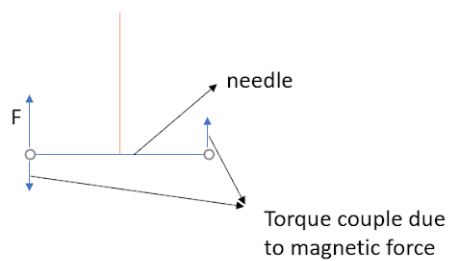
Torque on the magnet due to the magnetic field will be given by
$\tau =M\times B$
Where M is the magnetic moment given as the product of the pole strength and the length of the magnet, needle in this case. We can directly take the product as the
$\tau =M\times B=18\times {{10}^{-6}}\times 1.8\times 0.12=3.89\times {{10}^{-6}}$
This will need to be balanced by the torque presented due to the force. The torque by the force will be
$\tau =F\dfrac{l}{2}$
When we equate both we get
\[F=\dfrac{2\times 3.89\times {{10}^{-6}}}{l}=\dfrac{2\times 3.89\times {{10}^{-6}}}{0.12}=6.5\times {{10}^{-5}}\]N
Hence, the correct answer is B, i.e. $6.5\times {{10}^{-5}}N$.
Note:
Students must take care that the torque due to the magnetic field is being calculated when the needle becomes horizontal, not when the needle is at an angle with the horizontal. Because that is when we will need to balance the forces.
Formula used:
$\tau =M\times B$
Complete answer:
First, we will find the magnitude of the vertical component of the magnetic field of earth at that point. As we are given that the needle makes an angle of ${{45}^{o}}$ with the horizontal, then the magnitude of both the horizontal and vertical force on the needle due to the magnetic field of earth must be the same. So, the magnitude of the horizontal component of the magnetic field and the vertical component of the magnetic field of earth at this point must be the same. Thus, there is a magnetic field of magnitude in the vertical direction too.
Torque on the magnet due to the magnetic field will be given by
$\tau =M\times B$
Where M is the magnetic moment given as the product of the pole strength and the length of the magnet, needle in this case. We can directly take the product as the
$\tau =M\times B=18\times {{10}^{-6}}\times 1.8\times 0.12=3.89\times {{10}^{-6}}$
This will need to be balanced by the torque presented due to the force. The torque by the force will be
$\tau =F\dfrac{l}{2}$
When we equate both we get
\[F=\dfrac{2\times 3.89\times {{10}^{-6}}}{l}=\dfrac{2\times 3.89\times {{10}^{-6}}}{0.12}=6.5\times {{10}^{-5}}\]N
Hence, the correct answer is B, i.e. $6.5\times {{10}^{-5}}N$.
Note:
Students must take care that the torque due to the magnetic field is being calculated when the needle becomes horizontal, not when the needle is at an angle with the horizontal. Because that is when we will need to balance the forces.
Recently Updated Pages
Master Class 11 Social Science: Engaging Questions & Answers for Success

Master Class 11 Physics: Engaging Questions & Answers for Success
Master Class 11 Maths: Engaging Questions & Answers for Success
Master Class 11 Economics: Engaging Questions & Answers for Success
Master Class 11 Computer Science: Engaging Questions & Answers for Success
Master Class 11 Chemistry: Engaging Questions & Answers for Success
Trending doubts
One Metric ton is equal to kg A 10000 B 1000 C 100 class 11 physics CBSE
There are 720 permutations of the digits 1 2 3 4 5 class 11 maths CBSE
1 Quintal is equal to a 110 kg b 10 kg c 100kg d 1000 class 11 physics CBSE
State and prove Bernoullis theorem class 11 physics CBSE
Difference Between Prokaryotic Cells and Eukaryotic Cells
Which among the following are examples of coming together class 11 social science CBSE