




At perihelion, the gravitational potential energy of Pluto in its orbit has
A) a maximum value.
B) a minimum value.
C) the same value as at every other point in its orbit.
D) a value that depends on the sense of rotation.
Answer
 Verified
585k+ views
Hint: At perihelion, the Pluto will be closest to the Sun. The gravitational potential energy between two masses depends on the distance between the two masses. As the distance of separation decreases, the potential energy increases but it is a negative value.
Formula used:
The gravitational potential energy between two masses is given by, $V = \dfrac{{ - GMm}}{r}$ where $G$ is the gravitational constant, $M$ and $m$ are the masses and $r$ is the distance between the two masses.
Complete step by step answer:
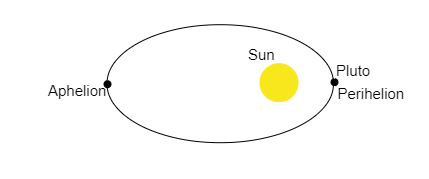
Step 1: Sketching a figure describing the revolution of Pluto around the Sun.
Pluto’s orbit of revolution has an elliptic nature. The Sun is considered to be located at one of the foci of the elliptical orbit.
The figure given below describes the revolution of Pluto around the Sun.
Step 2: Expressing the relation for the gravitational potential energy of Pluto.
The gravitational potential energy of Pluto is given by, $V = \dfrac{{ - GMm}}{r}$ where $G$ is the gravitational constant, $M$ is the mass of the Sun, $m$ is the mass of Pluto and $r$ is the distance between the Sun and Pluto.
As Pluto revolves around the Sun, the only quantity in the above equation that changes is the distance of separation $r$.
So we have $V \propto \dfrac{{ - 1}}{r}$ .
Since the distance of separation will be minimum at perihelion, the value of gravitational potential energy is most negative or minimum when Pluto is closest to the Sun. So the correct option is B.
Note:
From the relation for the gravitational potential energy, it is clear that it has the highest value when the distance of separation $r$ is the least. But the presence of the negative sign indicates that the highest value will be in fact the highest negative value. Aphelion refers to the point in the orbit when the distance of separation is the least.
Formula used:
The gravitational potential energy between two masses is given by, $V = \dfrac{{ - GMm}}{r}$ where $G$ is the gravitational constant, $M$ and $m$ are the masses and $r$ is the distance between the two masses.
Complete step by step answer:
Step 1: Sketching a figure describing the revolution of Pluto around the Sun.
Pluto’s orbit of revolution has an elliptic nature. The Sun is considered to be located at one of the foci of the elliptical orbit.
The figure given below describes the revolution of Pluto around the Sun.
Step 2: Expressing the relation for the gravitational potential energy of Pluto.
The gravitational potential energy of Pluto is given by, $V = \dfrac{{ - GMm}}{r}$ where $G$ is the gravitational constant, $M$ is the mass of the Sun, $m$ is the mass of Pluto and $r$ is the distance between the Sun and Pluto.
As Pluto revolves around the Sun, the only quantity in the above equation that changes is the distance of separation $r$.
So we have $V \propto \dfrac{{ - 1}}{r}$ .
Since the distance of separation will be minimum at perihelion, the value of gravitational potential energy is most negative or minimum when Pluto is closest to the Sun. So the correct option is B.
Note:
From the relation for the gravitational potential energy, it is clear that it has the highest value when the distance of separation $r$ is the least. But the presence of the negative sign indicates that the highest value will be in fact the highest negative value. Aphelion refers to the point in the orbit when the distance of separation is the least.
Recently Updated Pages
Master Class 10 Computer Science: Engaging Questions & Answers for Success

Master Class 10 General Knowledge: Engaging Questions & Answers for Success
Master Class 10 English: Engaging Questions & Answers for Success
Master Class 10 Social Science: Engaging Questions & Answers for Success
Master Class 10 Maths: Engaging Questions & Answers for Success
Master Class 10 Science: Engaging Questions & Answers for Success
Trending doubts
What is the median of the first 10 natural numbers class 10 maths CBSE
Which women's tennis player has 24 Grand Slam singles titles?
Who is the Brand Ambassador of Incredible India?
Why is there a time difference of about 5 hours between class 10 social science CBSE
Write a letter to the principal requesting him to grant class 10 english CBSE
State and prove converse of BPT Basic Proportionality class 10 maths CBSE