




At an instant the point P in the figure represents the instantaneous center of rotation for a uniform rectangular plate ABCD $\left( {12cm \times 10cm} \right)$ At the given instant the point A (Corner) has velocity $24cm/sec)$ The magnitude of the velocity of the center of mass of the plate is:
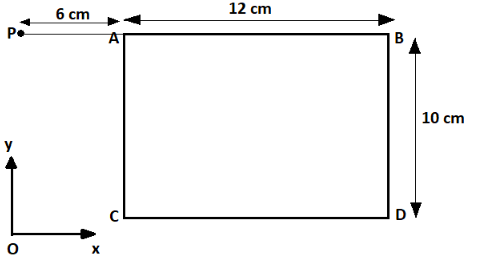
A. $13cm/s$
B. $26cm/s$
C. $52cm/s$
D. $104cm/s$
Answer
 Verified
592.5k+ views
Hint:In order to solve this you have to know the concept of center of mass. Also remember that the center of mass of the rectangular plate will always lie at its center. The center of mass is a position defined relative to an object or system of objects.
Complete step by step solution:
Here, in this question take a point M at the center of the rectangular plate shown in the figure below
And then draw a perpendicular NM on the side AB and also join point P with the center point M as shown in the figure below
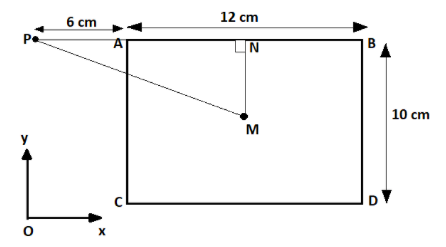
As we know that the M is the center point. So the point N on the side AB is the midpoint of that side.
Hence, $NM = 5cm$ and $AN = 6cm$
As we know that the center of mass of the rectangular plate ABCD will lie at its center.
Using pythagoras theorem, we get
$P{M^2} = M{N^2} + N{P^2}$
On putting the values, we get
$P{M^2} = {5^2} + {\left( {6 + 6} \right)^2}$
On further solving, we get
$PM = \sqrt {25 + 144} = 13cm$
Now, the angular velocity of point A is given by,
$\omega = \dfrac{v}{{PA}}$
Here $v$ is the velocity of point A which is given in the question as $v = 24cm/s$
On putting the values in the above equation, we have
$ \Rightarrow \omega = \dfrac{{24}}{6} = 4cm/s$
All the points in the plate will rotate with this same angular velocity. Therefore, the velocity of center of mass M is given by
${v_M} = PM \times \omega $
On putting the value we have
$ \Rightarrow {v_M} = 13 \times 4 = 52cm/s$
Hence, the magnitude of the velocity of the center of mass of the plate is $52cm/s$
Therefore, the correct option is C
Note:Always keep in mind that as long as the system is closed, the velocity of center of mass of the system doesn’t change. The system moves as if all the mass is concentrated at a single point. The main characteristics of the center of mass of any system is that it appears to carry the whole mass of the system.
Complete step by step solution:
Here, in this question take a point M at the center of the rectangular plate shown in the figure below
And then draw a perpendicular NM on the side AB and also join point P with the center point M as shown in the figure below
As we know that the M is the center point. So the point N on the side AB is the midpoint of that side.
Hence, $NM = 5cm$ and $AN = 6cm$
As we know that the center of mass of the rectangular plate ABCD will lie at its center.
Using pythagoras theorem, we get
$P{M^2} = M{N^2} + N{P^2}$
On putting the values, we get
$P{M^2} = {5^2} + {\left( {6 + 6} \right)^2}$
On further solving, we get
$PM = \sqrt {25 + 144} = 13cm$
Now, the angular velocity of point A is given by,
$\omega = \dfrac{v}{{PA}}$
Here $v$ is the velocity of point A which is given in the question as $v = 24cm/s$
On putting the values in the above equation, we have
$ \Rightarrow \omega = \dfrac{{24}}{6} = 4cm/s$
All the points in the plate will rotate with this same angular velocity. Therefore, the velocity of center of mass M is given by
${v_M} = PM \times \omega $
On putting the value we have
$ \Rightarrow {v_M} = 13 \times 4 = 52cm/s$
Hence, the magnitude of the velocity of the center of mass of the plate is $52cm/s$
Therefore, the correct option is C
Note:Always keep in mind that as long as the system is closed, the velocity of center of mass of the system doesn’t change. The system moves as if all the mass is concentrated at a single point. The main characteristics of the center of mass of any system is that it appears to carry the whole mass of the system.
Recently Updated Pages
Master Class 11 Social Science: Engaging Questions & Answers for Success

Master Class 11 Physics: Engaging Questions & Answers for Success
Master Class 11 Maths: Engaging Questions & Answers for Success
Master Class 11 Economics: Engaging Questions & Answers for Success
Master Class 11 Computer Science: Engaging Questions & Answers for Success
Master Class 11 Chemistry: Engaging Questions & Answers for Success
Trending doubts
One Metric ton is equal to kg A 10000 B 1000 C 100 class 11 physics CBSE
There are 720 permutations of the digits 1 2 3 4 5 class 11 maths CBSE
1 Quintal is equal to a 110 kg b 10 kg c 100kg d 1000 class 11 physics CBSE
State and prove Bernoullis theorem class 11 physics CBSE
Difference Between Prokaryotic Cells and Eukaryotic Cells
Which among the following are examples of coming together class 11 social science CBSE