




Assertion: Viscous force is a measure of the resistance of a liquid.
Reason: It converts kinetic energy into heat energy of the liquid.
Which of the following statements is correct?
A) Both assertion and reason are true and the reason is the correct explanation of assertion.
B) Both assertion and reason are true but the reason is not the correct explanation of assertion.
C) The assertion is true and the reason is true.
D) The assertion is true but the reason is not true.
Answer
 Verified
617.7k+ views
Hint:Viscous force is a force that opposes the relative movement of the layers of a liquid. Basically, it opposes the flow of the liquid and so can also be viewed as a frictional force. Frictional forces convert the kinetic energy of motion into heat energy.
Complete step by step answer.
Step 1: Explain if the assertion and reason hold based on the concept of viscosity.
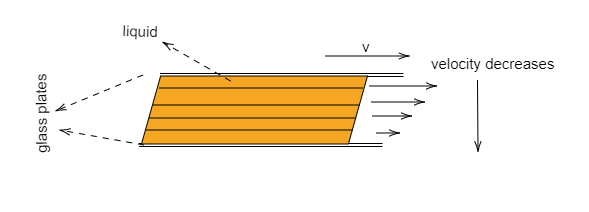
Consider a liquid moving between two glass plates where the bottom plate is stationary but the top plate moves with some velocity v. As the liquid moves between theses plates, its topmost layer will move with the same velocity as that of the top plate. The velocities of the layers will decrease uniformly from top to bottom. Hence each layer of the liquid will exert a force to drag the layer just above it. This dragging force is referred to as viscous force. It is a resistance offered to oppose the flow of the liquid.
So, the given assertion is true.
The internal resistance of the liquid is similar to the frictional force that exists when a solid body moves on a surface. Just like in mechanics, the kinetic energy of the motion of the liquid gets converted to heat energy.
So, the given reason is also true and it is the correct explanation of the given assertion.
Hence the correct option is A.
Note: The conversion of kinetic energy into heat energy in a liquid takes place constantly and is irreversible. If this conversion of energy by friction did not occur the liquid would flow continuously without stopping as it no longer offers resistance to its flow. Viscous force generates the idea of the thickness of a liquid.
Complete step by step answer.
Step 1: Explain if the assertion and reason hold based on the concept of viscosity.
Liquid moving between glass plates
Consider a liquid moving between two glass plates where the bottom plate is stationary but the top plate moves with some velocity v. As the liquid moves between theses plates, its topmost layer will move with the same velocity as that of the top plate. The velocities of the layers will decrease uniformly from top to bottom. Hence each layer of the liquid will exert a force to drag the layer just above it. This dragging force is referred to as viscous force. It is a resistance offered to oppose the flow of the liquid.
So, the given assertion is true.
The internal resistance of the liquid is similar to the frictional force that exists when a solid body moves on a surface. Just like in mechanics, the kinetic energy of the motion of the liquid gets converted to heat energy.
So, the given reason is also true and it is the correct explanation of the given assertion.
Hence the correct option is A.
Note: The conversion of kinetic energy into heat energy in a liquid takes place constantly and is irreversible. If this conversion of energy by friction did not occur the liquid would flow continuously without stopping as it no longer offers resistance to its flow. Viscous force generates the idea of the thickness of a liquid.
Recently Updated Pages
Master Class 11 English: Engaging Questions & Answers for Success

Master Class 11 Social Science: Engaging Questions & Answers for Success
Master Class 11 Maths: Engaging Questions & Answers for Success
Master Class 11 Biology: Engaging Questions & Answers for Success
Master Class 11 Physics: Engaging Questions & Answers for Success
Master Class 11 Chemistry: Engaging Questions & Answers for Success
Trending doubts
One Metric ton is equal to kg A 10000 B 1000 C 100 class 11 physics CBSE
Difference Between Prokaryotic Cells and Eukaryotic Cells
Find the value of the expression given below sin 30circ class 11 maths CBSE
1 ton equals to A 100 kg B 1000 kg C 10 kg D 10000 class 11 physics CBSE
Two of the body parts which do not appear in MRI are class 11 biology CBSE
What are hard magnetic materials class 11 physics CBSE