




As the thoracic muscles relax, what happens to the volume of the thoracic cavity?
Answer
 Verified
513.3k+ views
Hint: The external intercostal muscles, internal intercostal muscles, innermost intercostal muscles, subcostalis, and transverses thoracic make up the thoracic wall. During respiration, these muscles are primarily responsible for changing the volume of the thoracic cavity.
Complete Answer
The three intercostal muscles (external, internal, and innermost), the subcostalis, and the transverse thoracic are the muscles that make up the thorax wall. Each intercostal space has eleven pairs of intercostal muscles, arranged from superficial to deep. The external intercostal muscle, which arises from the inferior aspect of the rib above and inserts anteromedially on the superior aspect of the rib below, is the most superficial layer. The anterior (external) intercostal membrane is made up of thin connective tissue aponeuroses that extend from the rib tubercle posteriorly and attach to the costochondral junction anteriorly.
Thoracic volume returns to normal as the thoracic muscles relax.
During inspiration:
1. The diaphragm contracts during inspiration, increasing the volume of the thoracic chamber in the anteroposterior axis.
2. External intercostal muscle contraction raises the ribs and sternum, increasing the volume of the thoracic chamber in the dorso-ventral axis.
3. As a result, the volume of the lungs expands.
During expiration:
1. The diaphragm and sternum are returned to their normal positions and the pulmonary volume is reduced by relaxing the diaphragm and external intercostal muscles.
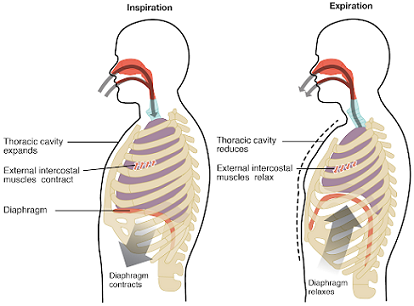
Thus, As the thoracic muscles relax, the thoracic volume returns to normal.
Note:
The Thoracic Cavity is made up of the Pericardial and Pleural Cavities, as well as the Mediastinum. The Ribs (and Sternum), Vertebral Column, and Diaphragm form the Thoracic Cavity's boundaries. The Thoracic Cavity and the Abdominal Cavity are separated by the Diaphragm.
Complete Answer
The three intercostal muscles (external, internal, and innermost), the subcostalis, and the transverse thoracic are the muscles that make up the thorax wall. Each intercostal space has eleven pairs of intercostal muscles, arranged from superficial to deep. The external intercostal muscle, which arises from the inferior aspect of the rib above and inserts anteromedially on the superior aspect of the rib below, is the most superficial layer. The anterior (external) intercostal membrane is made up of thin connective tissue aponeuroses that extend from the rib tubercle posteriorly and attach to the costochondral junction anteriorly.
Thoracic volume returns to normal as the thoracic muscles relax.
During inspiration:
1. The diaphragm contracts during inspiration, increasing the volume of the thoracic chamber in the anteroposterior axis.
2. External intercostal muscle contraction raises the ribs and sternum, increasing the volume of the thoracic chamber in the dorso-ventral axis.
3. As a result, the volume of the lungs expands.
During expiration:
1. The diaphragm and sternum are returned to their normal positions and the pulmonary volume is reduced by relaxing the diaphragm and external intercostal muscles.
Thus, As the thoracic muscles relax, the thoracic volume returns to normal.
Note:
The Thoracic Cavity is made up of the Pericardial and Pleural Cavities, as well as the Mediastinum. The Ribs (and Sternum), Vertebral Column, and Diaphragm form the Thoracic Cavity's boundaries. The Thoracic Cavity and the Abdominal Cavity are separated by the Diaphragm.
Recently Updated Pages
Master Class 12 Economics: Engaging Questions & Answers for Success

Master Class 12 English: Engaging Questions & Answers for Success
Master Class 12 Social Science: Engaging Questions & Answers for Success
Master Class 12 Maths: Engaging Questions & Answers for Success
Master Class 12 Physics: Engaging Questions & Answers for Success
Master Class 11 Social Science: Engaging Questions & Answers for Success
Trending doubts
One Metric ton is equal to kg A 10000 B 1000 C 100 class 11 physics CBSE
Difference Between Prokaryotic Cells and Eukaryotic Cells
Two of the body parts which do not appear in MRI are class 11 biology CBSE
1 ton equals to A 100 kg B 1000 kg C 10 kg D 10000 class 11 physics CBSE
Draw a diagram of nephron and explain its structur class 11 biology CBSE
10 examples of friction in our daily life