




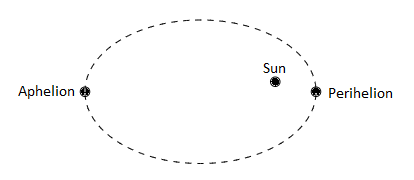
As Pluto moves from the perihelion to the aphelion, the work done by the gravitational pull of the Sun on Pluto is
(A) is zero
(B) is positive
(C) is negative
(D) depends on sense or rotation
Answer
 Verified
619.2k+ views
Hint: Gravitational pull is maximum when the gravitational attraction object and the other is close. Pluto rotates around the sun in the orbit. The orbit of Pluto is eccentric in shape. Gravitational pull decreases when the distance between the points of gravitation increases.
Complete step by step answer:
Perihelion is the shortest point in the orbit of space bodies from the sun. Aphelion is the farthest point in the orbit from the sun. The gravitational pull of the sun to Pluto is always towards the center of the sun. Hence, at the point of perihelion, Pluto is closest to the sun. At this point, the gravitational pull is maximum. When Pluto is at the aphelion, the work done by the gravitational pull is minimum. This is because at the point of aphelion, Pluto is at the longest distance from the sun and hence the work done by the gravitational pull decreases for some distance, at some point the work done by the gravitational pull will become zero, and still the distance increases, work done by the gravitational pull goes to negative.
Thus, option (C) is correct.
Additional information:
Pluto was discovered in 1930 by Clyde Tombaugh. Once Pluto is one of the planets and distant from the sun. But it does not meet the criteria of the planet and hence now it is considered as the largest dwarf planet and biggest known member of the Kuiper belt.
Note:
The orbit of Pluto is more eccentric than the orbit of the other planets. So, the gravitational pull by the sun on Pluto is maximum when Pluto is close to the sun and the gravitational pull by the sun on Pluto is minimum when Pluto is far away from the sun.
Complete step by step answer:
Perihelion is the shortest point in the orbit of space bodies from the sun. Aphelion is the farthest point in the orbit from the sun. The gravitational pull of the sun to Pluto is always towards the center of the sun. Hence, at the point of perihelion, Pluto is closest to the sun. At this point, the gravitational pull is maximum. When Pluto is at the aphelion, the work done by the gravitational pull is minimum. This is because at the point of aphelion, Pluto is at the longest distance from the sun and hence the work done by the gravitational pull decreases for some distance, at some point the work done by the gravitational pull will become zero, and still the distance increases, work done by the gravitational pull goes to negative.
Thus, option (C) is correct.
Additional information:
Pluto was discovered in 1930 by Clyde Tombaugh. Once Pluto is one of the planets and distant from the sun. But it does not meet the criteria of the planet and hence now it is considered as the largest dwarf planet and biggest known member of the Kuiper belt.
Note:
The orbit of Pluto is more eccentric than the orbit of the other planets. So, the gravitational pull by the sun on Pluto is maximum when Pluto is close to the sun and the gravitational pull by the sun on Pluto is minimum when Pluto is far away from the sun.
Recently Updated Pages
Master Class 12 Economics: Engaging Questions & Answers for Success

Master Class 12 English: Engaging Questions & Answers for Success
Master Class 12 Social Science: Engaging Questions & Answers for Success
Master Class 12 Maths: Engaging Questions & Answers for Success
Master Class 12 Physics: Engaging Questions & Answers for Success
Master Class 11 Social Science: Engaging Questions & Answers for Success
Trending doubts
One Metric ton is equal to kg A 10000 B 1000 C 100 class 11 physics CBSE
Difference Between Prokaryotic Cells and Eukaryotic Cells
Two of the body parts which do not appear in MRI are class 11 biology CBSE
1 ton equals to A 100 kg B 1000 kg C 10 kg D 10000 class 11 physics CBSE
Draw a diagram of nephron and explain its structur class 11 biology CBSE
10 examples of friction in our daily life