




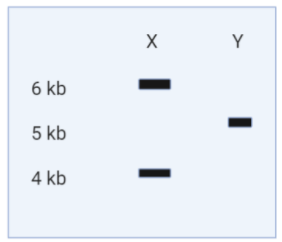
As indicated in the gel image, lanes X and Y represent samples obtained from a circular DNA plasmid after complete digestion using restriction enzyme X or Y with different recognition sites, respectively. How many sites for X and Y are present in the plasmid (sizes of the bands in kilo base pairs (kb) is shown)?
A. 1 for X, 1 for Y.
B. 2 for X, 1 for Y.
C. 1 for X, 2 for Y.
D. 2 for X, 2 for Y.
Answer
 Verified
637.2k+ views
Hint: Restriction enzymes, also known as restriction endonucleases, are proteins produced by bacteria. They cut DNA at specific points along the chain in a precise manner. They have the capability to identify these specific points by looking at the particular arrangements of the base pair of DNA at that location known as a restriction site.
Complete answer: After recognition, restriction enzymes cut each strand of double-helix DNA. They cut the DNA and make small fragments of 4-6 base pairs in size. The restriction enzyme breaks the DNA molecule into fragments by continuously cutting it at the restriction sites.
From the image, we can see that there are two fragments for sample X (one of 6 kb and the other of 4 kb), thus the size of the circular plasmid must be 10 kb. Sample in lane X has 2 bands; hence we can say that the enzyme has cut the plasmid DNA from two restriction sites. At one site, the enzyme has cut the DNA and made it linear from the circular, and at the other site, the enzyme has cut the DNA producing two bands of 6 and 4 kb respectively.
Similarly, for the sample in the Y lane, there will be two restriction sites. The enzyme must have cut the circular DNA at one site making it linear. Then the enzyme would have cut the linear DNA at 5kb making two equal bands of 5 kb each. Thus for both X and Y samples, there are two restriction sites present.
So, the correct answer is “Option D”.
Note:
Restriction enzymes detect the required sequence and cut the DNA from that point, thus are also known as molecular scissors. The sequences recognized by these enzymes are known as palindromes which read two strands in the opposite directions.
Complete answer: After recognition, restriction enzymes cut each strand of double-helix DNA. They cut the DNA and make small fragments of 4-6 base pairs in size. The restriction enzyme breaks the DNA molecule into fragments by continuously cutting it at the restriction sites.
From the image, we can see that there are two fragments for sample X (one of 6 kb and the other of 4 kb), thus the size of the circular plasmid must be 10 kb. Sample in lane X has 2 bands; hence we can say that the enzyme has cut the plasmid DNA from two restriction sites. At one site, the enzyme has cut the DNA and made it linear from the circular, and at the other site, the enzyme has cut the DNA producing two bands of 6 and 4 kb respectively.
Similarly, for the sample in the Y lane, there will be two restriction sites. The enzyme must have cut the circular DNA at one site making it linear. Then the enzyme would have cut the linear DNA at 5kb making two equal bands of 5 kb each. Thus for both X and Y samples, there are two restriction sites present.
So, the correct answer is “Option D”.
Note:
Restriction enzymes detect the required sequence and cut the DNA from that point, thus are also known as molecular scissors. The sequences recognized by these enzymes are known as palindromes which read two strands in the opposite directions.
Recently Updated Pages
If x a + bt + ct2 where x is in meters and t is in class 11 physics CBSE

A car covers the first half distance between two places class 11 physics CBSE
The resultant of two vectors overrightarrow P and overrightarrow class 11 physics CBSE
Find the value of cos 135 class 11 maths CBSE
A mass M is held in place by an applied force F and class 11 physics CBSE
A solution of glucose in water is labelled as 10 dfracwv class 11 chemistry CBSE
Trending doubts
One Metric ton is equal to kg A 10000 B 1000 C 100 class 11 physics CBSE
Find the value of the expression given below sin 30circ class 11 maths CBSE
What do you mean by retardation What is its SI uni class 11 physics CBSE
Draw a diagram of nephron and explain its structur class 11 biology CBSE
10 examples of friction in our daily life
Difference between physical and chemical change class 11 chemistry CBSE