




Why are villi present in the intestine and not in the stomach?
Answer
 Verified
633.6k+ views
Hint: They increase the surface area for the absorption of various nutrients and water and occurs in the small intestine.
Complete step-by-step solution:
1. Villi are the small, finger-like projections that extend into the lumen of the small intestine. The villi was approximately 0.5-1.6 mm in length. These villi consist of many small projections from its epithelium; these projections are called microvilli. The villi increase the surface area of the intestinal walls for absorption.
2. The large surface area is required for absorption because the digestive nutrients like amino acids are transported through the process of diffusion via a semipermeable membrane. This decreases the distance, which has to be traveled by the digestive nutrients molecules. These villi are connected to the blood vessels, which helps the supply of nutrients to various body parts.
3. The epithelium of the villi in the small intestine consists of two main cells which are enterocytes and goblet cells. On the surface of the epithelium, enzymes for digestion are also present. They help in absorption due to the presence of thin-wall for shorter and effective diffusion along with efficient absorption of fatty acids and glycerol into the bloodstream. The inflammation in the villi causes coeliac diseases.
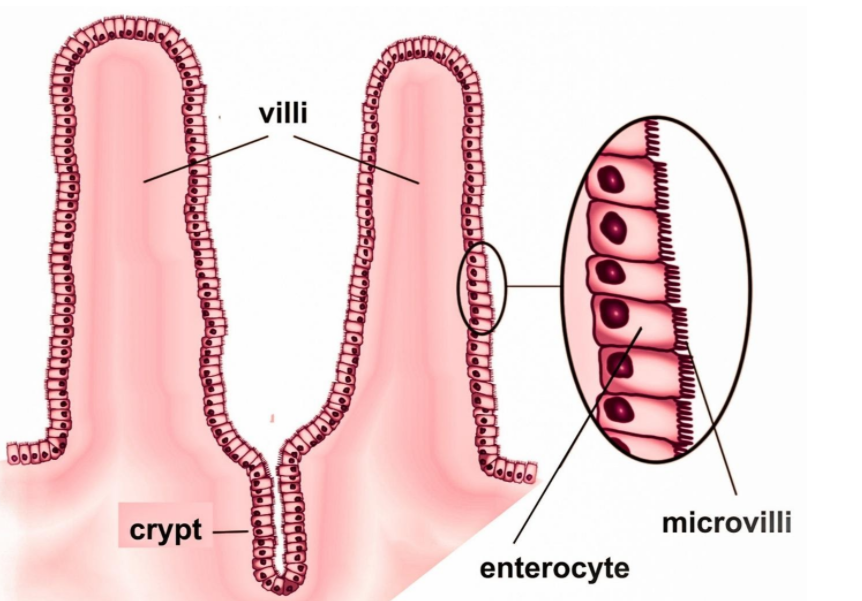
The lumen of the small intestine
Note: The stomach collects the food through the esophagus and adds gastric acid and enzymes in it for the digestion of food. The stomach does not absorb any nutrients, absorption of nutrients occurs only in the intestinal region. It is only the region where substances are mixed together. Thus, the stomach does not require a large surface area and villi for nutrients absorption.
Complete step-by-step solution:
1. Villi are the small, finger-like projections that extend into the lumen of the small intestine. The villi was approximately 0.5-1.6 mm in length. These villi consist of many small projections from its epithelium; these projections are called microvilli. The villi increase the surface area of the intestinal walls for absorption.
2. The large surface area is required for absorption because the digestive nutrients like amino acids are transported through the process of diffusion via a semipermeable membrane. This decreases the distance, which has to be traveled by the digestive nutrients molecules. These villi are connected to the blood vessels, which helps the supply of nutrients to various body parts.
3. The epithelium of the villi in the small intestine consists of two main cells which are enterocytes and goblet cells. On the surface of the epithelium, enzymes for digestion are also present. They help in absorption due to the presence of thin-wall for shorter and effective diffusion along with efficient absorption of fatty acids and glycerol into the bloodstream. The inflammation in the villi causes coeliac diseases.
The lumen of the small intestine
Note: The stomach collects the food through the esophagus and adds gastric acid and enzymes in it for the digestion of food. The stomach does not absorb any nutrients, absorption of nutrients occurs only in the intestinal region. It is only the region where substances are mixed together. Thus, the stomach does not require a large surface area and villi for nutrients absorption.
Recently Updated Pages
Master Class 12 Economics: Engaging Questions & Answers for Success

Master Class 12 English: Engaging Questions & Answers for Success
Master Class 12 Social Science: Engaging Questions & Answers for Success
Master Class 12 Maths: Engaging Questions & Answers for Success
Master Class 12 Physics: Engaging Questions & Answers for Success
Master Class 9 General Knowledge: Engaging Questions & Answers for Success
Trending doubts
One Metric ton is equal to kg A 10000 B 1000 C 100 class 11 physics CBSE
Difference Between Prokaryotic Cells and Eukaryotic Cells
Find the value of the expression given below sin 30circ class 11 maths CBSE
Two of the body parts which do not appear in MRI are class 11 biology CBSE
Draw a diagram of nephron and explain its structur class 11 biology CBSE
10 examples of friction in our daily life