




What are those structures that appear as “beads-on-string” in the chromosomes, when viewed under an electron microscope?
A) Base pairs
B) Genes
C) Nucleotides
D) Nucleosomes
Answer
 Verified
611.7k+ views
Hint: The chromatin fibres are formed when the beads-on-string structure in chromatin is packaged. These chromatin fibres further coil and condensed in cell division (metaphase stage) to form chromosomes.
Complete step-by-step answer:
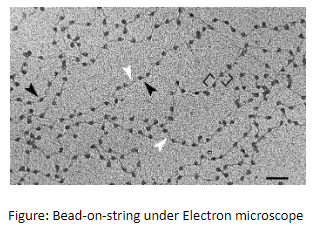
The packaging of DNA helix in eukaryotes is more complex as compared to prokaryotes. There is a set of a positively charged protein called histones. These charges are depending upon the abundance of amino acids residues with charged side chains. The histones are rich arginines and lysines amino acid residues. These amino acid residues carry a positive charge in their side chain. Histones are arranged to form a unit of eight molecules, called histone octamers. The DNA that is negatively charged is wrapped around a histone octamer (positively charged) and forms a structure called a nucleosome. A classic nucleosome contains 200bp of DNA helix. In the nucleus, the nucleosome constitutes the repeating unit of a structure called chromatin. It is a thread-like stained body present in the nucleus. When viewed under electron microscopes the nucleosome in chromatin appeared as a bead-on-string structure. The bead-on-string is packed in the chromatin and forms the chromatin fibres. Further, these fibres condensed and coiled in the metaphase stage of the cell division to form chromosomes. At a higher level, the packaging of chromatin required an additional set of a protein called non-histone chromosomal protein.
Option D is the correct answer.
Note: In prokaryotes such as E.coli, they do have a defined nucleus. Hence the DNA is not scattered throughout the cell. The region called a nucleoid, the negatively charged DNA is held by some positively charged protein. The DNA in the nucleoid is arranged in a large loop held by protein.
Complete step-by-step answer:
The packaging of DNA helix in eukaryotes is more complex as compared to prokaryotes. There is a set of a positively charged protein called histones. These charges are depending upon the abundance of amino acids residues with charged side chains. The histones are rich arginines and lysines amino acid residues. These amino acid residues carry a positive charge in their side chain. Histones are arranged to form a unit of eight molecules, called histone octamers. The DNA that is negatively charged is wrapped around a histone octamer (positively charged) and forms a structure called a nucleosome. A classic nucleosome contains 200bp of DNA helix. In the nucleus, the nucleosome constitutes the repeating unit of a structure called chromatin. It is a thread-like stained body present in the nucleus. When viewed under electron microscopes the nucleosome in chromatin appeared as a bead-on-string structure. The bead-on-string is packed in the chromatin and forms the chromatin fibres. Further, these fibres condensed and coiled in the metaphase stage of the cell division to form chromosomes. At a higher level, the packaging of chromatin required an additional set of a protein called non-histone chromosomal protein.
Option D is the correct answer.
Note: In prokaryotes such as E.coli, they do have a defined nucleus. Hence the DNA is not scattered throughout the cell. The region called a nucleoid, the negatively charged DNA is held by some positively charged protein. The DNA in the nucleoid is arranged in a large loop held by protein.
Recently Updated Pages
Master Class 11 English: Engaging Questions & Answers for Success

Master Class 11 Social Science: Engaging Questions & Answers for Success
Master Class 11 Maths: Engaging Questions & Answers for Success
Master Class 11 Biology: Engaging Questions & Answers for Success
Master Class 11 Physics: Engaging Questions & Answers for Success
Master Class 11 Chemistry: Engaging Questions & Answers for Success
Trending doubts
Explain the Treaty of Vienna of 1815 class 10 social science CBSE
What is the full form of CNG A Complete Natural Gas class 10 social science CBSE
In cricket, what is a "Yorker" designed to do?
What is the full form of POSCO class 10 social science CBSE
Define Potential, Developed, Stock and Reserved resources
What were the majoritarian measures taken in Sri Lanka class 10 social science CBSE