




Are there two branchial arteries in the body? Are there two brachiocephalic arteries in the body?
Answer
 Verified
516.6k+ views
Hint: There are two brachial arteries present in the body. But, there is only one brachiocephalic artery in the body. Brachial arteries are significant for every aspect of upper limb mobility. The brachiocephalic artery is also known as brachiocephalic trunk or innominate artery. The brachiocephalic artery is one of the three great vessels of the arch of the aorta, supplying blood to the neck, head, and upper extremities.
Complete answer:
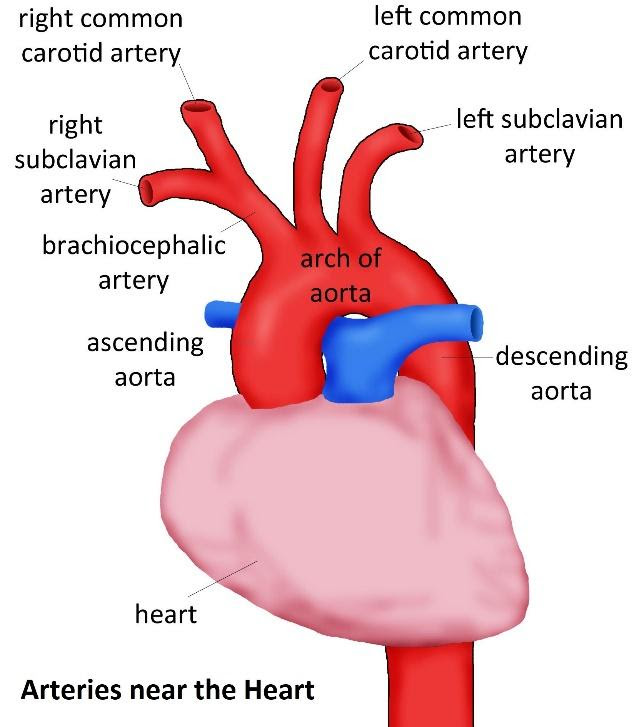
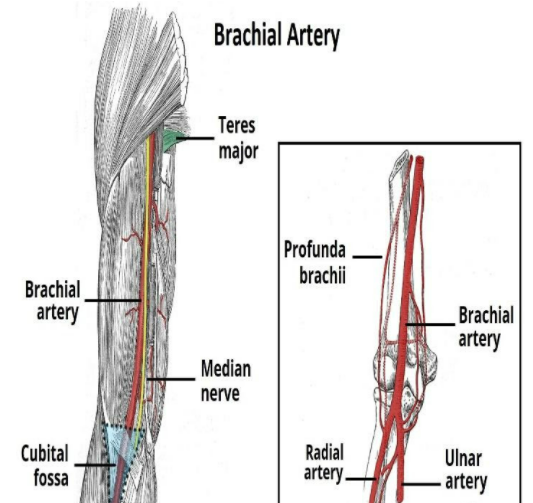
Fig.: First – Brachiocephalic Artery, Second – Brachial Artery with it inset in one of the Arms
The arch of the aorta possesses three branches, namely, the left common carotid artery, the left subclavian artery, and the brachiocephalic artery.
On the right side of the aorta, a brachiocephalic artery is present, which gives rise to the right common carotid artery and the right subclavian artery.
On the left side of the aorta, there is no presence of the brachiocephalic artery. The left subclavian artery and left common carotid artery arise directly from the arch of the aorta. So, there is only one brachiocephalic artery.
So, for the left side of the body, there is no brachiocephalic artery. However, there are two brachiocephalic veins present.
The left and right subclavian arteries supply left and right arms by the formation of the left axillary artery and right axillary artery. The left axillary artery in the left arm gives rise to a branchial artery and the right axillary artery in the right arm also gives rise to a branchial artery. So, there are two branchial arteries, with one present in each arm.
Note:
The brachial arteries are major blood vessels present in the upper arms. They serve as the main suppliers of blood to the arms and the hands. They continue from the axillary arteries at the shoulder and travel down the underside of the arm. They are essential components of the circulatory system, connecting the lower margin of the Teres major tendon in the shoulder to the elbow.
Complete answer:
Fig.: First – Brachiocephalic Artery, Second – Brachial Artery with it inset in one of the Arms
The arch of the aorta possesses three branches, namely, the left common carotid artery, the left subclavian artery, and the brachiocephalic artery.
On the right side of the aorta, a brachiocephalic artery is present, which gives rise to the right common carotid artery and the right subclavian artery.
On the left side of the aorta, there is no presence of the brachiocephalic artery. The left subclavian artery and left common carotid artery arise directly from the arch of the aorta. So, there is only one brachiocephalic artery.
So, for the left side of the body, there is no brachiocephalic artery. However, there are two brachiocephalic veins present.
The left and right subclavian arteries supply left and right arms by the formation of the left axillary artery and right axillary artery. The left axillary artery in the left arm gives rise to a branchial artery and the right axillary artery in the right arm also gives rise to a branchial artery. So, there are two branchial arteries, with one present in each arm.
Note:
The brachial arteries are major blood vessels present in the upper arms. They serve as the main suppliers of blood to the arms and the hands. They continue from the axillary arteries at the shoulder and travel down the underside of the arm. They are essential components of the circulatory system, connecting the lower margin of the Teres major tendon in the shoulder to the elbow.
Recently Updated Pages
Master Class 11 English: Engaging Questions & Answers for Success

Master Class 11 Social Science: Engaging Questions & Answers for Success
Master Class 11 Maths: Engaging Questions & Answers for Success
Master Class 11 Biology: Engaging Questions & Answers for Success
Master Class 11 Physics: Engaging Questions & Answers for Success
Master Class 11 Chemistry: Engaging Questions & Answers for Success
Trending doubts
One Metric ton is equal to kg A 10000 B 1000 C 100 class 11 physics CBSE
Difference Between Prokaryotic Cells and Eukaryotic Cells
Find the value of the expression given below sin 30circ class 11 maths CBSE
1 ton equals to A 100 kg B 1000 kg C 10 kg D 10000 class 11 physics CBSE
Two of the body parts which do not appear in MRI are class 11 biology CBSE
What are hard magnetic materials class 11 physics CBSE