




Why are the wings of bats and wings of a bird called an analogous organ?
Answer
 Verified
653.1k+ views
Hint: Analogous organs are those organs that have a different basic structure and developmental origin but they perform a similar function. These structures develop in unrelated organisms that exhibit convergent evolution.
Complete answer:
Wings of bat and Wings of bird and example of analogous organs. In the case of bat wings, they consist of a flap of skin stretching between the bones of the arm and fingers. Bird wings consist of feathers covering all over the arm.
From the diagram mentioned below, we can see that the bird’s wings and the bat wings were not inherited from a common ancestor. Bird and bat wings are called analogous because they have separate evolutionary Origins but they both perform a similar function which is a key role in flight.
Analogous organs are the result of convergent evolution. According to convergent evolution, it is a process in which organisms that are not closely related, independently evolve similar traits to adapt to a similar environment.
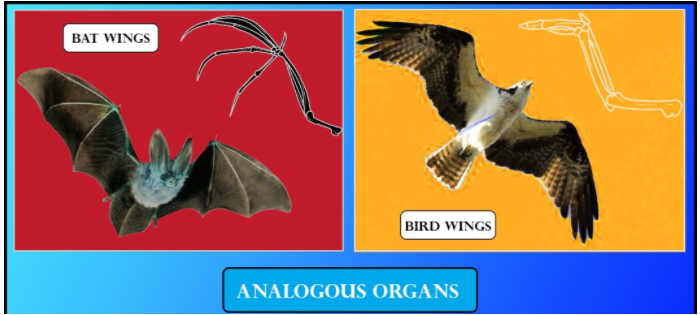
Note: Alike analogous organs, homologous organs are also found in which basic body design and structure are the same indicating towards the common origin but they perform a different function to adapt in different environments. For example, the forelimb of man and frog has the same basic design but they carry out different functions.
Complete answer:
Wings of bat and Wings of bird and example of analogous organs. In the case of bat wings, they consist of a flap of skin stretching between the bones of the arm and fingers. Bird wings consist of feathers covering all over the arm.
From the diagram mentioned below, we can see that the bird’s wings and the bat wings were not inherited from a common ancestor. Bird and bat wings are called analogous because they have separate evolutionary Origins but they both perform a similar function which is a key role in flight.
Analogous organs are the result of convergent evolution. According to convergent evolution, it is a process in which organisms that are not closely related, independently evolve similar traits to adapt to a similar environment.
Note: Alike analogous organs, homologous organs are also found in which basic body design and structure are the same indicating towards the common origin but they perform a different function to adapt in different environments. For example, the forelimb of man and frog has the same basic design but they carry out different functions.
Recently Updated Pages
Master Class 11 Social Science: Engaging Questions & Answers for Success

Master Class 11 English: Engaging Questions & Answers for Success
Master Class 11 Accountancy: Engaging Questions & Answers for Success
Master Class 11 Physics: Engaging Questions & Answers for Success
Master Class 11 Computer Science: Engaging Questions & Answers for Success
Master Class 11 Business Studies: Engaging Questions & Answers for Success
Trending doubts
One Metric ton is equal to kg A 10000 B 1000 C 100 class 11 physics CBSE
Find the value of the expression given below sin 30circ class 11 maths CBSE
Draw a diagram of nephron and explain its structur class 11 biology CBSE
10 examples of friction in our daily life
Proton was discovered by A Thomson B Rutherford C Chadwick class 11 chemistry CBSE
The teeth used for biting and cutting food are called class 11 biology CBSE