




What are the various constituents of air? Write their uses.
Answer
 Verified
537.6k+ views
Hint: “The atmosphere is a protective layer of gases that keeps temperatures within a specific range and deflects dangerous sun rays, protecting all life on Earth.”
The atmosphere is a gaseous blanket that covers the Earth. Earth's gravitational attraction keeps it close to the planet's surface. The three primary constituents of the atmosphere are argon, oxygen, and nitrogen.
The greenhouse effect is the result of gases in the Earth's atmosphere trapping the Sun's heat. The Earth is substantially warmer as a result of this process than it would be without an atmosphere. The greenhouse effect is one of the factors that contribute to Earth's pleasant living conditions.
Complete answer:
Components of air-
1. Water vapour- During the summer, water in oceans and rivers evaporates and escapes into the atmosphere. As a result, water vapour is one of the air's constituents. It makes up a very little percentage of the earth's atmosphere.
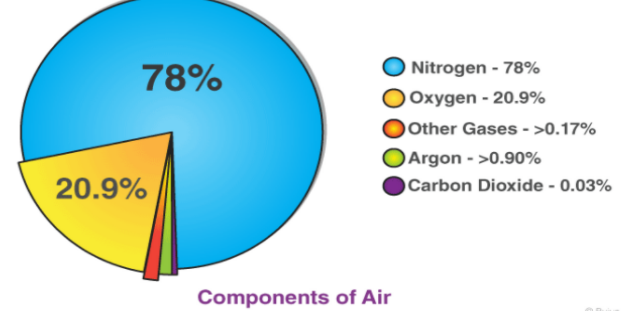
2. Oxygen- Combustion is aided by the presence of certain substances in the air. The substance in question is oxygen. One of the most important components of the air we breathe is oxygen. The oxygen content in air is around \[21\% \].
Uses- Necessary for respiration and combustion
3. Nitrogen- You'll notice that if you blow on a burning candle, it goes out. Incombustible gases (gases that do not enable combustion) are also present in air. The presence of nitrogen has a crucial role in this. Nitrogen is the most abundant gas on our planet, accounting for about \[78\] percent of the atmosphere.
Uses- Used in Nitrogen fixation by bacteria.
4. Carbon dioxide- Carbon dioxide is primarily created through the breathing of plants and animals, as well as the combustion of fuel. It takes up \[0.038\] percent of the atmosphere of the planet. Its occupancy shifts from one location to another in our environment.
Uses- Used by plants to make their foods. Used in fire extinguishers.
5. Smoke and dust particles- Because of the burning of fuels, smoke is present in our environment. The number of people who use it fluctuates depending on where they are. It is a combination of gases that is frequently hazardous. Apart from them, dust particles exist in our atmosphere, which we can see when a ray of light shines through a dark room. Smoke and dust particles make up less than \[1\% \] of the atmosphere on Earth.
Note:
Structure of atmosphere-
The troposphere is the most essential layer of the atmosphere. Here is where the air we breathe comes from. The majority of meteorological events, such as rain, hail, and thunderstorms, take place in this layer.
The stratosphere is located immediately above the troposphere. This layer is suitable for flying aeroplanes since it is free of accompanying meteorological phenomena. Ozone is present.
The next and third layers of the atmosphere are known as the mesosphere. It is located in the stratosphere.
Thermosphere - As you climb higher in the thermosphere, the temperature rises quite quickly. This sphere includes the ionosphere. This layer is beneficial to radio transmission.
Exosphere- The exosphere is the last and uppermost layer of the atmosphere.
The atmosphere is a gaseous blanket that covers the Earth. Earth's gravitational attraction keeps it close to the planet's surface. The three primary constituents of the atmosphere are argon, oxygen, and nitrogen.
The greenhouse effect is the result of gases in the Earth's atmosphere trapping the Sun's heat. The Earth is substantially warmer as a result of this process than it would be without an atmosphere. The greenhouse effect is one of the factors that contribute to Earth's pleasant living conditions.
Complete answer:
Components of air-
1. Water vapour- During the summer, water in oceans and rivers evaporates and escapes into the atmosphere. As a result, water vapour is one of the air's constituents. It makes up a very little percentage of the earth's atmosphere.
2. Oxygen- Combustion is aided by the presence of certain substances in the air. The substance in question is oxygen. One of the most important components of the air we breathe is oxygen. The oxygen content in air is around \[21\% \].
Uses- Necessary for respiration and combustion
3. Nitrogen- You'll notice that if you blow on a burning candle, it goes out. Incombustible gases (gases that do not enable combustion) are also present in air. The presence of nitrogen has a crucial role in this. Nitrogen is the most abundant gas on our planet, accounting for about \[78\] percent of the atmosphere.
Uses- Used in Nitrogen fixation by bacteria.
4. Carbon dioxide- Carbon dioxide is primarily created through the breathing of plants and animals, as well as the combustion of fuel. It takes up \[0.038\] percent of the atmosphere of the planet. Its occupancy shifts from one location to another in our environment.
Uses- Used by plants to make their foods. Used in fire extinguishers.
5. Smoke and dust particles- Because of the burning of fuels, smoke is present in our environment. The number of people who use it fluctuates depending on where they are. It is a combination of gases that is frequently hazardous. Apart from them, dust particles exist in our atmosphere, which we can see when a ray of light shines through a dark room. Smoke and dust particles make up less than \[1\% \] of the atmosphere on Earth.
Note:
Structure of atmosphere-
The troposphere is the most essential layer of the atmosphere. Here is where the air we breathe comes from. The majority of meteorological events, such as rain, hail, and thunderstorms, take place in this layer.
The stratosphere is located immediately above the troposphere. This layer is suitable for flying aeroplanes since it is free of accompanying meteorological phenomena. Ozone is present.
The next and third layers of the atmosphere are known as the mesosphere. It is located in the stratosphere.
Thermosphere - As you climb higher in the thermosphere, the temperature rises quite quickly. This sphere includes the ionosphere. This layer is beneficial to radio transmission.
Exosphere- The exosphere is the last and uppermost layer of the atmosphere.
Recently Updated Pages
Master Class 11 English: Engaging Questions & Answers for Success

Master Class 11 Social Science: Engaging Questions & Answers for Success
Master Class 11 Maths: Engaging Questions & Answers for Success
Master Class 11 Chemistry: Engaging Questions & Answers for Success
Master Class 11 Biology: Engaging Questions & Answers for Success
Master Class 11 Physics: Engaging Questions & Answers for Success
Trending doubts
Explain the Treaty of Vienna of 1815 class 10 social science CBSE
Why is it 530 pm in india when it is 1200 afternoon class 10 social science CBSE
What is the full form of CNG A Complete Natural Gas class 10 social science CBSE
In cricket, what is a "Yorker" designed to do?
What is the full form of POSCO class 10 social science CBSE
Define Potential, Developed, Stock and Reserved resources