




What are the three functions of a Na-K pump?
Answer
 Verified
567.6k+ views
Hint: The plasma membrane is permeable to sodium and potassium ions. These ions move in the opposite direction against the concentration gradient by using energy in the form of ATP. This process is vital in carrying out several metabolic life processes in various organs.
Complete answer:
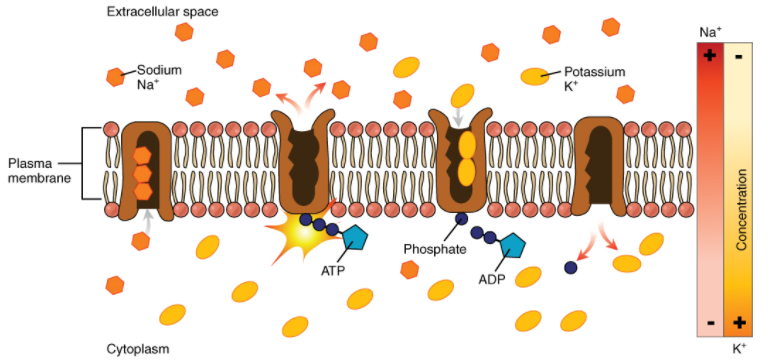
The sodium-potassium ATPase is an enzyme that is present in the cell membrane of the animal cell. The movement of the sodium and potassium ions to and from the cell driven by ATP is known as the sodium-potassium pump. The sodium-potassium pump functions with respect to the concentration gradient. In these three sodium ions move out of the cell and two potassium ions move inside the cell at the cost of one ATP. The sodium-potassium pump is very useful for cell physiology.
The functions of the sodium-potassium pump are as follows-
- Transport: The movement of the sodium outside the cell acts as a driving force for the secondary active transporters like membrane transport proteins which facilitate the inward movement of the glucose, amino acids and nutrients inside the cell.
- It controls the cell volume. If this pump doesn’t work then the cell will swell.
-The sodium-potassium pump is important for maintaining the resting membrane potential in the neurons. This mediates the movement of impulses.
- Muscle contraction is dependent on a sodium-potassium pump.
The mechanism of the movement of the sodium and potassium is shown in the figure below:
Note: Sodium potassium pump was discovered by Jens Christian Skou and was awarded the Nobel prize for the same. The function of the sodium-potassium pump is regulated by the cAMP and thyroid hormone. This pump is found in all mammalian cells.
Complete answer:
The sodium-potassium ATPase is an enzyme that is present in the cell membrane of the animal cell. The movement of the sodium and potassium ions to and from the cell driven by ATP is known as the sodium-potassium pump. The sodium-potassium pump functions with respect to the concentration gradient. In these three sodium ions move out of the cell and two potassium ions move inside the cell at the cost of one ATP. The sodium-potassium pump is very useful for cell physiology.
The functions of the sodium-potassium pump are as follows-
- Transport: The movement of the sodium outside the cell acts as a driving force for the secondary active transporters like membrane transport proteins which facilitate the inward movement of the glucose, amino acids and nutrients inside the cell.
- It controls the cell volume. If this pump doesn’t work then the cell will swell.
-The sodium-potassium pump is important for maintaining the resting membrane potential in the neurons. This mediates the movement of impulses.
- Muscle contraction is dependent on a sodium-potassium pump.
The mechanism of the movement of the sodium and potassium is shown in the figure below:
Note: Sodium potassium pump was discovered by Jens Christian Skou and was awarded the Nobel prize for the same. The function of the sodium-potassium pump is regulated by the cAMP and thyroid hormone. This pump is found in all mammalian cells.
Recently Updated Pages
If x a + bt + ct2 where x is in meters and t is in class 11 physics CBSE

A car covers the first half distance between two places class 11 physics CBSE
The resultant of two vectors overrightarrow P and overrightarrow class 11 physics CBSE
Find the value of cos 135 class 11 maths CBSE
A mass M is held in place by an applied force F and class 11 physics CBSE
A solution of glucose in water is labelled as 10 dfracwv class 11 chemistry CBSE
Trending doubts
Find the value of the expression given below sin 30circ class 11 maths CBSE
One Metric ton is equal to kg A 10000 B 1000 C 100 class 11 physics CBSE
Draw a diagram of nephron and explain its structur class 11 biology CBSE
10 examples of friction in our daily life
Proton was discovered by A Thomson B Rutherford C Chadwick class 11 chemistry CBSE
Bond order ofO2 O2+ O2 and O22 is in order A O2 langle class 11 chemistry CBSE