




What are the structures and regions of the stomach?
Answer
 Verified
518.7k+ views
Hint: Stomach is a J-shaped structure and lies between duodenum and esophagus. It lies just behind the diaphragm and towards the left of the abdominal cavity. It acts as a flexible organ in the body, which is able to hold up to three liters of food. It is a bag-like organ of the digestive system. It receives food from the esophageal region and passes it to the small intestine. A typical adult stomach is $15.2$cm wide and $30.5$cm long.
Complete answer
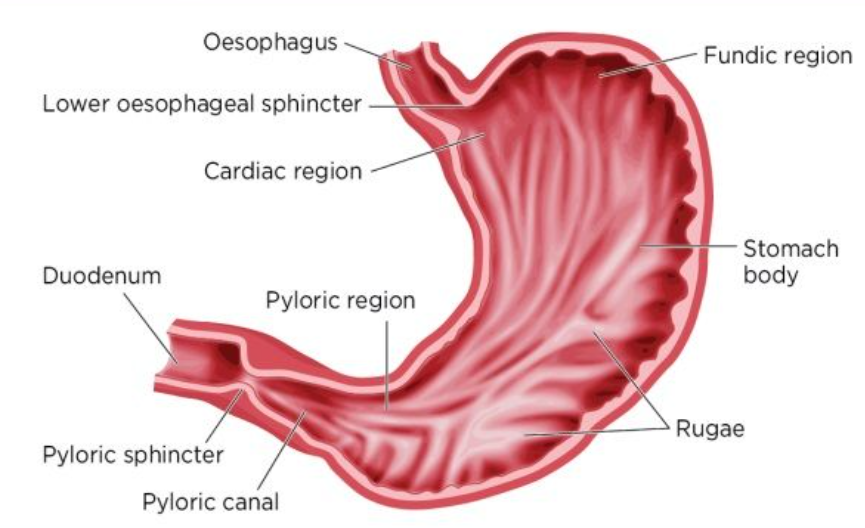
Fig: Parts of a Stomach
Stomach can be classified into four parts, namely:
1. Fundus or fundic region
2. Stomach body or intermediate region
3. Antrum
4. Pylorus or pyloric region
Fundus – it is an expanded area, which is curving up above the cardiac opening (cardiac opening is opening from the stomach into the esophageal region). It is a dome-shaped region, which exists in the top-left.
Stomach body – It is the central portion of the stomach, which is the largest structure. It is the expansive and main stomach chamber.
Antrum – it is a lower part of the stomach, which is a funnel-shaped region.
Pylorus – it is a narrowing region, where the stomach meets the small intestine. It connects duodenum and stomach.
Both cardiac and pyloric regions possess sphincter muscles, which keeps the neighboring region closed, with the exception during the food passage time.
Rugae are prominent folds present in the inner mucosal lining, which perform expansion.
Note:
Stomach performs some functions. It churns the food into a semi fluid acidic substance, called chyme. It kills any germs in food through the presence of hydrochloric acid. It aids in the partial digestion of foods and breakdown of proteins. It acts as a reservoir for ingested food. Further, it also behaves as a mixing and digestion chamber. It has two openings, one in the esophageal region and another in the duodenal region.
Complete answer
Fig: Parts of a Stomach
Stomach can be classified into four parts, namely:
1. Fundus or fundic region
2. Stomach body or intermediate region
3. Antrum
4. Pylorus or pyloric region
Fundus – it is an expanded area, which is curving up above the cardiac opening (cardiac opening is opening from the stomach into the esophageal region). It is a dome-shaped region, which exists in the top-left.
Stomach body – It is the central portion of the stomach, which is the largest structure. It is the expansive and main stomach chamber.
Antrum – it is a lower part of the stomach, which is a funnel-shaped region.
Pylorus – it is a narrowing region, where the stomach meets the small intestine. It connects duodenum and stomach.
Both cardiac and pyloric regions possess sphincter muscles, which keeps the neighboring region closed, with the exception during the food passage time.
Rugae are prominent folds present in the inner mucosal lining, which perform expansion.
Note:
Stomach performs some functions. It churns the food into a semi fluid acidic substance, called chyme. It kills any germs in food through the presence of hydrochloric acid. It aids in the partial digestion of foods and breakdown of proteins. It acts as a reservoir for ingested food. Further, it also behaves as a mixing and digestion chamber. It has two openings, one in the esophageal region and another in the duodenal region.
Recently Updated Pages
Master Class 11 Social Science: Engaging Questions & Answers for Success

Master Class 11 Chemistry: Engaging Questions & Answers for Success
Master Class 12 Business Studies: Engaging Questions & Answers for Success
Master Class 12 Chemistry: Engaging Questions & Answers for Success
Master Class 12 Biology: Engaging Questions & Answers for Success
Class 12 Question and Answer - Your Ultimate Solutions Guide
Trending doubts
One Metric ton is equal to kg A 10000 B 1000 C 100 class 11 physics CBSE
Difference Between Prokaryotic Cells and Eukaryotic Cells
How many of the following diseases can be studied with class 11 biology CBSE
Two of the body parts which do not appear in MRI are class 11 biology CBSE
Which of the following enzymes is used for carboxylation class 11 biology CBSE
Explain zero factorial class 11 maths CBSE