




What are the resonance structures of benzoate anions?
Answer
 Verified
595.2k+ views
Hint: Benzoate anion is the anionic form of benzoic acid where benzoic acid is represented by the chemical formula${{C}_{6}}{{H}_{5}}COOH$where anion is the ion which contains negative charge on it and produces by losing an electron and benzoate anion is represented as $\pi $.
Complete answer:
Resonance structures are sets of Lewis structures which describe the delocalization of electrons in polyatomic ions or molecules. In many cases a single Lewis structure fails to explain the bonding in a molecule due to presence of partial charge and fractional bonds in it. In these cases resonance structure helps to describe the chemical bonding in that molecule.
In this case the formate ion i.e. $HCO{{O}^{-}}$ is composed of one atom of hydrogen and carbon and two atoms of oxygen in which the ion contains a charge of -1. It can be able to form resonance structures by considering delocalisation of electron from $\pi $ bond which shows conjugation in the benzene ring with the carbonyl group of carboxylate ion and produce 4 resonating structures which can be shown as follows:
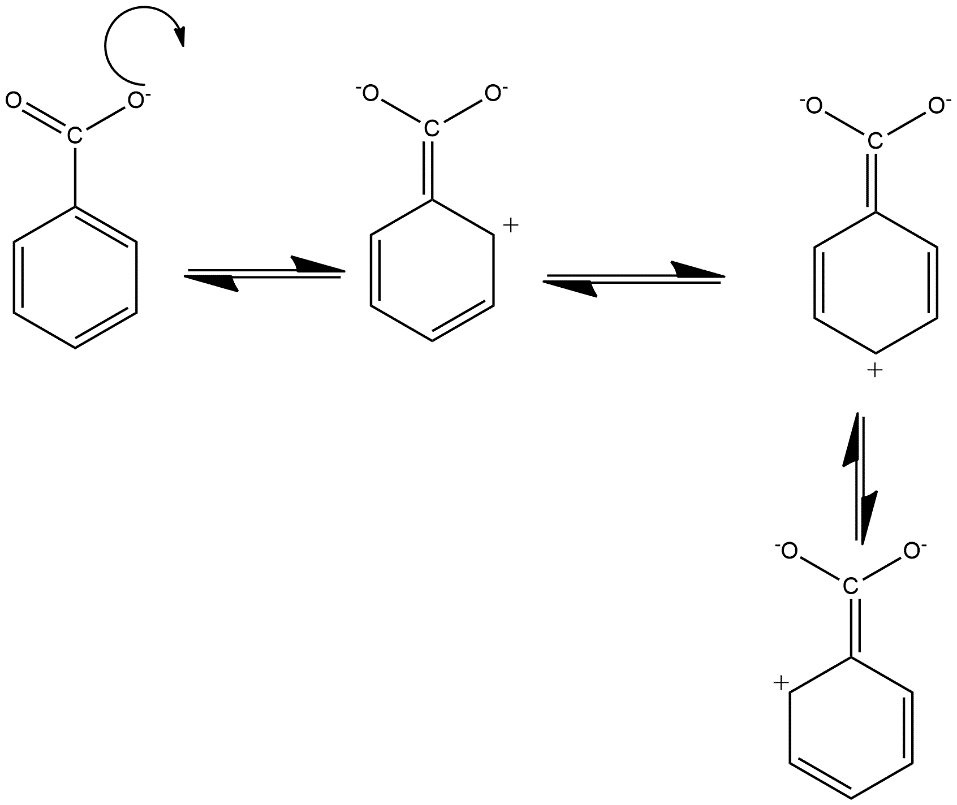
Hence in this way four resonating structures of the benzoate anion where the transference of charge is taking place with the conjugation of benzene ring.
Note:
Resonance describes the bonding in particular molecules or ions by merging a number of contributory structures or forms which are jointly known as canonical structures or resonance structures within the theory of valence bonding into a hybrid resonance also known as hybrid structure.
Complete answer:
Resonance structures are sets of Lewis structures which describe the delocalization of electrons in polyatomic ions or molecules. In many cases a single Lewis structure fails to explain the bonding in a molecule due to presence of partial charge and fractional bonds in it. In these cases resonance structure helps to describe the chemical bonding in that molecule.
In this case the formate ion i.e. $HCO{{O}^{-}}$ is composed of one atom of hydrogen and carbon and two atoms of oxygen in which the ion contains a charge of -1. It can be able to form resonance structures by considering delocalisation of electron from $\pi $ bond which shows conjugation in the benzene ring with the carbonyl group of carboxylate ion and produce 4 resonating structures which can be shown as follows:
Hence in this way four resonating structures of the benzoate anion where the transference of charge is taking place with the conjugation of benzene ring.
Note:
Resonance describes the bonding in particular molecules or ions by merging a number of contributory structures or forms which are jointly known as canonical structures or resonance structures within the theory of valence bonding into a hybrid resonance also known as hybrid structure.
Recently Updated Pages
If x a + bt + ct2 where x is in meters and t is in class 11 physics CBSE

A car covers the first half distance between two places class 11 physics CBSE
The resultant of two vectors overrightarrow P and overrightarrow class 11 physics CBSE
Find the value of cos 135 class 11 maths CBSE
A mass M is held in place by an applied force F and class 11 physics CBSE
A solution of glucose in water is labelled as 10 dfracwv class 11 chemistry CBSE
Trending doubts
Find the value of the expression given below sin 30circ class 11 maths CBSE
One Metric ton is equal to kg A 10000 B 1000 C 100 class 11 physics CBSE
Draw a diagram of nephron and explain its structur class 11 biology CBSE
10 examples of friction in our daily life
Proton was discovered by A Thomson B Rutherford C Chadwick class 11 chemistry CBSE
Bond order ofO2 O2+ O2 and O22 is in order A O2 langle class 11 chemistry CBSE